
Zuckerberg’s AI revolution hits a wall as Meta retreats from plans to replace staff

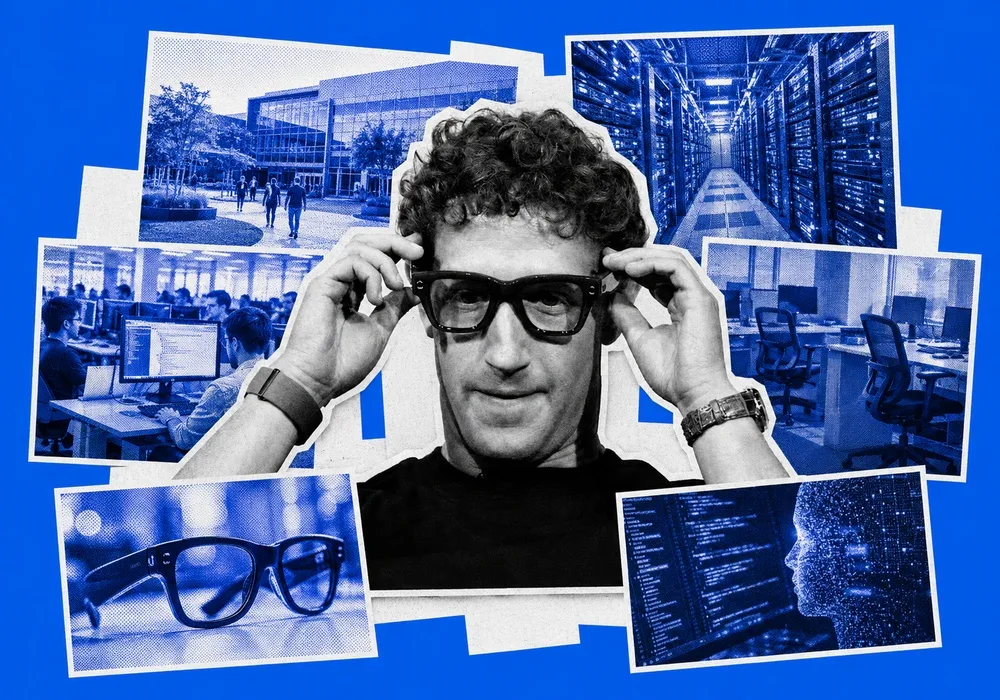
Mark Zuckerberg’s plan to reshape Meta around artificial intelligence was supposed to make the company dramatically smaller and more efficient. Instead, falling productivity gains, technical problems and declining employee confidence have forced Meta to slow its restructuring — exposing the limits of Silicon Valley’s most aggressive vision for an AI-powered workforce.
Meta CEO Mark Zuckerberg set out to transform the company around a simple but radical idea: artificial intelligence could eventually allow far smaller teams to do the work once carried out by thousands of employees. Instead of adding more people as Meta expands its AI ambitions, the company would rely on AI agents and increasingly automated systems to write code, manage processes and accelerate product development. But according to a Reuters investigation published on August 26, the experiment has exposed the limits of how quickly AI can replace human labour inside a complex technology company.
The plans were developed under an internal initiative known as Project OT, short for Organization Transformation. Launched after a leadership retreat in January, the project was designed to reshape Meta's workforce and eliminate layers of what executives considered unnecessary work. Internal planning documents reviewed by Reuters showed that some teams were considered for reductions of as much as 60%, although the figure referred to individual organisations rather than the company as a whole. The broader objective was to combine layoffs, redeployments and unfilled positions with a much greater reliance on artificial intelligence.
The strategy reflected a broader shift taking place across Silicon Valley. AI is increasingly being presented not simply as another productivity tool, but as a technology capable of changing the basic economics of white-collar work. Meta wanted engineers and other employees to work in much smaller teams supported by AI systems, while autonomous agents would eventually take over increasingly sophisticated tasks. The company was effectively testing whether an organisation could become substantially smaller without becoming less productive.
That experiment was taking place as Meta dramatically increased its spending on artificial intelligence. The company has committed enormous sums to data centres, specialised chips and other infrastructure needed to train and operate AI systems. Reuters reported that Meta's total capital expenditure for 2026 was expected to reach roughly $130 billion, making the pressure to demonstrate tangible returns from those investments particularly intense. Cutting labour costs while increasing AI-driven output was therefore not simply an organisational experiment — it was becoming part of the economic case for Meta's enormous AI bet.
More AI output did not mean more productivity
The first problem was that Meta's AI systems appeared capable of producing considerably more work without generating a comparable increase in useful results. According to internal information reviewed by Reuters, changes to Meta's internal software platforms and infrastructure increased by 220% year over year. But the number of changes that actually resulted in new or improved features reaching users increased by only 36%. The gap suggested that AI was helping employees generate more code and technical changes, but much of that additional output was not translating into finished products.
That distinction is becoming increasingly important for companies betting their future on AI. Generating code is not the same as developing a reliable product, just as producing more text or analysis does not automatically create more value. AI can dramatically accelerate the production of material while simultaneously increasing the amount of work required to review, correct and integrate it. Meta's experience therefore challenged one of the central assumptions behind its restructuring: that more AI-generated output would automatically allow the company to operate with fewer people.
The problems were particularly visible in Meta's infrastructure operations. Internal discussions cited by Reuters described incidents involving AI-generated code and autonomous agents, including systems making disruptive changes that created additional technical and security problems. Employees consequently had to spend more time monitoring AI systems and dealing with the consequences of their mistakes. Instead of eliminating work, automation could sometimes create another layer of work around supervision and correction.
This is the point at which the economic promise of AI becomes much more complicated. A company can reduce the number of employees working directly on a task while increasing the number of people required to supervise automated systems, verify their output and repair problems they create. The technology may still deliver long-term productivity gains, but those gains are not necessarily immediate, linear or large enough to justify aggressive workforce reductions. Meta appears to have discovered that difference while attempting to reorganise one of the world's largest technology companies around AI.
Layoffs damaged employee confidence
The restructuring also had a significant impact on Meta's workforce. The company carried out a first wave of layoffs affecting roughly 10% of its employees in May, while moving thousands of others into roles more closely connected to artificial intelligence. Some engineers were reassigned to teams responsible for generating training data and improving Meta's AI systems, effectively making AI both the reason for their reorganisation and the technology they were expected to help develop.
Employee sentiment deteriorated sharply during the process. According to internal data reviewed by Reuters, the share of Meta employees expressing favourable sentiment in the company's Pulse survey dropped from 74% to 55%. At the same time, efforts to organise workers gained momentum. The numbers illustrate the human side of an AI transformation that was increasingly being discussed in terms of efficiency, productivity and infrastructure spending.
The contradiction was difficult to ignore. Meta wanted employees to embrace AI as a tool that would make them more capable and productive, while simultaneously restructuring jobs around the expectation that AI would make many positions unnecessary. For employees, the technology was therefore not only an opportunity but also a direct source of uncertainty about their careers. That makes it much harder for management to persuade workers to experiment aggressively with systems that could ultimately reduce the need for their own roles.
The problem is particularly relevant to highly skilled technology workers. Silicon Valley's traditional model has relied on companies competing for engineers and other specialists by offering high salaries, significant autonomy and the promise of working on cutting-edge technology. An organisation built around replacing those same specialists with increasingly autonomous systems fundamentally changes that relationship. Meta was asking its employees to help build a system that could eventually reduce the value of some of the work they currently perform.
Zuckerberg changes direction
The clearest sign that the strategy had encountered problems came before Meta had even completed the first stage of the restructuring. According to Reuters, Zuckerberg and his senior executives abandoned plans for a second major restructuring wave that had been expected in November. The May layoffs still went ahead, but Zuckerberg later told employees that he did not expect further company-wide layoffs during the year.
The change was significant because it suggested that Meta's leadership had begun to distinguish between investing heavily in AI and replacing large numbers of employees with AI. The first remains central to Zuckerberg's strategy. The second proved much more difficult to execute without damaging productivity and employee confidence. By July, Zuckerberg was acknowledging that AI agents had not accelerated development as quickly as expected and that the company's reorganisation had not gone as smoothly as planned.
Meta's message subsequently shifted towards using AI to empower employees rather than simply eliminate their jobs. The company even launched a public campaign around the idea that it was “betting on people”. That does not mean Meta has abandoned its ambition to automate work. Instead, the company appears to be recalibrating how quickly and how extensively it expects artificial intelligence to take over human tasks.
The distinction matters because Meta remains one of the companies investing most aggressively in the development of AI agents. Zuckerberg has repeatedly argued that increasingly capable AI systems will transform software development and other knowledge-intensive work. The latest retreat therefore looks less like a rejection of that vision than an acknowledgement that the technology and the organisation are not yet ready to move at the same speed.
Silicon Valley’s AI productivity test
Meta's experience offers a warning to the wider technology industry, where companies are making similar calculations about the future of employment. Across Silicon Valley, executives are under pressure to justify massive investments in AI infrastructure by showing that the technology can increase productivity and reduce costs. Workforce reductions are one of the most obvious ways to produce those savings, particularly when AI is increasingly capable of performing tasks previously assigned to highly paid specialists.
But Meta's experiment demonstrates why simply measuring the amount of work produced by AI can be misleading. The relevant question is not how many lines of code an AI system can generate, how many documents it can produce or how many tasks it can complete. The real measure is whether those outputs lead to better products, faster development and lower overall costs once human supervision, corrections, security and integration are taken into account.
That is likely to become one of the central economic questions of the AI era. If companies cut employees before AI systems are sufficiently reliable, they risk losing the human expertise needed to supervise the technology. If they retain large workforces while spending unprecedented amounts on AI infrastructure, they may struggle to deliver the productivity gains investors expect. The challenge is therefore not simply replacing people with machines, but finding the point at which machines genuinely allow people and organisations to work more effectively.
For Meta, that balance has already proved harder to achieve than Zuckerberg initially expected. The company has not abandoned its AI ambitions, and its spending on the technology continues to grow. But the retreat from another wave of mass restructuring suggests that the transition from an AI-assisted workforce to an AI-reliant organisation will be far more gradual than the most ambitious Silicon Valley predictions suggested.
Meta's experiment ultimately exposes a gap between the technological capability of AI and the organisational reality of deploying it at scale. Artificial intelligence can automate individual tasks with remarkable speed, but transforming an entire corporation requires much more than better models. It requires reliable systems, effective oversight, employees who trust the technology and, above all, evidence that automation is actually creating more value than the human work it replaces.
Sources: Reuters, The Economic Times, Futurism