
AI Could Lift Europe’s Productivity — but Expose Its Economic Weaknesses

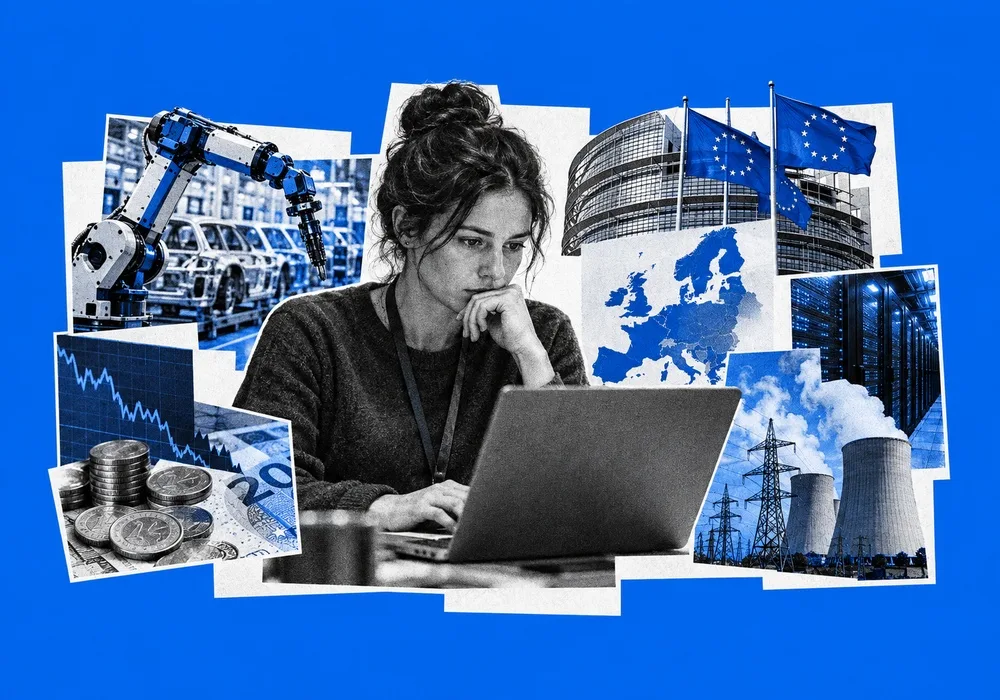
AI could lift European productivity by around 1% over the next five years, but the gains are unlikely to be evenly distributed. An IMF assessment presented to EU finance ministers warns that rapid AI adoption could also widen inequality, strain electricity infrastructure and deepen Europe’s dependence on foreign technology.
Artificial intelligence could raise productivity across Europe by around 1% over the next five years, but the gains will not be evenly distributed. A new assessment prepared for EU finance ministers warns that faster AI adoption could simultaneously deepen inequality, increase pressure on Europe’s electricity infrastructure and reinforce the bloc’s dependence on technology developed outside Europe.
The assessment was discussed at the informal meeting of EU finance ministers in Dublin on 18–19 September, where AI was placed alongside competitiveness, investment and financial innovation on the economic agenda. The Irish EU Presidency framed the meeting around Europe’s ability to use new technologies to strengthen productivity and growth while dealing with the economic and social disruption that rapid AI development may bring.
The issue is particularly significant for Europe because the bloc enters the next phase of the AI race with a persistent productivity gap, fragmented markets and relatively limited presence in some of the fastest-growing technology sectors. The European Commission has already identified weak investment and Europe’s limited position in AI-related industries as structural constraints on competitiveness.
Productivity gains will depend on adoption
The IMF estimates that AI could increase European productivity by roughly 1% over five years. That would provide a meaningful boost to an economy facing weak productivity growth, demographic pressures and increasing competition from the United States and China.
The effect, however, is not expected to be uniform. Around 60% of workers in advanced European economies are employed in occupations that are highly exposed to AI, meaning that the technology could affect a substantial share of the labour market. Exposure does not necessarily mean job losses: in many occupations AI can complement workers by automating specific tasks, improving decision-making or increasing output. But where AI substitutes for human labour, the transition could be considerably more disruptive.
This creates a distribution problem for European policymakers. Countries and regions with stronger digital infrastructure, deeper capital markets and more technologically advanced companies are better positioned to capture the productivity gains, while economies with weaker investment capacity may adopt AI more slowly and benefit less.
The IMF has previously made a similar point about Europe’s AI potential, arguing that productivity gains will depend not only on technology itself but also on reforms that allow companies to scale, workers to acquire new skills and businesses to operate more easily across national borders.
Europe’s fragmented market remains a constraint
The AI debate is therefore becoming increasingly connected to the broader question of whether Europe can complete its single market.
The IMF has pointed to fragmentation in services, regulation, labour markets and access to finance as obstacles to faster technology adoption. Its 2026 assessment of the euro area also argues that reducing regulatory fragmentation and improving access to capital would help innovative companies scale across Europe rather than remain confined to individual national markets.
This is particularly important for AI because the technology favours scale. Large amounts of capital are required for computing infrastructure, data centres, specialised chips and research. Companies also need access to sufficiently large markets if they are to compete with US and Chinese technology firms.
For the EU, the challenge is therefore broader than supporting individual AI companies. It is about creating conditions in which European firms can develop, finance and deploy AI across a market of 27 countries without encountering a different regulatory or commercial environment at every border.
The electricity challenge is becoming part of the AI race
AI also creates a physical infrastructure problem.
The expansion of data centres and high-performance computing is increasing demand for electricity, putting additional pressure on power networks in major European data hubs. Frankfurt, London, Amsterdam, Paris and Dublin are among the locations particularly exposed to this pressure as demand for data-centre capacity expands.
That creates a difficult policy equation for Europe. The bloc wants to accelerate digitalisation while simultaneously trying to reduce energy costs, decarbonise its electricity system and improve energy security.
The problem is not simply the amount of electricity available. Europe also faces significant differences in electricity prices between countries and continued dependence on imported energy. The IMF has previously warned that industrial electricity prices in some EU member states can be several times higher than in others, highlighting the limitations of a market that is formally integrated but still highly fragmented in practice.
AI investment could therefore amplify existing weaknesses in Europe's energy infrastructure unless additional generation, grids and cross-border interconnections are developed alongside digital infrastructure.
Labour markets will absorb much of the disruption
The distribution of AI's economic gains will ultimately depend heavily on what happens to European workers.
A large proportion of the workforce is already employed in occupations exposed to AI. Some workers will benefit from tools that allow them to perform more tasks or increase their productivity, while others may face restructuring as companies automate activities previously performed by people.
This makes skills policy a central part of Europe’s AI strategy. The IMF has called for investment in reskilling and upskilling, alongside labour-market policies that help workers move between occupations as demand changes. Its broader AI analysis warns that without investment in education and lifelong learning, younger workers and parts of the middle-income workforce could face particularly significant adjustment pressures.
For governments, this means that AI policy can no longer be treated solely as a technology or industrial-policy issue. Its effects will extend into employment, education, taxation and social protection.
Europe also faces a strategic dependency problem
The economic benefits of AI could come with a geopolitical cost if Europe remains heavily dependent on technologies developed elsewhere.
The IMF has highlighted Europe’s reliance on foreign technology, particularly from the United States and China, as another structural vulnerability. AI systems depend on a wider ecosystem that includes advanced chips, cloud computing, data-centre infrastructure and specialised software. Control over those components is increasingly linked to economic and strategic power.
Europe has sought to strengthen its technological sovereignty through investment, regulation and support for domestic AI capabilities. But regulation alone cannot eliminate the underlying dependency if European companies lack the capital and infrastructure required to compete at scale.
The question is therefore increasingly tied to economic security. Europe’s ability to capture the productivity benefits of AI will depend not only on how quickly businesses adopt the technology, but also on whether the continent can build enough of the infrastructure and industrial capacity behind it.
AI is becoming part of Europe’s competitiveness strategy
The Dublin discussions reflect a broader shift in the way European policymakers view AI. Rather than treating it exclusively as a digital-sector issue, EU governments are increasingly considering it in relation to productivity, investment, energy, labour markets and economic security. The European Commission said ahead of the meeting that ministers would examine AI’s impact specifically across productivity, labour markets, energy and geopolitics.
That approach is consistent with the wider European debate over competitiveness. The Commission’s 2026 economic forecast identified AI investment as a source of potential growth while warning that Europe’s relatively weak position in fast-growing AI-related sectors could prevent EU companies from capturing the full benefits of global technological expansion.
The IMF’s latest assessment adds another dimension: AI could provide Europe with a productivity boost, but the technology will also expose existing weaknesses in the bloc’s economic architecture. Fragmented markets, uneven investment capacity, energy constraints and dependence on foreign technology could determine how widely the gains are distributed.
For Europe, the AI race is therefore becoming less about simply adopting a new technology and more about whether the EU can build the capital, energy systems, skills and integrated market needed to turn that technology into sustained economic growth.
Sources: IMF, Council of the EU, European Commission