
Why Airfares Are Soaring Across Europe: Inside the 10-Week Jet Fuel Crisis

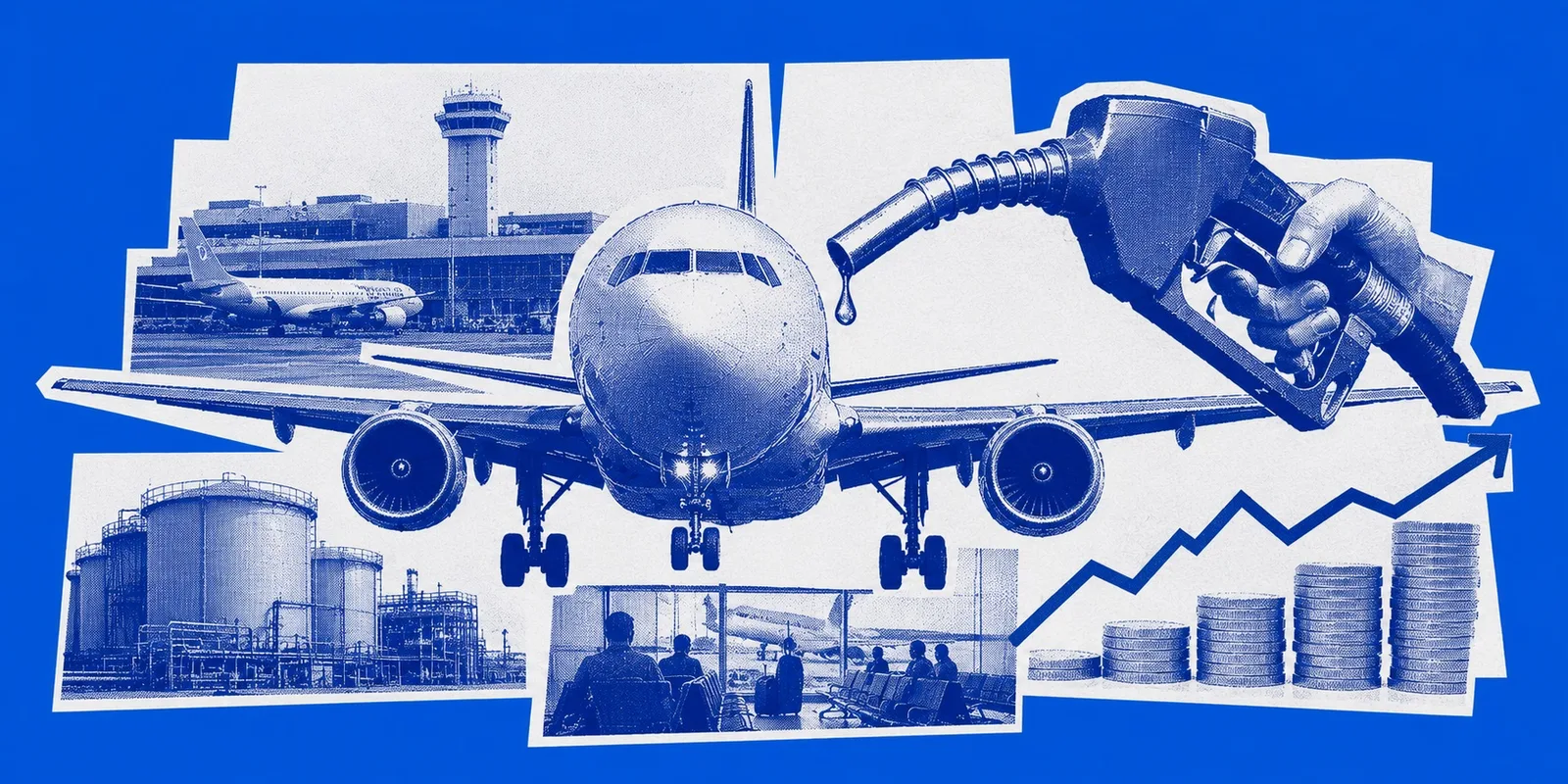
Ten weeks into the blockade of the Strait of Hormuz, the global aviation industry is facing its deepest structural shock since the pandemic, triggering record airfare hikes and mass flight cancellations across Europe. The disruption, caused by the war involving the United States, Israel, and Iran, has pushed jet fuel prices from $85–$90 to $150–$200 a barrel. Europe, which previously received around 500,000 barrels of aviation fuel a day through the Gulf route, is now forced to rely on more expensive imports from the US and West Africa.
The consequences are already visible. Airlines are cancelling flights, cutting capacity and adding charges to tickets. More than 10 million passenger seats have been removed from summer schedules. Lufthansa has cancelled 20,000 short-haul flights. Prices on some routes between Europe and Asia have increased fivefold.
And Spirit Airlines, one of North America's largest low-cost carriers, has collapsed.
That is why the current crisis matters beyond the price of a summer holiday. It is exposing the fragility of an aviation model built on cheap fuel, high passenger volumes and margins too thin to absorb a prolonged geopolitical shock.
A supply disruption has become an industry crisis
Jet fuel typically accounts for between 20% and 30% of an airline's operating costs. An increase of more than 80% in the price of the main input is therefore not a normal fluctuation that can be absorbed through minor adjustments.
The financial impact has appeared with unusual speed. US airlines increased their fuel spending by 56.4% in March alone, taking the monthly bill above $5 billion. Lufthansa expects an additional €1.7 billion in fuel costs this year. Air France-KLM faces an estimated €2.4 billion increase, while American Airlines has been hit with more than $4 billion in additional expenses. ANA has projected an extra $883 million.
Those numbers explain why the crisis has moved so quickly from energy markets into the passenger cabin.
Fuel surcharges are returning. Baggage fees are rising. Some airlines are charging for cabin luggage under their most basic fares. Lufthansa's Economy Basic model restricts what passengers can bring on board, while Delta and American Airlines have increased baggage charges. The price of the ticket is no longer the only price of flying.
The industry is being forced to monetise everything it once used to make low-cost travel appear simple.
The first casualty is the low-cost model
Spirit Airlines is the most dramatic warning sign. Its collapse does not mean every low-cost airline is heading toward bankruptcy. It does show how quickly a carrier can become vulnerable when high fuel prices collide with weak margins and limited room to absorb losses.
Wizz Air has cut its profit forecast by €50 million. EasyJet expects a loss of £540–560 million. Air New Zealand is forecasting its largest loss in four years. Other airlines are reducing capacity rather than continuing to operate routes that no longer make economic sense.
The low-cost model depends on a delicate equation. Planes must fly frequently. Seats must be filled. Fuel must remain affordable. Additional revenue from baggage, food and other services can improve margins, but it cannot fully compensate for a prolonged tripling of the main operating cost.
The model also depends on the assumption that passengers will continue to travel even when prices rise. That assumption may hold for some time. Demand for air travel has remained resilient, and many people still want or need to fly. But demand is not the same as profitability.
An aircraft that is full can still lose money.
The airlines best positioned to survive the shock are those with stronger balance sheets, greater access to capital and more sophisticated fuel-hedging strategies. Scale matters. A major airline can cancel routes, shift aircraft and negotiate supplies in ways unavailable to a smaller carrier.
For smaller operators, the crisis creates a harsher choice: raise prices and risk losing passengers, or keep fares low and absorb losses that cannot be sustained indefinitely.
Europe is discovering that fuel security is also transport security
The European Union's response has moved beyond ordinary market management. The European Commission has launched AccelerateEU, a system designed to monitor fuel stocks and coordinate their distribution across airports.
That decision carries political significance. It signals that aviation fuel is being treated as a strategic resource rather than simply another commodity to be purchased by individual companies in the market.
European refineries, including Repsol and OMV, have postponed planned maintenance and increased jet-fuel production. Imports from the United States and Nigeria have risen sharply. The objective is to replace supplies lost through the Gulf and prevent a physical shortage during the summer peak.
The immediate stocks are not uniform across the continent. European reserves were estimated at around six weeks in April, with substantial differences between countries. Britain had roughly three months, Portugal four, Hungary five, Denmark six, Italy and Germany seven, while France and Ireland had around eight weeks.
That distribution matters because a crisis in aviation fuel does not need to produce an absolute continental shortage to disrupt the market. Uneven reserves can create local bottlenecks, force airlines to reposition aircraft and increase competition between airports for available supplies.
Even a rapid reopening of the Strait of Hormuz would not instantly restore the old system. Refineries have altered production plans. New suppliers have entered the market. Shipping routes and contracts have changed. Airlines have already revised schedules and pricing.
The physical flow of fuel may recover faster than the economic system built around it.
The new route to Europe is more expensive
The crisis is also rearranging the geography of the energy market.
Europe is moving more aggressively toward refineries in the United States and West Africa, including Nigeria. That shift reduces dependence on the Gulf route but does not recreate the old cost structure. Different transport distances, supply contracts and refinery capacities create a more expensive chain.
This is the central economic problem. Diversification improves resilience, but resilience has a price.
For years, global aviation benefited from a highly interconnected fuel system in which large volumes could move through established routes at relatively low cost. The blockade has exposed the concentration risk hidden inside that efficiency.
The European response will therefore involve a trade-off. Governments can build more strategic reserves, coordinate supply and maintain greater control over critical resources. But the more the system is designed to withstand geopolitical shocks, the less it can rely on the cheapest available supply at any given moment.
AccelerateEU may prevent the worst-case scenario: airports running out of fuel and airlines grounding large parts of their fleets.
It cannot restore the old price.
The passenger will pay in several different ways
The most visible impact is the increase in ticket prices. International fares in the United States have risen by 16% on average to $1,101, while domestic fares have increased by 24%. On some Europe-Asia routes, the increase has been far more dramatic.
But the more important change is the way the industry is passing the cost to consumers.
A passenger may not see the entire increase in the headline fare. Instead, the bill appears through fuel surcharges, baggage fees, charges for cabin luggage and more restrictive basic tariffs.
That approach allows airlines to preserve the appearance of competition while making the overall journey more expensive.
The result is a different kind of low-cost travel. The ticket may still look affordable. The complete journey will not.
Short-haul aviation is particularly exposed. With airlines cancelling thousands of short routes, European railways are among the few clear beneficiaries. Some passengers will switch to trains not because the rail network has suddenly become more attractive, but because flying has become less economically rational.
That shift could outlast the immediate crisis.
Ukraine faces the same shock from a different direction
For Ukraine, the crisis is especially complicated.
Its civilian airspace has remained closed since February 24, 2022, meaning Ukrainian airlines operate largely through European markets. SkyUp has already had to pass higher fuel costs to passengers through fuel surcharges while diversifying purchases across Europe and North Africa.
At the same time, the increase in aviation fuel prices raises the cost of operating military aircraft, including F-16s and Mirage jets. For a country already operating under severe budgetary pressure, a more expensive fuel market adds another burden to defence spending.
The connection between the Strait of Hormuz and Ukraine's fiscal position is not obvious to most passengers booking a flight in Europe. It is nevertheless real. A global fuel shock raises the cost of both civilian transport and military operations at a moment when Ukraine has little room for additional expenditure.
The crisis will not end when the blockade ends
The central question for aviation is no longer whether fuel prices will eventually fall. It is whether the industry can return to the assumptions that made mass cheap air travel possible.
The current shock has already forced airlines to remove capacity, redesign fares and rethink routes. Stronger carriers are gaining room to consolidate their positions. Weaker low-cost operators are being pushed toward restructuring, mergers or failure. Airports and governments are becoming more involved in fuel allocation.
The old model depended on abundance being treated as permanent.
That assumption has now been broken. The next generation of European air travel may still be large, global and highly competitive. But it is unlikely to be as cheap, as flexible or as forgiving as the one that existed before the Strait of Hormuz became the bottleneck through which the economics of an entire industry were forced to pass.
Sources: The Guardian, Reuters.