
Ursula von der Leyen Puts European Independence at the Centre of the EU’s Next Phase

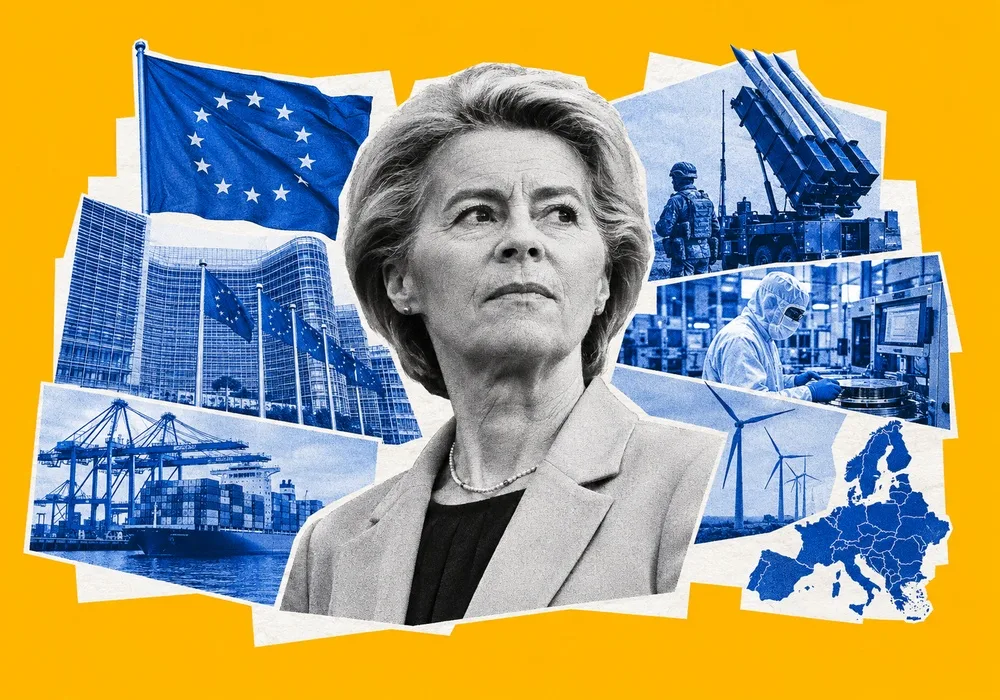
Ursula von der Leyen’s 2026 State of the Union outlined a broad shift towards European independence, linking defence, Ukraine, industrial policy, energy, critical minerals, AI, climate resilience and global partnerships. From a proposed European Security Council and deeper defence cooperation with Ukraine to a tougher China strategy and the possibility of Canadian associate membership, the Commission is seeking to turn strategic autonomy into practical European capacity.
Ursula von der Leyen used her 2026 State of the Union address to set out a broad new direction for the European Union, placing European independence at the centre of the bloc’s response to a rapidly changing international environment. Speaking before the European Parliament in Strasbourg on 16 September, the European Commission president linked the war in Ukraine, Russia’s hybrid activities, Europe’s dependence on China, high energy costs, technological competition and climate disruption as parts of the same strategic challenge.
The speech was notable less for a single flagship announcement than for the way the Commission brought together policies that have often been treated separately. Defence, industrial policy, energy, critical raw materials, artificial intelligence, trade and enlargement were presented as interconnected elements of Europe’s ability to act. The underlying argument was that the EU’s economic weight alone is no longer sufficient: the bloc also needs the infrastructure, industrial capacity and political mechanisms to turn that weight into strategic capability.
Von der Leyen described Europe as facing a more unstable international environment while also arguing that the EU has significant strengths to build on. The Commission’s approach for the next phase of its mandate is therefore not to reduce Europe’s international engagement, but to make the bloc less vulnerable to pressure from individual external powers and more capable of making independent decisions when its interests are at stake.
A European Security Council for a New Security Environment
The most significant institutional proposal concerned European security. Von der Leyen called for the creation of a European Security Council that would provide a more structured mechanism for member states to coordinate their response to emerging threats. The proposal comes as European governments increasingly deal with cyberattacks, sabotage, disinformation, infrastructure threats and drone incursions that do not necessarily amount to conventional military attacks but can nevertheless affect national security.
The proposed mechanism would address a gap between national responses and existing NATO structures. Ahead of the speech, details reported from the draft text indicated that the initiative could involve not only EU member states but also close partners such as Ukraine, the United Kingdom, Norway and Canada. The idea is not presented as a replacement for NATO, but as an additional European framework for political consultation and coordinated action when a member state faces a serious security threat.
Von der Leyen also proposed a European equivalent of the consultation principle contained in Article 4 of the NATO treaty. Under such a mechanism, a country facing a serious threat could trigger consultations with its European partners, allowing governments to assess the situation collectively and coordinate measures before a crisis develops further. This is particularly relevant to hybrid activity, where attribution, proportionality and the threshold for a conventional military response can be difficult to establish.
The proposal reflects the changing character of European security. Threats to European states increasingly extend beyond conventional military capabilities to include critical infrastructure, telecommunications, energy networks, undersea cables, cyber systems, satellite infrastructure and unmanned technologies. The Commission is therefore seeking to build a security architecture capable of responding to a wider range of threats while continuing to operate alongside NATO and national defence structures.
Ukraine Becomes More Deeply Integrated into European Defence
Ukraine remained a central part of the security agenda. The EU has increasingly moved from treating support for Ukraine as an emergency response towards incorporating Ukrainian capabilities into longer-term European defence planning. The Commission says that the EU has mobilised €89.7 billion in military assistance and trained almost 97,000 members of the Ukrainian armed forces through the EU Military Assistance Mission.
The relationship is also becoming more industrial. In July, the EU and Ukraine signed a new defence-industrial partnership, while a drone cooperation initiative was launched to deepen collaboration in drone and counter-drone technologies. Ukraine’s experience of large-scale drone warfare has created expertise that European governments increasingly regard as relevant to the development of their own military capabilities, particularly as European defence industries seek to adapt to cheaper and more rapidly produced autonomous systems.
Financial support is also being extended. EU member states have agreed to provide up to €90 billion for Ukraine’s budgetary and military needs in 2026 and 2027. This comes on top of more than €200 billion in overall EU support since Russia launched its full-scale invasion. The scale of the commitment indicates that Brussels continues to view Ukraine’s ability to withstand Russian pressure as directly connected to the security of the European Union itself.
Energy has become a particularly important part of that relationship. More than €4 billion has already been provided for Ukraine’s energy sector, while a further €920 million package announced earlier this year is intended to support the country through the 2026–27 winter. The funding is aimed at electricity generation, grid resilience, energy efficiency and heat supply, while the EU is also working to restore damaged infrastructure and increase decentralised generation, including solar installations for critical facilities.
The EU has simultaneously continued to increase economic pressure on Russia. Twenty-one sanctions packages have been adopted since the beginning of the full-scale invasion, while hundreds of vessels associated with Russia’s shadow fleet have been targeted. Around €210 billion in Russian Central Bank assets remain immobilised in the European Union, keeping the question of how those assets could contribute to Ukraine’s recovery and defence at the centre of European discussions.
From Strategic Autonomy to European Independence
The language of independence used by von der Leyen represents a broader evolution of the EU’s approach to strategic autonomy. For years, the concept focused primarily on reducing specific dependencies while maintaining Europe’s position as an open trading power. The 2026 State of the Union presents a more comprehensive version of the idea, in which defence, energy, technology, industrial production and trade are all connected to the ability of Europe to make and implement its own decisions.
That does not mean economic isolation. The Commission is simultaneously expanding relationships with partners around the world. Agreements and negotiations with Australia, India, Indonesia, Mexico, Mercosur and other countries are intended to open markets for European companies while creating alternatives to concentrated supply chains. The objective is to make diversification a source of resilience rather than a retreat from global trade.
The same principle is increasingly visible in European defence policy. The EU is seeking to increase domestic production of ammunition, missiles, drones and air-defence systems while encouraging joint procurement and cross-border industrial cooperation. The European defence market remains fragmented, however, with national procurement systems and different industrial priorities limiting the extent to which European governments can operate as a single buyer.
Completing the Single Market is therefore becoming part of the security agenda. The Commission wants to remove barriers that make it difficult for companies to scale across borders and has set the end of 2027 as a target for completing the remaining work on the internal market. The logic is that a larger and more integrated European market should also create a stronger industrial base capable of supporting the EU’s strategic objectives.
China and the Return of Industrial Power Politics
China occupied a prominent place in von der Leyen’s economic argument. The EU’s trade deficit with China has reached approximately €1 billion per day, according to Reuters, and the Commission president described the situation as a new “China shock” affecting European industry. The concern is not limited to imports themselves, but extends to the combination of Chinese industrial overcapacity, state support, European dependence on Chinese inputs and the pressure this creates for manufacturers across the bloc.
The issue is particularly acute in sectors such as electric vehicles, batteries, solar technologies, electronics and advanced manufacturing. European policymakers are increasingly concerned that dependence on Chinese products at one end of the supply chain can coexist with dependence on Chinese raw materials at the other. This creates a strategic vulnerability even when European companies remain competitive in individual segments.
Critical minerals have therefore become an important part of the EU’s economic-security strategy. Von der Leyen announced plans for a new European corporation focused on critical raw materials, intended to strengthen joint purchasing and strategic stockpiling. The initiative is designed to increase the EU’s bargaining power and reduce exposure to supply disruptions, particularly in areas where China occupies a dominant position.
The Commission has already identified 34 critical raw materials and selected strategic projects both inside and outside the EU. It has also committed funding to accelerate their development. The broader objective is to diversify sources of supply, build recycling capacity and establish stronger European processing capabilities rather than simply replacing one foreign supplier with another.
Von der Leyen’s message on China was consequently not about ending economic relations with Beijing. Instead, she signalled that the EU is prepared to use trade-defence instruments and other economic tools to address what it considers structural imbalances. The approach reflects a wider shift in European policy in which trade is increasingly viewed through the lens of industrial resilience and geopolitical leverage.
Energy Security and the Cost of European Industry
Energy remains one of the central constraints on European competitiveness. The Commission has increasingly argued that reducing fossil-fuel dependence is not only necessary for meeting climate targets but also essential for insulating European economies from external shocks. The experience of the energy crisis following Russia’s invasion demonstrated how quickly energy dependence can become a geopolitical vulnerability.
Renewables have expanded substantially in the EU, accounting for around 47% of electricity generation in 2025 compared with 36% in 2021. The Commission argues that the growth of solar and wind power has already reduced Europe’s exposure to imported fossil fuels, while continued electrification could reduce that dependence further.
The next stage of the strategy is focused on electrification across transport, heating and industry. The Commission’s July 2026 electrification action plan aims to accelerate the replacement of imported fossil fuels with electricity generated increasingly from domestic sources. That will require not only more generation capacity but also major investment in grids, interconnectors, storage and cross-border infrastructure.
Nuclear power also remains part of the Commission’s wider energy strategy, alongside renewables, biomethane and other domestic sources. The objective is to create a more diversified European energy system while reducing the exposure of European consumers and industry to international fossil-fuel prices.
The industrial dimension is particularly important. European manufacturers face higher energy costs than many competitors in the United States and parts of Asia, making energy policy inseparable from the future of European production. The Commission is therefore attempting to address the problem through a combination of cheaper domestic electricity, infrastructure investment and measures designed to accelerate industrial electrification.
Artificial Intelligence and the Race for Technological Capacity
Artificial intelligence was another major component of the speech, but von der Leyen’s approach was not limited to regulation. The Commission wants Europe to become a major user and developer of AI while retaining the ability to control the infrastructure on which the technology depends.
AI is expected to play a growing role in European manufacturing, healthcare, agriculture, transport and scientific research. The Commission is therefore supporting investment in computing capacity, data infrastructure, semiconductors and cloud services while encouraging European companies to integrate AI into existing industries.
At the same time, the rapid development of frontier models has created a new regulatory challenge. Von der Leyen said the Commission would invite leading AI laboratories to discussions on model evaluation, early-warning mechanisms and AI security. The goal is to improve Europe’s ability to identify and respond to risks associated with increasingly capable systems while avoiding a regulatory environment that prevents European companies from developing the technology.
This creates a difficult balance for Brussels. The EU wants to remain a global regulatory power, as it has done through the AI Act, but it also wants European companies to compete in an industry increasingly dominated by firms based in the United States and China. Regulation alone cannot provide technological sovereignty; Europe also needs computing infrastructure, capital, research capacity and companies capable of scaling globally.
The Commission’s wider technology agenda therefore includes Chips Act 2.0, measures for cloud and AI development, support for open-source technologies and initiatives aimed at accelerating the adoption of AI across European industries. The broader objective is to ensure that Europe is not simply a market in which foreign technologies are deployed, but also a place where critical technologies are developed and scaled.
New Rules for Children in the Digital Environment
The Commission is also moving towards a new European framework governing children's access to digital services. The planned EU Kids Act would establish a common approach to age verification, parental controls and safer digital design, with a proposed minimum age of 15 for autonomous social-media accounts.
The proposal is expected to cover more than traditional social networks. Video-sharing platforms, online games and AI chatbots could also fall under the new framework, reflecting concerns that the digital environment facing children has changed significantly since many existing regulations were introduced.
The proposed rules would also address design features intended to keep users engaged for long periods, while requiring stronger mechanisms for parents and children to report harmful content and protect personal data. Platforms that fail to comply could face substantial penalties, with draft plans indicating fines of up to 6% of annual global turnover.
The proposal will still need to pass through the EU legislative process. Its significance therefore lies not only in the proposed age limit but in the attempt to establish a common European digital standard at a time when several member states are developing their own restrictions.
Climate Adaptation After an Extreme Summer
Climate policy was framed in notably practical terms. Von der Leyen referred to the summer as a period that demonstrated the scale of Europe’s exposure to extreme weather, pointing to wildfires, heatwaves and agricultural losses across the continent.
The Commission estimates that approximately 660,000 hectares were burned during the summer, while around 12 million tonnes of agricultural production were lost. It also cited more than 35,000 excess deaths associated with extreme heat. The figures were presented as evidence that climate change is already affecting European economies and public services rather than representing a distant environmental risk.
The Commission plans to introduce a Climate Resilience Package and a separate Heatwave Preparedness Package, focusing on areas such as urban cooling, water management, infrastructure and emergency response. The emphasis reflects a gradual change in European climate policy: mitigation remains central, but adaptation is becoming an increasingly urgent part of economic planning.
Water security is expected to become particularly important. Ageing infrastructure, drought and rising demand are placing pressure on water systems in several parts of Europe. The Commission estimates that almost one litre in every four is lost through leaks in European water infrastructure, highlighting the scale of investment required even before considering the additional pressures created by climate change.
Canada and the Possibility of Associate EU Membership
One of the most unexpected announcements came when von der Leyen addressed the future relationship between the EU and Canada. With Canadian Prime Minister Mark Carney present in Strasbourg, she said Europe was prepared to explore taking the relationship to a new level, including the possibility of Canada becoming the EU’s first associate member.
The proposal would represent a new category in the EU’s external relationships. Associate membership does not currently have a clearly established legal form in the EU treaties, meaning that substantial political and institutional negotiations would be required before it could become reality.
The idea nevertheless fits the wider strategy outlined in the speech. Canada is already a close partner on Ukraine, defence, critical minerals, energy, climate policy and Arctic security. At a time when both Europe and Canada are reassessing their exposure to geopolitical and trade shocks, closer institutional ties could provide a framework for expanding cooperation across several of these areas.
The proposal also comes amid a broader effort by Canada to diversify its international relationships. Carney has sought closer economic and security ties with Europe as Ottawa navigates a more uncertain relationship with Washington. Several European governments have previously been cautious about creating new institutional arrangements, however, meaning that the proposal will require significant political discussion before its implications become clear.
A Wider Network of Strategic Partnerships
Canada is part of a broader diversification strategy. Over the past year, the EU has expanded or advanced trade relations with Australia, India, Indonesia, Mexico and Mercosur while pursuing additional agreements across the Indo-Pacific and Gulf regions.
The strategy reflects a recognition that European resilience cannot be achieved solely by producing more inside the EU. The bloc will continue to depend on global markets for energy, raw materials, technology and consumer demand. The objective is therefore to create a sufficiently broad network of relationships that disruptions with one partner do not translate into systemic vulnerability for the European economy.
This approach also gives the EU more options in negotiations with major powers. A diversified network of trade and investment relationships can reduce the economic consequences of political disputes while giving European companies greater access to alternative markets.
The result is an increasingly deliberate attempt to combine openness with resilience rather than treating the two as competing objectives.
Migration, Borders and European Resilience
Migration remains another area in which the EU is trying to strengthen common capacity. The new Migration and Asylum Pact became operational in June 2026, establishing common procedures for screening, asylum applications, border management and solidarity between member states.
Recent migration pressure around Ceuta has provided an early test of the new framework. The Commission has supported Spain financially and operationally while working with member states and digital platforms to address disinformation associated with migrant-smuggling networks.
The EU is also expanding the role of Frontex and implementing the Entry/Exit System, which is intended to provide more systematic information about the movement of non-EU nationals across the external border.
The longer-term challenge is balancing common European rules with national political pressures. Migration remains an area in which member states have significantly different priorities, making implementation one of the most politically sensitive elements of the Commission’s wider resilience agenda.
Enlargement Becomes Part of the Security Debate
The future enlargement of the EU was also presented in increasingly strategic terms. The Commission argues that the stability of the European neighbourhood directly affects the security of the Union and that enlargement can contribute to that stability.
Ukraine and Moldova remain at the centre of the current enlargement agenda, alongside the Western Balkans. The Commission has also strengthened relations with Armenia and Azerbaijan and increased its focus on connectivity across the South Caucasus.
For Ukraine, accession is particularly significant because it would extend the EU’s political, economic and security structures further east. The process remains conditional on reforms and the completion of the accession negotiations, but the Commission increasingly frames the enlargement agenda as part of the wider geopolitical architecture of Europe.
This approach also changes the meaning of the EU’s neighbourhood policy. The countries surrounding the Union are increasingly viewed not only through the lens of trade and development but also in terms of infrastructure, defence, energy and strategic stability.
The Cost of European Independence
The central question left by the State of the Union is how the EU will finance and implement this increasingly ambitious agenda.
Europe is being asked to invest simultaneously in defence, Ukraine, energy infrastructure, critical minerals, AI computing capacity, climate adaptation, border management, industrial competitiveness and enlargement. Each individual priority has a strategic rationale, but their combined cost is substantial.
The Commission has already expanded the use of common European financing mechanisms and wants to mobilise significantly more private capital. Yet the scale of the investment required means that national budgets, the EU budget and private financing will all have to play a role.
This is particularly relevant as member states face their own fiscal pressures. Increasing defence spending, supporting Ukraine and financing infrastructure all compete with domestic spending priorities. The political challenge for Brussels is therefore not only to define what Europe needs to become more independent, but also to establish how the member states will pay for that transformation.
The same problem applies to implementation. A European Security Council will require agreement among governments. Completing the Single Market requires countries to remove national barriers. Industrial consolidation depends on companies and governments coordinating procurement. Critical-mineral projects need long-term investment. AI infrastructure requires access to enormous amounts of capital and electricity.
The gap between announcing a European strategy and creating European capacity is therefore likely to become one of the defining issues of the Commission’s remaining mandate.
From Strategy to Capacity
The 2026 State of the Union presents a European Union attempting to adapt to a world in which economic interdependence can no longer be separated from security.
Russia’s war against Ukraine has exposed the military dimension of European dependence. China has highlighted vulnerabilities in industrial supply chains and critical minerals. The energy crisis demonstrated the geopolitical cost of fossil-fuel dependence. The AI race has shown that technological power increasingly depends on access to computing infrastructure, capital and data. Extreme weather is forcing governments to treat climate resilience as an economic necessity.
Von der Leyen’s response is to bring these challenges under one strategic framework.
The European Security Council, deeper defence-industrial cooperation with Ukraine, critical-raw-material stockpiling, electrification, AI investment, Single Market reform and closer ties with Canada all serve different purposes, but they point towards the same institutional direction: a European Union seeking greater capacity to act collectively.
The concept of independence also does not imply withdrawal from alliances or global trade. The EU continues to rely on NATO, seeks closer cooperation with Canada and other partners, and is expanding trade relations across several regions. The objective is to reduce situations in which Europe has only one viable external option.
That leaves implementation as the central test. The 2026 State of the Union has established a broad agenda covering defence, industry, technology, energy, trade, climate and the European neighbourhood. Whether that agenda produces a more resilient and capable Union will depend on decisions over funding, national coordination and the willingness of member states to transfer more of their economic and security capacity into genuinely European frameworks.
Sources: European Commission