
Ukraine-South Korea Row: How a Leak Over North Korean POWs Threatens Kyiv’s Ammo Supply

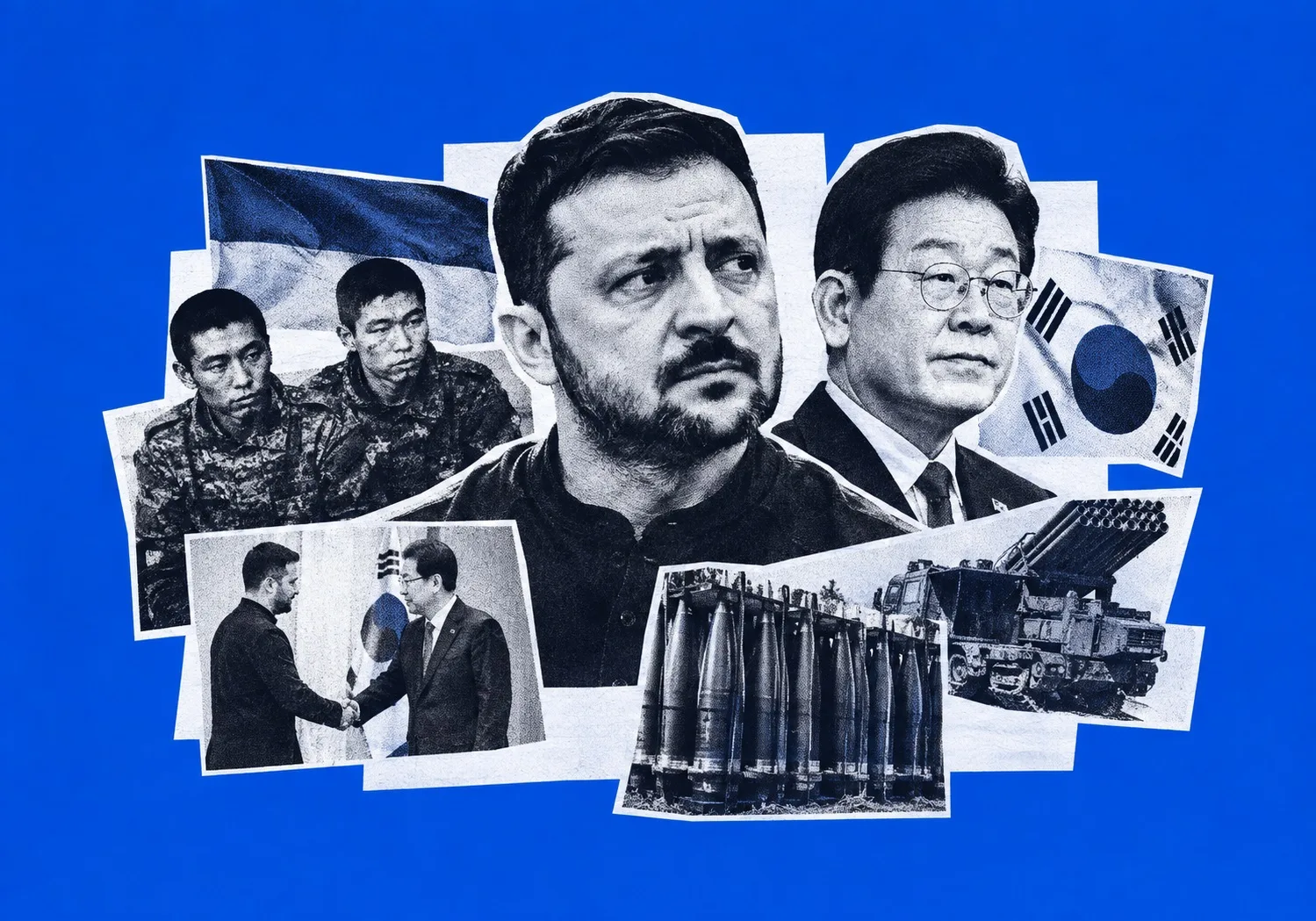
A public dispute over two North Korean prisoners of war has triggered the most serious diplomatic crisis between Kyiv and Seoul since 2022. As President Lee Jae-Myung demands an apology, the rift exposes a fundamental clash between Ukraine’s public diplomacy and South Korea’s need for secret security cooperation - putting vital indirect military support at risk.
The dispute traces back to January 2025, when Ukrainian forces captured two North Korean soldiers in Russia’s Kursk region. By July 2026, Volodymyr Zelenskyy and Lee Jae Myung had agreed on arrangements for their transfer based on their free will - a process Seoul insists was to remain strictly confidential at Kyiv’s own request.
That understanding was effectively shattered on 23 September, when Zelenskyy told the UN General Assembly that Ukraine had sent the two prisoners to South Korea.
Seoul’s reaction has since moved well beyond a private diplomatic complaint. On 27 September, the South Korean presidential administration demanded an explanation and a public apology, accusing Kyiv of disclosing a confidential operation and subsequently denying that a non-disclosure understanding existed. The following day, South Korea’s foreign ministry summoned Ukraine’s chargé d’affaires, Andrii Vieshkin.
The dispute is now being managed through daily diplomatic contacts, but the political problem is harder to contain than the language used by either side might suggest.
Two different definitions of strategic communication
For Kyiv, the presence of North Korean troops in Russia’s war against Ukraine is strategically significant in its own right. Publicising evidence of that involvement serves a wider diplomatic purpose: it demonstrates that Russia’s war is no longer simply a European conflict and seeks to mobilise international support around that fact.
Seoul operates under a different set of constraints.
North Korea is not merely a distant participant in the conflict. It is a direct security concern for South Korea, while Russia remains a state capable of affecting the military balance on the Korean peninsula. Moscow has repeatedly warned Seoul that direct or indirect weapons transfers to Ukraine would damage bilateral relations and could prompt Russia to provide critical military technologies to Pyongyang.
That makes discretion more than a matter of diplomatic etiquette.
For South Korea, controlled communication can be part of the security mechanism itself. A public statement concerning North Korean personnel, especially one that appears to expose a private arrangement involving the South Korean president, can create political and strategic costs that are difficult to reverse once the information is public.
The argument between Kyiv and Seoul therefore concerns not simply whether an agreement existed in a legally binding form. It is also about whether a political understanding was treated as sufficiently binding to govern public behaviour.
Ukraine’s Foreign Minister Andrii Sybiha has described the episode as a “diplomatic misunderstanding” and expressed a desire for a rapid settlement. Kyiv has nevertheless continued to reject the existence of any formally binding confidentiality agreement.
That leaves both governments searching for language that can resolve the political dispute without forcing either side to abandon its stated position.
The defence connection beneath the dispute
The stakes are higher because South Korea occupies an unusual position in Ukraine’s wartime supply chain.
Seoul officially maintains strict restrictions on providing lethal weapons to countries engaged in active armed conflict. Its declared support for Ukraine has instead focused on areas including humanitarian assistance, demining, medical equipment and energy recovery.
Yet South Korea is also one of the world’s major defence exporters, producing systems and ammunition that are highly relevant to Ukraine’s military requirements. Its industrial base includes 155mm artillery ammunition, K9 Thunder self-propelled artillery, K2 Black Panther tanks, K239 Chunmoo multiple-launch rocket systems and Cheongung-II air-defence systems.
The most sensitive element is not necessarily a direct Ukrainian-South Korean weapons pipeline. The relationship has also involved indirect arrangements. South Korean 155mm ammunition has been transferred to the United States to replenish American stocks, allowing Washington to release its own ammunition for Ukraine.
That arrangement has significance precisely because it can operate without requiring Seoul to abandon its formal restrictions on direct lethal assistance.
A breakdown in political trust could make such indirect mechanisms more difficult to sustain, regardless of whether they are formally connected to the prisoner dispute.
The issue is therefore not simply whether Seoul will announce a new weapons policy. It is whether the political conditions that make discreet cooperation possible will survive.
Why the dispute matters beyond two prisoners
The prisoner issue has exposed a broader weakness in the way European security diplomacy is adapting to an increasingly interconnected war.
North Korea’s military involvement has already connected the European theatre to the security calculations of East Asia. For Ukraine, this creates an obvious incentive to treat North Korean participation as part of the international case against Russia.
But the same development requires Kyiv to navigate the diplomatic conventions of countries whose security calculations are shaped by a different geography.
South Korea cannot treat North Korea as merely another foreign partner of Moscow. Any public discussion involving Pyongyang carries implications for Seoul’s own deterrence strategy and for the possibility of further Russian-North Korean military cooperation.
That distinction matters because Ukraine increasingly depends on partners whose interests extend far beyond Europe.
The diplomatic system around the war is becoming less compartmentalised. European governments, Asian defence producers and states facing North Korean security threats are being drawn into the same strategic environment. A communication strategy designed primarily for Western coalition-building can therefore produce unintended costs when applied to a partner operating under a different security logic.
The dispute with Seoul is an unusually visible example of that problem.
The price of losing diplomatic room
Lee’s latest intervention on 2 October sharpened the confrontation. In a public statement on X, the South Korean president said Ukraine had requested confidentiality and then effectively portrayed another head of state as a liar by disputing the existence of the understanding. He also objected to Ukrainian remarks about the risk of war on the Korean peninsula.
Lee warned that South Korea would take “additional measures” if Kyiv continued to refuse to acknowledge the agreement and issue a public apology. He did not publicly specify what those measures would entail.
That ambiguity is itself important. Seoul has not announced a formal suspension of cooperation with Ukraine, while diplomatic contacts between the two foreign ministries continue daily. The channel for repairing the relationship therefore remains open.
But the available room for quiet diplomacy has narrowed.
The Ukrainian government needs a formulation that can address Seoul’s demand for recognition and political dignity without formally conceding a legal obligation that Kyiv says does not exist. South Korea, meanwhile, needs to demonstrate that its president and government can enter sensitive arrangements without seeing them publicly reframed afterwards.
Neither side benefits from allowing the dispute to harden into a precedent.
For Ukraine, the immediate cost of a prolonged confrontation would not necessarily appear as a single cancelled programme or an announced weapons embargo. It could instead emerge through the erosion of confidence surrounding arrangements that depend on political discretion. For South Korea, the cost lies in having its carefully managed position towards Ukraine, Russia and North Korea become harder to maintain.
That is why the daily diplomatic contacts between Kyiv and Seoul matter more than the public rhetoric might indicate.
The central question is no longer what happened to two North Korean prisoners. It is whether Ukraine and South Korea can reconstruct a working layer of trust after demonstrating how little space remains between private diplomacy and public wartime messaging. As North Korea becomes more deeply connected to Russia’s war in Europe, Kyiv will have to operate in an environment where a disclosure intended to strengthen one coalition can simultaneously weaken another.
Sources: Jaemyung_Lee/X, CNN, The Guardian, The Korea Times, DW, Reuters