
Ukraine Builds New Regional Partnership Through the Carpathian Eight

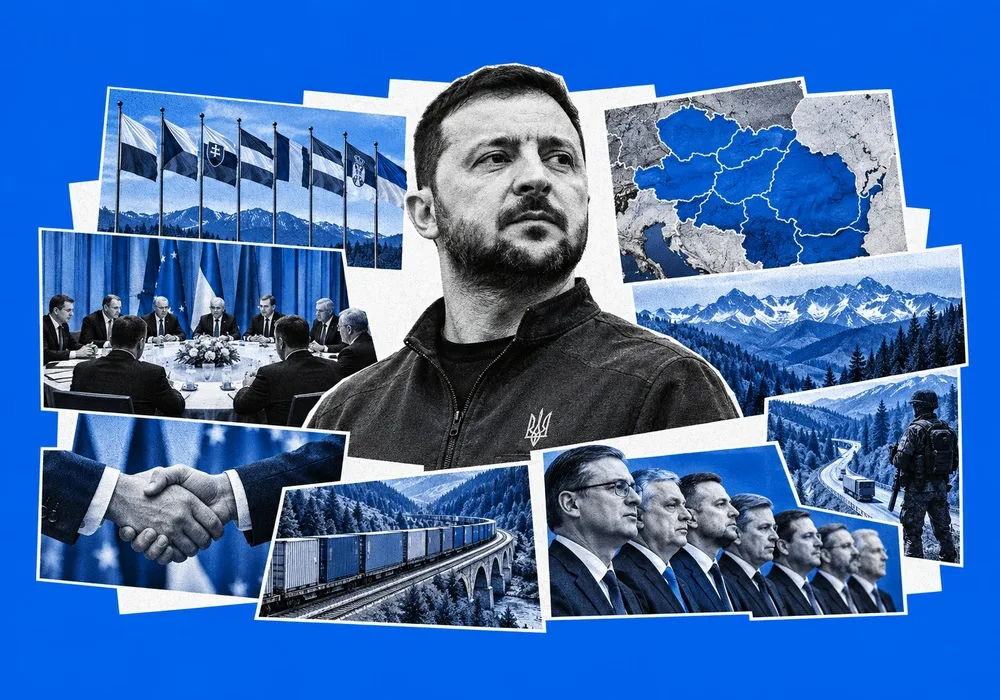
Ukraine has launched the Carpathian Eight, a new regional format bringing together eight Central and Eastern European countries around security, energy, trade and infrastructure. More than 50 agreements worth over €1 billion have been prepared, while almost 100 proposed projects form an investment portfolio approaching €40 billion.
Ukraine is seeking to turn its increasingly dense network of wartime cooperation with Central and Eastern European neighbours into a more permanent regional framework, launching the Carpathian Eight initiative at a summit in western Ukraine on 18 September. The new format brings together Ukraine, Poland, Romania, Slovakia, Czechia, Hungary, Austria and Serbia, with the European Union also involved in the discussions. The initiative combines security cooperation with trade, energy, logistics and infrastructure, reflecting the extent to which Russia’s war has reshaped the economic and strategic geography of the region.
The first summit brought together Polish Prime Minister Donald Tusk, Romanian President Nicușor Dan and Serbian President Aleksandar Vučić, alongside representatives from the other participating countries. For Kyiv, the meeting was designed to move cooperation beyond individual bilateral agreements and towards a regional mechanism connecting governments, businesses, regions and local communities. Zelenskyy presented the Carpathian macro-region as an emerging economic and security space whose importance has increased significantly since Russia’s full-scale invasion of Ukraine.
From wartime routes to a regional economic network
The economic component of the initiative is substantial. More than 50 agreements worth over €1 billion were prepared for signing during the summit, covering energy, logistics, infrastructure and cross-sectoral cooperation. At the same time, almost 100 potential business projects from the eight countries were presented with a combined value approaching €40 billion, creating what Kyiv describes as a joint investment portfolio for the Carpathian macro-region.
The scale of the proposed portfolio is significant because the Carpathians have historically been treated primarily as a geographic and cultural region rather than as an integrated economic market. Ukraine is now attempting to use the existing connections between the countries to create a more coherent investment space, with cross-border infrastructure and logistics at its centre. The ambition is to make the region more attractive to European capital while connecting Ukrainian infrastructure and production more closely to EU markets.
Energy is one of the most prominent components. Around half of the investment portfolio is linked to energy projects, including solar and wind generation, energy storage, electricity interconnectors and the use of Ukraine’s extensive underground gas-storage facilities. Kyiv has also proposed creating a Carpathian wind-energy cluster with a capacity of 1.5 GW.
This reflects a broader shift in the role Ukraine wants to play in the European energy system. Rather than remaining primarily a transit country between energy producers and consumers, Kyiv is presenting the Carpathian region as a potential source of additional European energy capacity. Zelenskyy has argued that the region could become an energy supplier to the EU, linking the development of renewables and infrastructure with Europe’s efforts to reduce its dependence on Russian energy.
Security is becoming part of regional infrastructure
The economic agenda is closely connected to security. Ukraine’s western borders have become critical to the movement of military assistance, commercial goods, humanitarian supplies and people since Russia expanded its war in 2022. Roads, railways, border crossings and ports are therefore increasingly treated as strategic infrastructure rather than simply commercial assets.
Zelenskyy said the countries already cooperate on defence, energy, export and import routes, humanitarian issues and EU-level coordination, but argued that the new format should bring these areas into a stronger system of regional cooperation. He specifically identified security and logistics as shared challenges, particularly as Russia continues to attack Ukrainian infrastructure and seek to disrupt routes connecting Ukraine with European markets.
The security dimension also extends beyond the immediate protection of Ukraine. Poland has been particularly focused on the possibility that Russia could use missile, drone or hybrid attacks to test the resilience of countries supporting Kyiv. Prime Minister Donald Tusk said before travelling to Ukraine that Poland was preparing for a period of heightened risk and was strengthening security infrastructure along its eastern border. He also said discussions with Zelenskyy would include Poland’s participation in an anti-ballistic missile coalition.
Poland subsequently joined the coalition, which is intended to develop a new anti-ballistic missile capability together with Ukraine and other European partners. Warsaw also announced a new package of military assistance for Ukraine, although details of the package were not immediately disclosed.
This gives the Carpathian format a practical security component at a time when the distinction between economic and defence infrastructure in Central and Eastern Europe is becoming increasingly blurred. Transport corridors that support trade can also support military mobility; energy interconnectors can strengthen resilience during attacks; and industrial cooperation can contribute to the development of defence capabilities.
A new layer of European integration
The initiative is not intended to replace existing European institutions. Instead, Kyiv is presenting it as an additional regional mechanism that could operate within the broader EU framework.
The summit declaration calls for deeper cooperation between participating regions and communities, including through European Groupings of Territorial Cooperation. It also links the development of the Carpathian region with EU cohesion policy, energy resilience, infrastructure modernisation, sustainable development and environmental protection.
This regional approach is particularly relevant because the countries involved do not have identical political positions or levels of integration. Most are EU and NATO members, while Serbia remains outside both structures and Hungary has frequently taken positions on Ukraine that differ from those of several of its neighbours. Bringing these states into a single economic and regional framework therefore places greater emphasis on areas where practical cooperation is possible even when broader political positions diverge.
For Ukraine, this could also provide another route into European economic structures while its EU accession process continues. Rather than waiting for formal institutional integration to deliver deeper economic links, Kyiv is seeking to build those connections through infrastructure, investment and regional partnerships now.
The Carpathians as an east-west corridor
The geography of the initiative is important. The Carpathian region connects Ukraine with Poland, Slovakia, Hungary and Romania and provides routes towards the wider Central European market. Russia’s war has increased the strategic value of these connections, particularly as Ukraine has had to redirect trade away from routes disrupted by the war.
The development of alternative transport corridors has become increasingly important for Ukraine’s economy. Railways, roads and border crossings in the west have helped maintain exports and imports during the war, while neighbouring countries have become key gateways for Ukrainian goods entering the EU. The Carpathian initiative seeks to institutionalise some of this cooperation rather than leaving it dependent on individual projects or emergency arrangements.
That could become particularly relevant for reconstruction. Ukraine will require large-scale investment in energy generation, electricity networks, transport infrastructure, housing and industrial capacity. Connecting those reconstruction projects with neighbouring economies could create supply chains extending across the region rather than concentrating investment exclusively inside Ukraine.
The same logic applies to defence production. Ukraine’s experience in drone warfare and other military technologies has created new opportunities for industrial cooperation with European partners, while European states are looking for ways to expand production capacity and reduce vulnerabilities in their own defence supply chains.
During separate meetings at the summit, Zelenskyy and the leaders of Romania, Poland and Serbia discussed joint drone production, the EU's SAFE instrument, infrastructure and security in the Black Sea region.
From temporary wartime cooperation to a permanent framework
The central question for the Carpathian Eight is whether the initiative can develop beyond a summit and a collection of investment announcements. Its economic portfolio gives the format a concrete starting point, but many of the proposed projects will require long-term financing, regulatory coordination and cross-border infrastructure decisions.
Kyiv is already seeking a dedicated Carpathian strategy at EU level, arguing that greater European funding could support development in the participating regions and communities. The initiative's organisers also see the region as capable of achieving faster economic growth than the EU average if investment in infrastructure, energy and cross-border connectivity accelerates.
For Europe, the emerging structure represents another example of regional cooperation developing around the consequences of Russia’s war. The countries involved are increasingly connected not only by geography, but by shared concerns over energy security, transport resilience, defence production and the protection of critical infrastructure.
Ukraine’s role in this network is also changing. The country is no longer approaching its neighbours only as sources of military and financial support. Through the Carpathian Eight, Kyiv is attempting to position itself as an economic, energy and industrial partner and to make its integration with Central Europe part of the region’s long-term development.
The Carpathian initiative therefore places the geography of Central and Eastern Europe at the centre of a broader European transformation. Its success will depend on whether the announced projects translate into functioning infrastructure, investment and industrial links, but the framework itself signals an effort to make wartime cooperation a more durable part of the region’s economic and security architecture.
Sources: Office of the President of Ukraine