
UK Joins EU-Led €211m OceanEye Alliance for Global Ocean Observation

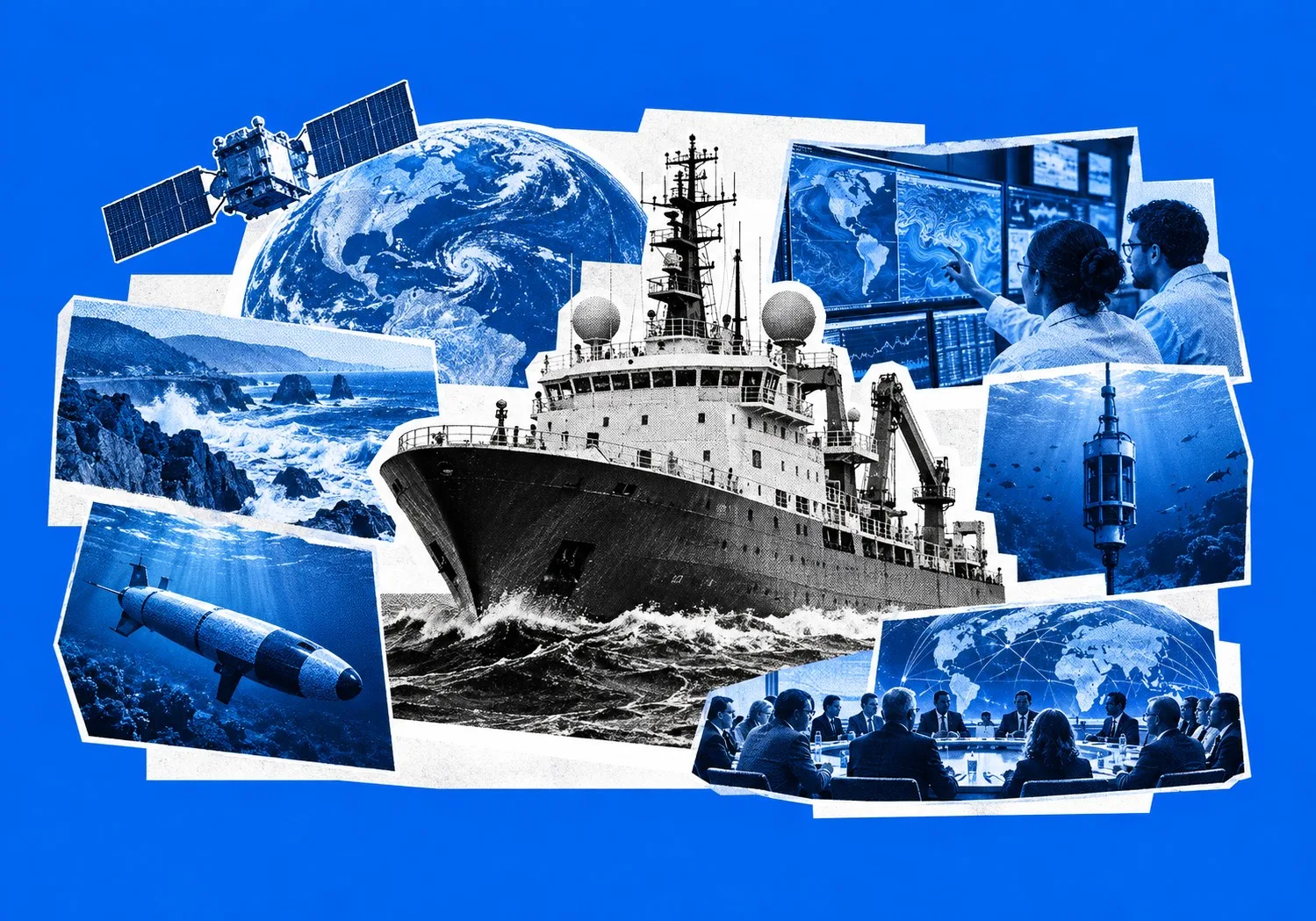
Whitehall integrates Met Office data into a new 30-nation ocean monitoring deal amid warnings over US funding cuts and El Niño shocks.
Britain has joined the EU-led OceanEye International Alliance, a €211m partnership designed to fortify global ocean observation against severe weather events and uncertain US scientific funding.
Announced in New York by European Commission President Ursula von der Leyen, Canadian Prime Minister Mark Carney, and UK Environment Secretary Angela Eagle, the 30-country agreement will integrate Met Office data directly into an EU program constructing a real-time digital twin of the world's oceans by 2030.
The gathering at UN headquarters was ostensibly an immediate response to an unfolding ecological emergency—specifically, a "supersized" El Niño warming the Pacific, disrupting harvests, and triggering extreme weather events across both hemispheres.
Yet beneath the green diplomatic rhetoric lies a calculated shift in geopolitical risk management.
For decades, the global grid of buoys, deep-sea sensors, and satellite links that feeds global weather models operated quietly in the background of international relations.
It was rarely discussed at summits, precisely because it was assumed to be permanent.
New York changed that.
By pooling €211m (£178m) into OceanEye, Brussels, London, and Ottawa are actively building an alternative spine for global climate intelligence—one structured to run with or without Washington.
Capitol Hill’s Single Point of Failure
The political push behind OceanEye has very little to do with abstract environmental solidarity. It was triggered by panic.
The United States currently funds and operates more than half of the world's ocean monitoring infrastructure, from the high-latitude arrays of the North Atlantic to deep-trench telemetry networks in the Pacific.
Earlier this year, quiet diplomatic anxiety turned into acute scientific alarm when Washington floated a proposal to pull the plug on $368m in funding for its Ocean Observatories Initiative. Congressional opposition and scientific outcry eventually forced a retreat, but the damage to international confidence was done.
The math simply does not add up for foreign ministries accustomed to taking free American scientific telemetry for granted.
The realization swept through allied capitals that a single domestic budget vote on Capitol Hill could effectively blind global meteorologists, compromise commercial shipping routes, and leave coastal infrastructure exposed.
Relying on American political predictability was no longer a workable strategy for European policy-makers.
OceanEye is a direct attempt to hedge against Washington's domestic volatility. The €211m pledged across 30 nations will not replace the vast US oceanographic fleet—the arithmetic simply does not work out. But it does alter the financial plumbing of global ocean science, replacing fickle, single-country grants with pooled, long-term state commitments through binding international legal frameworks.

The End of Neutral Telemetry
This institutional shift points to a broader change in how statecraft treats environmental data. Marine observation has effectively lost its academic innocence. Defense ministries, trade regulators, and insurance underwriters now view deep-sea and surface telemetry as core national infrastructure.
Real-time oceanic feeds are no longer the exclusive domain of climate scientists tracking thermal expansion.
Naval command structures rely heavily on oceanographic data to calculate acoustic wave propagation in deep water, making real-time thermal readings essential for modern submarine deployment and anti-submarine warfare. Commercial maritime fleets depend on precise surface-current modeling to optimize transoceanic fuel expenditure, cutting operational overheads in an era of volatile bunker fuel prices. Central banks and commodity traders now factor deep-sea salinity shifts directly into agricultural risk modeling, evaluating how thermal anomalies in the Pacific will ripple through global grain yields, fertilizer demand, and food-inflation indices six months down the line.
Without continuous data flows, states cannot calculate economic exposure or prepare for supply chain disruptions. As Tom Pickerell, Global Director of the World Resources Institute’s Ocean Program, pointed out in New York, reliable data is the single prerequisite for nations attempting to enforce sustainable ocean management plans. If you cannot measure the water, you cannot manage the risk.
Historically, the Global Ocean Observing System has suffered from glaring blind spots. Deep-water trenches, polar seas, and biological tracking have long been starved of capital because they offer little immediate commercial return for individual research institutions. By directing fresh funds into these exact operational gaps, OceanEye aims to convert fragmented academic research into a live, industrial-grade predictive tool.
Simulating 1.3 Billion Cubic Kilometres of Water
The technical anchor for this coalition is an EU initiative launched in June with €92m in seed funding. The ambition is high-concept: construct a live "digital twin" of the world’s oceans by 2030.
By combining real-time feeds from satellites, autonomous Argo profiling floats, and deep-sea moorings, the European program intends to generate a predictive computer model capable of simulating ocean movements, temperature anomalies, and biochemical shifts in real time.
The entry of 30 external partners fundamentally alters the viability of that project.
A predictive model is only as smart as the volume and geographic distribution of the data fed into its underlying algorithms. By drawing non-EU partners into the fold, Brussels gains seamless access to vast territorial waters and historical archives that were previously locked inside national agencies.
For participating developing nations across Africa and South America, the trade-off works in reverse. They gain access to high-end predictive modeling that would be fiscal suicide to construct independently. In a period dominated by anomalous El Niño shocks, early warning capability is becoming a baseline requirement for basic economic survival.
Whitehall’s Back Door Into Europe
In Whitehall, Britain's decision to join OceanEye is being viewed as a case study in pragmatic post-Brexit diplomacy.
Prime Minister Andy Burnham’s government has avoided grandstanding over European relations, choosing instead to use technical and scientific integration as a low-profile route back into European cooperation.
Angela Eagle’s commitment to plug Met Office data directly into the EU-Canada architecture allows London to secure a seat at the table without reopening the raw political wounds of treaty renegotiation.
The Met Office brings formidable technical weight to the alliance.
Its Hadley Centre operates some of the most sophisticated global climate prediction systems in existence, backed by centuries of continuous marine logs from British naval and merchant vessels.
For the UK, the arrangement delivers two distinct advantages: direct operational access to Europe's 2030 digital twin platform, alongside a quiet, functional bridge back into European institutional life that circumvents formal political hurdles in Westminster.
It demonstrates that while grand post-Brexit trade deals remain bogged down in parliamentary politics, technical alignment on security and climate infrastructure can move remarkably fast.
A Fragmented Horizon
The launch of the OceanEye Alliance is a neat diplomatic victory for Brussels, London, and Ottawa. They have managed to take an immediate climate threat—the current El Niño—and use it to construct a permanent, multi-state data alliance.
Yet the underlying reality remains uncomfortable.
Building a parallel, European-anchored scientific network accelerates the fragmentation of global governance.
A pledge of €211m is a significant down payment, but it remains modest compared to the vast capital deployed by the US Navy and American scientific agencies like NOAA. Washington still holds the majority of the physical hardware that keeps global climate models running.
By building a system explicitly designed to bypass American domestic instability, Europe and its allies have ensured that global weather forecasting will no longer be entirely hostage to political swings on Capitol Hill.
Whether this middle-power alliance can generate the raw material capacity to step into America's shoes if US funding falls away permanently is another question entirely.
Sources: The Guardian, World Resources Institute