
The Caspian Sea Is Retreating and Reshaping the Region

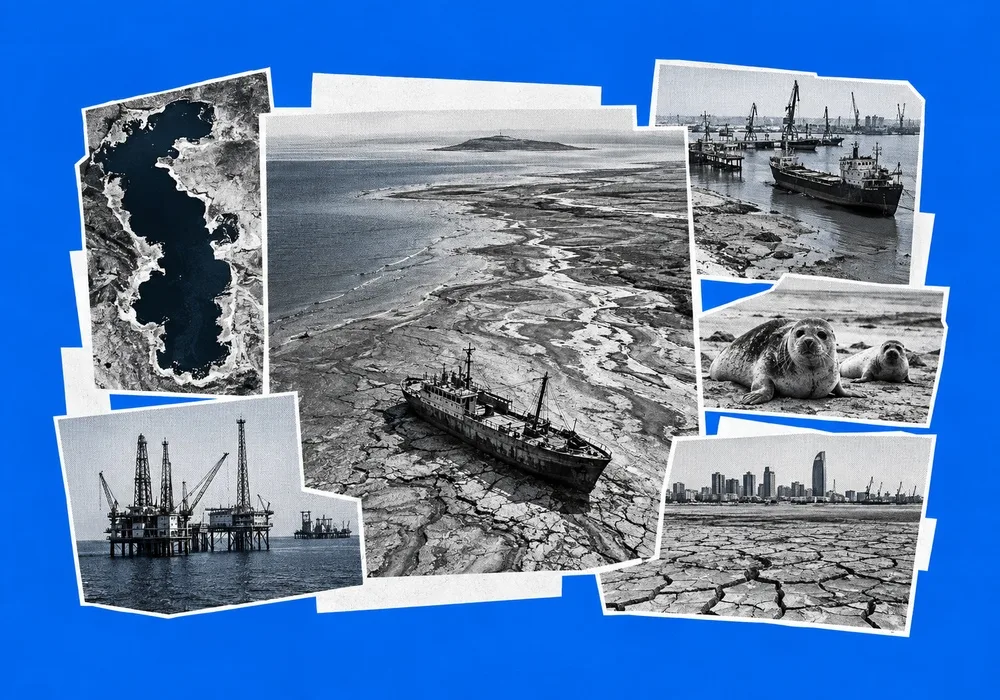
A new island has emerged in Kazakhstan’s sector of the Caspian Sea as water levels continue to decline. The retreat is reshaping the northern coastline, threatening ecosystems and creating new risks for ports, energy infrastructure and transport routes linking Central Asia with Europe.
A new island has emerged in Kazakhstan’s sector of the Caspian Sea as the water level continues to fall, providing a visible sign of a transformation that has been developing for decades. The newly exposed land near Kulaly Island is part of a broader retreat of the northern Caspian coastline, where shallow waters make even relatively small changes in sea level capable of dramatically altering the geography of the basin.
The emergence of new islands is not itself the main concern. The deeper issue is that the Caspian is losing water in a region where the sea supports fisheries, ports, shipping, wildlife and energy infrastructure. Environmental researchers warn that continued decline could fundamentally change the northern part of the basin, with consequences extending well beyond Kazakhstan’s coastline.
A sea whose geography is changing
The Caspian has always experienced natural fluctuations in its water level, but the current decline is increasingly associated with a combination of climate change and human activity. Rising temperatures increase evaporation, while changes in precipitation and river flows reduce the amount of freshwater entering the basin. Human consumption of water, particularly in the rivers feeding the Caspian, adds another pressure to an already changing water system.
The Volga is particularly important because it provides more than 80% of the Caspian’s river inflow. Changes in the river’s flow therefore have consequences for the entire sea. Reservoirs, agricultural demand and other forms of water consumption can alter how much water ultimately reaches the Caspian, while warmer temperatures increase evaporation across the basin.
The decline has become particularly pronounced in Kazakhstan’s northern sector. Measurements cited by Euronews show that the Caspian’s level in Kazakhstan’s sector fell from around 26.82 metres below sea level in 1996 to approximately 29.27 metres below sea level in 2025. Monitoring at Kulaly indicates that the decline has continued in 2026.
Because the northern Caspian is extremely shallow, falling water levels have an outsized geographical effect. Large areas of seabed can become exposed after a relatively modest retreat of the water. Researchers estimate that a five-metre decline could expose tens of thousands of square kilometres in the northern Caspian, potentially transforming coastal ecosystems and creating new land where there was previously open water.
The environmental consequences are already visible
The changes are particularly significant for the Caspian seal, an endemic species found nowhere else in the world. Its population has declined dramatically over the past century, and the shrinking sea is reducing and altering the habitats on which the animals depend.
Newly exposed islands can initially provide valuable refuges for wildlife because they are isolated from human activity. But as the water continues to retreat, some of these islands can eventually become connected to the mainland. That removes the protection provided by isolation and can bring wildlife into greater contact with people, infrastructure and other sources of disturbance.
Climate change is creating an additional problem. Caspian seals depend on suitable ice conditions for breeding, while warmer winters are reducing the availability and stability of ice in parts of the sea. The combination of shrinking water levels, changing ice conditions and increasing human activity is therefore placing pressure on the species from several directions at once.
The consequences extend beyond seals. Changes in the coastline and wetlands can affect fish stocks, migratory birds and other species that depend on the Caspian’s shallow-water ecosystems. As the sea retreats, the ecological boundaries of the basin are effectively being redrawn.
A growing economic and infrastructure problem
The shrinking Caspian is also becoming an economic issue for the countries around it. Ports and maritime infrastructure were built on the assumption that the coastline and navigable channels would remain broadly stable. Continued retreat could make some shallow-water areas increasingly difficult to use, forcing countries to invest in dredging, relocate infrastructure or redesign transport routes.
This is particularly relevant for Kazakhstan and Azerbaijan, whose economic strategies increasingly depend on the Caspian as a transport corridor connecting Central Asia with the South Caucasus and Europe. The Trans-Caspian transport route has gained importance as European and Central Asian states seek alternatives to routes passing through Russia. A changing Caspian therefore creates a new vulnerability for infrastructure that is becoming strategically more important.
The problem also affects the energy sector. The Caspian basin remains one of the world's major oil and gas regions, while offshore facilities, pipelines, ports and supply routes depend on predictable maritime conditions. A rapidly changing coastline can complicate the operation and long-term planning of this infrastructure.
The Aral Sea comparison
The decline has inevitably revived comparisons with the Aral Sea, although the two situations are not identical. The Aral Sea was devastated primarily by large-scale diversion of its feeder rivers for irrigation, while the Caspian is influenced by a much more complex combination of climate, river flows and human water consumption.
The comparison is nevertheless important because it demonstrates how quickly the geography and economy of a major inland body of water can change once its water balance is disrupted. In the northern Caspian, the danger is not necessarily that the entire sea will disappear, but that large shallow areas could undergo a profound ecological and economic transformation.
That distinction matters for European policymakers. The Caspian is increasingly connected to European interests through energy supplies, trade corridors and the diversification of transport routes linking Europe with Central Asia. A major change in the sea's geography could therefore affect infrastructure and supply chains far beyond the immediate coastline.
A problem that requires regional coordination
The Caspian is shared by Kazakhstan, Russia, Azerbaijan, Iran and Turkmenistan, making unilateral solutions difficult. Azerbaijan and Kazakhstan have already begun closer cooperation on monitoring the decline and assessing its causes, while the Caspian states are working on broader environmental and adaptation measures.
The challenge is that the countries around the sea have different economic priorities. Some depend heavily on hydrocarbons, others on shipping and trade, while Kazakhstan and Iran also face significant agricultural and water-management pressures. Managing the Caspian therefore requires balancing economic development with increasingly limited water resources.
The newly emerged island is consequently more than a geographical curiosity. It is a physical marker of a changing water system whose consequences are likely to accumulate gradually: retreating shorelines, altered ecosystems, pressure on ports and shipping, and increasing competition over water. For Europe, the significance lies in the fact that the Caspian is becoming an increasingly important link between European markets and Central Asia at precisely the moment when its physical environment is becoming less predictable.
Sources: Kazakhstan Prime Minister’s Office, UNDP Kazakhstan, Azerbaijan Ministry of Ecology