
Zelenskyy and Magyar Hold First Official Meeting in Brussels After Hungary Lifts EU Accession Veto

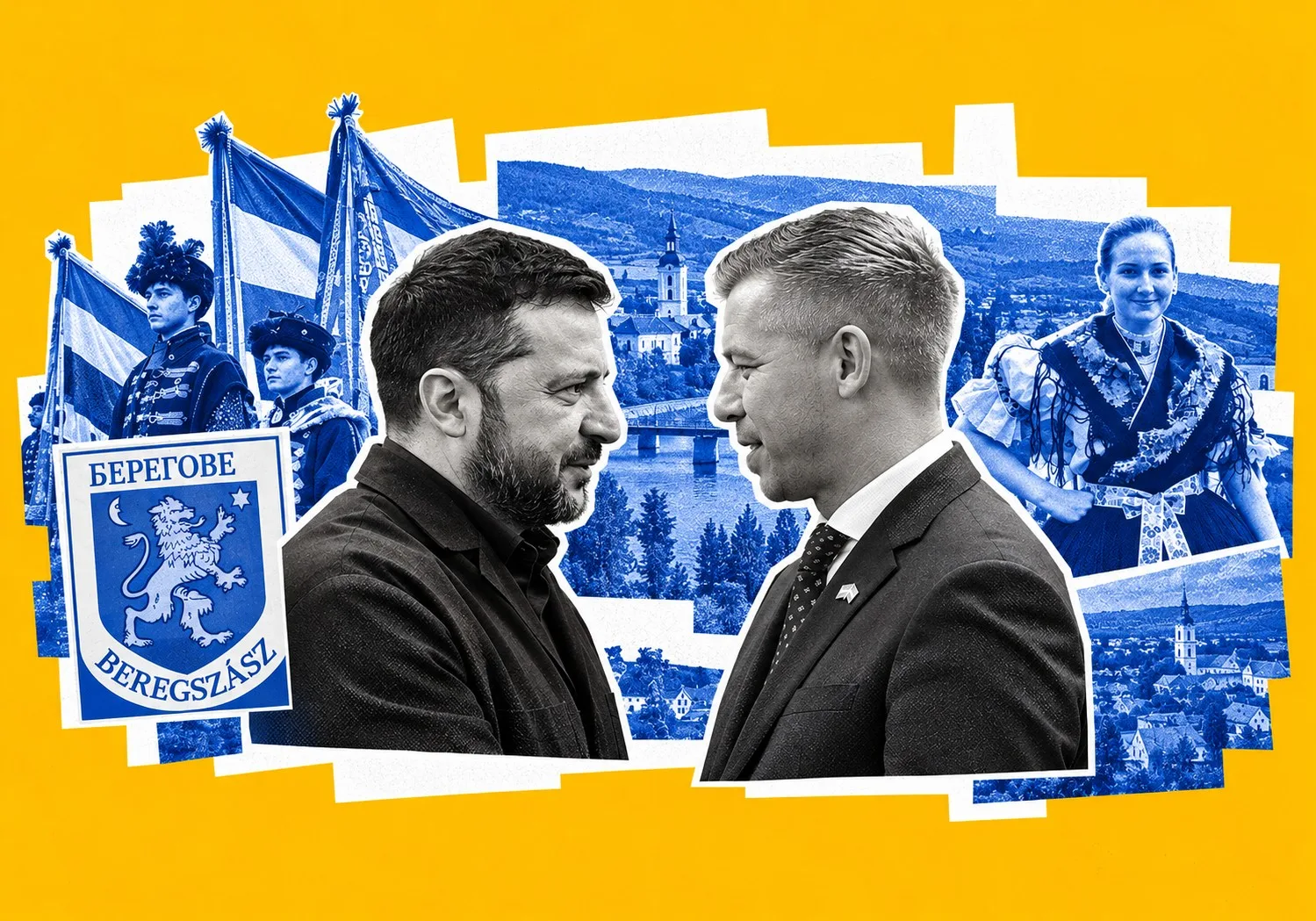
Their 15-minute conversation on the sidelines of the European Council summit followed a major procedural shift in Luxembourg two days earlier, where Hungary formally withdrew its veto on Ukraine’s European Union accession framework, allowing the opening of negotiating clusters two and three. The encounter in the Council building was the first face-to-face meeting between Zelenskyy and Magyar since Kyiv passed new national minority education legislation on October 12.
Speaking to journalists in Brussels following their meeting, President Zelenskyy emphasized the necessity of mutual diplomatic compromise, stating: "This is important, confidence for the neighbours, for the nations, for our relations. We are grateful to all the partners who opened two clusters for us. We are grateful that Hungary also supported these respective steps."
Zelenskyy characterized the discussion as "very good."

"We talked about many things. About relations, the economy, logistics. All of this is necessary between our states," Ukrainian president said.
In a post on social media, Zelenskyy noted that their discussions addressed broader diplomatic efforts to end Russia's war, economic cooperation, trade, and agricultural products, concluding.
"Ukraine always stands for good-neighbourly relations and mutual strengthening. We agreed to resume joint work at various levels and to exchange visits. Our teams will work out the dates," Zelenskyy wrote.
The sequence of events leading to the summit began in the Ukrainian Parliament - Verkhovna Rada.
On October 12, Ukrainian lawmakers passed new legislation amending national education laws, securing 273 votes in principle and 266 votes in its final reading before President Zelenskyy signed it into law.
The legislation alters statutory safeguards regarding language, education, and public administration for the more than 100,000 ethnic Hungarians living in Ukraine's Zakarpattia region.

Following the vote in Kyiv, Hungarian objections were cleared. On October 14, at intergovernmental conferences held in Luxembourg for Ukraine and Moldova, representatives of the 27 EU member states officially opened Clusters 2 and 3.
These domains govern single-market integration, state competition, and the free movement of goods and services.
With Cluster 1 ("Fundamentals") already open since June 15, Ukraine now has four of its six negotiating clusters active.
This sequence reflects a departure from the strategy of former Hungarian Prime Minister Viktor Orbán, whose administration consistently tied Ukraine’s EU progress to minority disputes while opposing European consensus on military aid, energy sanctions, and funding during the ongoing war.
Péter Magyar’s approach focuses instead on structured legal agreements and administrative compliance.
Speaking to reporters in Brussels on October 15, Magyar addressed the practical outcomes of the talks: "Everyone can see the historic success we have achieved in just a few weeks, because we have strengthened the rights of the Hungarian minority in Transcarpathia as regards education, language use and administrative procedures."
"Ukraine was able to start negotiations because the previous government, Orbán's government, approved it. But that fact alone means nothing. This could take a long time," Magyar noted.
The Evolution of the Bilateral Legal Dispute
The legal landscape governing minority education in Ukraine has undergone several statutory revisions over the past decade, forming the basis of the diplomatic negotiations between Budapest and Kyiv.
Articles 10 and 53 of the 1996 Constitution of Ukraine guarantee national minorities the right to receive education in their native language or to study their native language. However, subsequent legislative acts narrowed the interpretation of these rights in public institutions.
Primary statutes passed in 2017 restricted native-language instruction mainly to preschool and primary school levels, introducing mandatory Ukrainian-language quotas for secondary education.
This was reinforced by language legislation in 2019, which established the primacy of the state language across public administration, customer service, and educational institutions, while creating the office of the Commissioner for the Protection of the State Language.
Further adjustments occurred under secondary education legislation in 2020.
That statute mandated that in grades 5 through 9, instruction could occur in a minority language except for subjects such as Ukrainian language, Ukrainian literature, and History of Ukraine. In grades 10 through 12, the subject "Defense of Ukraine" was also required to be taught exclusively in the state language.
To address European Commission benchmarks and bilateral friction, the Verkhovna Rada passed amendments to minority framework laws in December 2023. That act amended seven existing laws, removing the fixed cutoff date for minority-language secondary education for official EU languages and reducing media quotas for minority languages to 30 percent.
However, specific administrative details remained unresolved, leading to further bilateral expert talks throughout 2024 and 2025.
The 11-Point Demand List and Executive Implementation
The administrative trail leading to the October 2026 agreement traces back to January 29–30, 2024, when Hungarian diplomats delivered an 11-point list of requirements during negotiations in Uzhhorod.
This document was complemented by a joint statement issued on May 19, 2026, by László Brenzovics and László Zubánics, presidents of the Cultural Alliance of Hungarians in Subcarpathia (KMKSZ) and the Democratic Union of Hungarians in Ukraine (UMDSZ).
Their statement outlined four core requirements: predictable conditions for Hungarian-language education, guaranteed school-leaving examinations in minority languages, parliamentary representation reflecting local demographics, and cultural self-government regarding national symbols.
By June 3, 2026, an expert-level bilateral agreement was finalized and subsequently approved by both governments on June 12.
The agreement established "minority school" as a distinct legal status, allowed free use of minority languages between students and teachers, mandated bilingual institutional signage, required minority-language proficiency for school principals, and guaranteed translated high school exit examinations.
Kyiv incorporated these commitments into its official EU-monitored minority action plan adopted in May 2025.
This plan contains 122 numbered measures monitored directly by the State Service of Ukraine for Ethnopolitics and Freedom of Conscience.
In June 2026, the Cabinet of Ministers further amended this action plan to align with the bilateral agreement. Subsequent executive actions included decrees in July 2026 that exempted schools operating minority-language classes in official EU languages from minimum pupil enrollment thresholds that would have otherwise threatened state educational subsidies under earlier funding rules.
Accession Conditionality and the Cluster Framework
European integration rules dictated the timing and structure of these legislative actions.
Point 40 of the EU’s June 21, 2024 negotiating framework explicitly required Ukraine to implement an inclusive national minority action plan and execute bilateral agreements with member states in good faith.
The architecture of EU accession negotiations relies on a cluster system where progress in Chapter 23 ("Judiciary and Fundamental Rights") governs the pace of the entire process.
Because Chapter 23 forms part of Cluster 1 ("Fundamentals"), opened on June 15, 2026, the European Commission established interim benchmarks requiring verifiable legislative compliance before further clusters could proceed.
Under these rules, Cluster 1 is both the first to open and the last to close, functioning as the primary mechanism through which member states evaluate a candidate country's adherence to rule-of-law standards.
The passage of the education law on October 12 provided the legal basis for Hungary to withdraw its objections at the EU Committee of Permanent Representatives.
This enabled the October 14 Luxembourg intergovernmental conference to open Cluster 2 ("Internal Market") and Cluster 3 ("Competitiveness and Inclusive Growth").
These clusters encompass complex regulatory alignment regarding the free movement of goods, capital, and labor, as well as intellectual property law, financial services, and competition policy.
Post-Meeting Assessments and Political Positions
In a social media statement following the October 16 meeting in Brussels, Prime Minister Magyar confirmed that both sides had evaluated the educational reforms as an essential preliminary step.
"As a first step towards restoring mutual trust, we assessed that the Parliament of Ukraine adopted the law on minority education based on the agreement, and that the Ukrainian side immediately began its implementation," Magyar wrote.
Magyar added that he had assured Zelenskyy of his "full solidarity with the inhuman Russian aggression against her country that has been going on for almost five years," while confirming that both countries had agreed to put political and economic relations on a new footing.

Magyar’s position remains distinct from his predecessor's approach to foreign policy.
In a prior interview with Rzeczpospolita, Magyar outlined his stance on minority rights and European integration: "Every country, including Ukraine, has the right and duty to defend its territorial integrity and independence. However, our situation in Hungary is unique. We have a Hungarian minority living in Ukraine that lacks basic rights... We are talking about the right to language, culture, and administrative autonomy."
When asked whether granting these rights served as a prerequisite for Hungary agreeing to start accession negotiations, Magyar stated that hhis is an indispensable condition/
"The first chapter of accession negotiations, after all, concerns the rule of law and democracy. If you want to join the European club, you must respect these rights," Hungarian PM said.
From the Ukrainian perspective, securing the opening of Clusters 2 and 3 allows technical integration with the European single market to proceed alongside ongoing war operations.
The parliamentary vote on the education law demonstrated legislative consensus in Kyiv, passing with 273 votes in principle and 266 in full.
Additionally, Magyar expressed appreciation for a resolution passed by the Verkhovna Rada in September 2026, which formally recognized historical grievances regarding forced labor and mass deportations affecting Transcarpathian Hungarians between 1944 and 1946.
Operational Implementation and Planned Visits
With the diplomatic veto lifted and negotiating clusters opened, attention is turning toward operationalizing the agreement in Zakarpattia.
Local administrative bodies and educational institutions must adjust to the new statutory frameworks governing bilingual signage, principal appointments, and exam translations.
Further consultations at the ministerial level are scheduled to oversee the implementation of these provisions across local municipalities.
Direct diplomatic exchanges between Budapest and Kyiv are also scheduled to expand.
Ukrainian officials confirmed that President Zelenskyy received an official invitation to visit Budapest on October 23, 2026, to attend events commemorating the 70th anniversary of the 1956 Hungarian Revolution.
The historical context of the 1956 revolution, during which Hungarian student demonstrations against Soviet forces developed into a national uprising that was suppressed by the Red Army, forms a backdrop for the proposed bilateral meeting in Budapest.
The continuation of these administrative and diplomatic processes remains tied to technical monitoring conducted by the European Commission under Chapter 23.
While the opening of Clusters 2 and 3 allows regulatory negotiations to proceed in Luxembourg and Brussels, long-term accession progress requires continuous verification of statutory enforcement across Ukraine's legal and administrative systems.
Sources: Euronews, Ukrainska Pravda