
Serbian President Aleksandar Vučić Led 'Illegal' Push for $500m Belgrade Trump Tower, Investigation Shows

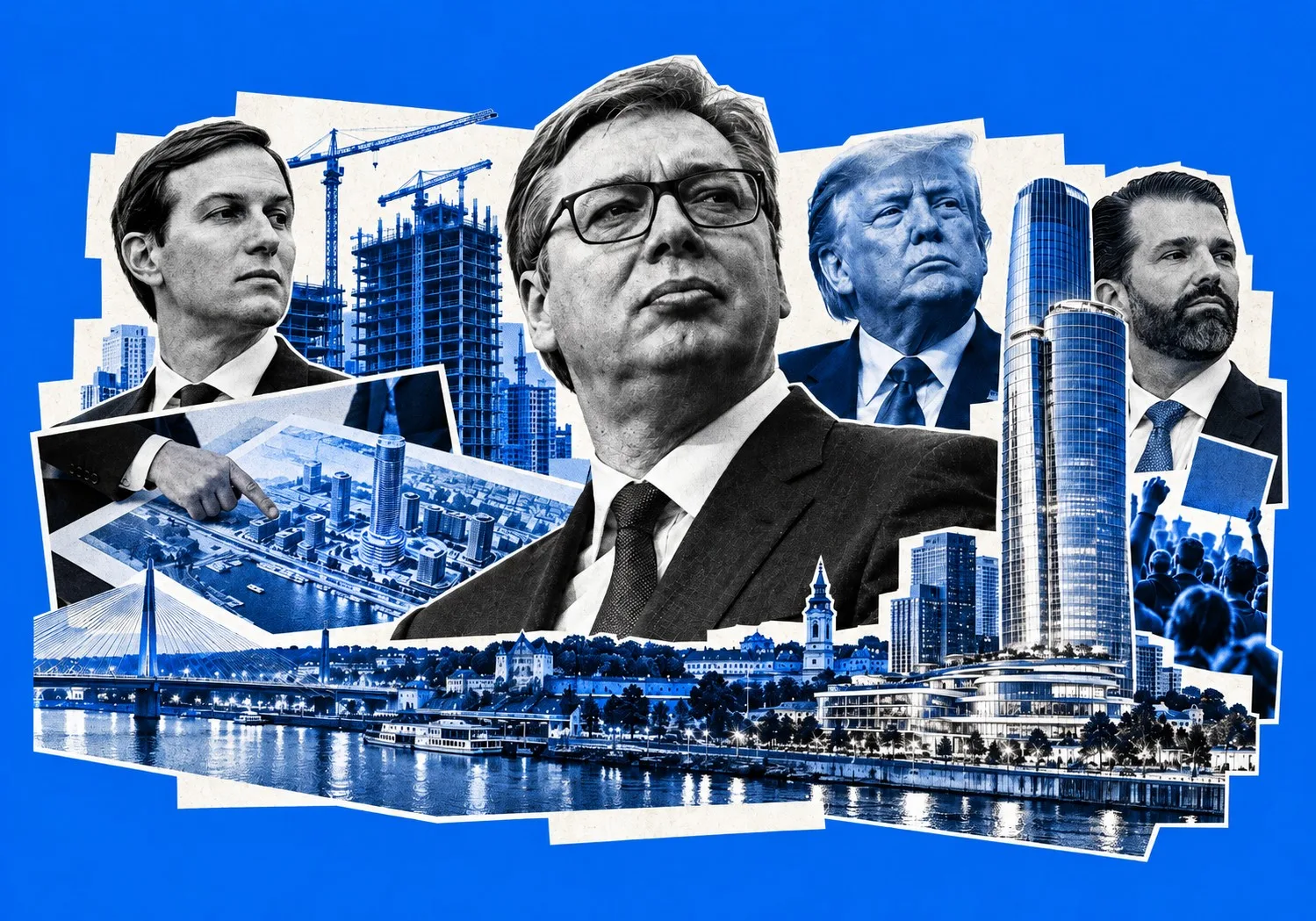
Serbian President Aleksandar Vučić personally intervened in a secret and allegedly illegal effort to push forward a $500m Trump-branded real estate project in Belgrade, an investigation by The Guardian has revealed. Leaked documents and former official testimony show Vučić directly pressured heritage authorities to strip legal protections from a historic site intended for Jared Kushner’s development firm, triggering a political crisis ahead of Serbia’s snap election on October 25.
The mechanics of this executive pressure trace back to an unrecorded meeting inside the presidential palace on February 6, 2024.
President Vučić summoned Dubravka Đukanović, then head of Serbia’s national Institute for the Protection of Cultural Monuments, demanding she rescind cultural heritage protections covering the former Yugoslav Army General Staff complex in central Belgrade.
The site—a landmark of modern Serbian architecture heavily damaged by NATO airstrikes in 1999—was legally protected, a status Vučić himself had publicly endorsed as recently as 2016.

Yet according to sources quoted by The Guardian, when Đukanović and her colleagues explained that arbitrary removal was legally impossible without expert review, the president’s tone turned hostile.
Accusing the preservation officers of being lazy and incompetent, Vučić delivered a clear directive: comply or leave.
The administrative coercion escalated three months later.
On May, 2024, the Serbian government signed a formal agreement with Jared Kushner’s investment firm, Affinity Partners.
Terms of the contract, reviewed by journalists, explicitly committed the Serbian state to stripping the site's heritage designation "to the satisfaction" of Kushner’s company—all while granting the firm a 99-year lease free of charge.

Within days of the signing, Finance Minister Siniša Mali summoned Đukanović and Olivera Vučković, Belgrade’s top heritage officer, to enforce the deal.
When both women refused to execute what they viewed as an illegal administrative order, Mali repeated the ultimatum.
They complied by resigning.
In her formal resignation letter obtained by The Guardian, Đukanović made her stance explicit, writing that she could not accept "inappropriate interventions" that would destroy an architectural complex of incalculable value to national identity.
To replace her, the regime installed Goran Vasić.
According to subsequent prosecutorial findings, Vasić promptly produced forged expert evaluations to legally invalidate the site's historical significance.
By November 2024—just ten days after Donald Trump won the US presidential election—the government formally announced the removal of the site's protected status.
Two months later, Eric Trump told The New York Times that the Trumps and Kushners were uniting on their first joint venture, officially designating the planned luxury skyscraper as a Trump brand property.
Prosecutorial Indictments and Executive Omissions
Then came Novi Sad.
In November 2025, a concrete canopy collapsed at the Novi Sad railway station, killing 16 people.
The disaster ignited mass anti-corruption demonstrations across Serbia under the banner "Serbia or mafia."
Facing immense public outrage, organized-crime prosecutors in Belgrade launched an independent inquiry into the General Staff transaction.
In December 2025, prosecutors took the unprecedented step of indicting Culture Minister Nikola Selaković and heritage chief Goran Vasić for abuse of public office.
It marked the first time a sitting minister in Vučić’s twelve-year administration faced criminal prosecution.
With legal scrutiny mounting, Kushner’s firm announced the project would not proceed "at this time." Vučić reacted furiously, denouncing prosecutors as "corrupt gangs" staging a coup and promising personal retaliation, while consistently denying any wrongdoing regarding the project.
Crucially, however, The Guardian discovered a glaring omission in the legal filings.
While the court indictment details Finance Minister Mali’s pressure on preservation officers, it makes no mention of Vučić’s initial, decisive strategy meeting in February 2024.
Questioned by The Guardian about this gap, a spokesperson for the organized-crime prosecutors' unit confirmed that state investigators do hold evidence regarding Vučić’s February meeting, adding that pretrial proceedings remain active to assess the criminal liability of additional figures.
Appearing in court in April 2026, indicted Culture Minister Selaković defended the deal, testifying that he viewed the proposed development purely as an economic opportunity for the nation.

Overriding the Judiciary Through Special Law
Faced with active court indictments that stalled the development, Vučić’s parliamentary majority executed a classic legislative end-run around the judicial branch.
Rather than awaiting trial outcomes, the government introduced emergency legislation specifically designed to clear the General Staff site for construction.
By passing the special law, the ruling party effectively invalidated the statutory basis of the ongoing prosecutions, overriding standard heritage protection frameworks in a single parliamentary vote.
The legislative bypass provoked fierce condemnation across Serbia’s political spectrum, as reported by the BBC and Politico Europe.
Opposition MP Aleksandar Jovanović Ćuta labeled the vote an unconstitutional crime, warning that a national memorial was being traded away for "casinos and Jacuzzis."
Centre-left politician Marinika Tepić similarly stated that the ruling party was sacrificing national history simply "to please Trump."
Anti-corruption group Transparency Serbia and national architectural associations voiced parallel concerns, arguing that using bespoke legislation to override general regulatory laws sets a dangerous precedent for the rule of law.
Interviewed by the BBC, Vučić mounted a firm defense of the parliamentary vote and rejected all allegations of illegality.
He argued that it was vital for Serbia to "overcome the burden from 1999," arguing that cultivating deeper political and economic alignment with Washington was paramount for the country's national interest.
To solidify his position ahead of further judicial exposure, Vučić called a snap parliamentary election for October 25, stepping down from the presidency to run for prime minister. The political maneuver effectively ensured that court hearings where witnesses might testify about his direct involvement were pushed back until after the polls close.
Corporate Denials and Transnational "Pay-to-Play" Dynamics
For their part, the commercial entities involved in the Belgrade development have consistently rejected claims of improper political influence.
A representative for the Trump Organization told The Guardian that the company had no plans to develop projects in Belgrade, was never involved in acquisition negotiations, and possessed no knowledge of alleged legal infractions in Serbia.
Spokespersons for Jared Kushner’s firm similarly dismissed suggestions of a "pay-to-play" arrangement as "categorically false." They described the project as a commercial effort to transform a site linked to a painful historical chapter into a symbol of economic opportunity, maintaining that Kushner had zero involvement in internal Serbian government decisions regarding the building’s heritage status.

Ethics experts and regional correspondents cited by The Guardian, however, view the Belgrade deal as part of a wider, systematic pattern surrounding the second-term Trump administration.
Kathleen Clark, a government ethics lawyer at Washington University School of Law, observed that discarding foreign business restrictions dramatically lowers the barrier for foreign leaders seeking to purchase presidential goodwill.
The Guardian documented a series of parallel transactions across the globe:
- Vietnam: Rapid regulatory clearances for a $1.5bn resort venture coincided with halved US tariffs.
- Saudi Arabia: Massive sovereign capital injections into Kushner's investment fund preceded major US fighter jet sales.
- The Gulf: Digital currency partnerships with Trump family ventures aligned with granted access to restricted US microchip technology.
In each case, foreign executives and political leaders secured direct lines of communication to the White House.
For Serbia, the geopolitical stakes are acute.
Vučić’s government faces looming economic pressure from US tariffs alongside Western enforcement actions targeting Russian interests in the country, including the majority Russian-owned national oil refinery, NIS.
Additionally, Belgrade remains deeply reliant on external diplomatic leverage regarding Kosovo.
Against this backdrop, Donald Trump Jr. made repeated high-profile visits to Belgrade, appearing on political broadcasts to echo regime talking points and accusing anti-corruption protesters of weaponizing the Novi Sad disaster.
All eyes are now turned to Serbia’s parliamentary election on October 25, where President Aleksandar Vučić is running for prime minister after stepping down from the presidency, seeking to retain his decade-long grip on power amid escalating legal and political friction.
Political analysts and legal observers suggest that his campaign for the prime minister's office is driven by a strategic need to secure political immunity and institutional cover against potential criminal investigations into his executive actions while serving as president of Serbia.
Sources: The Guardian, BBC