
Russia Extends State Control Over European Companies as Tensions With the EU Deepen

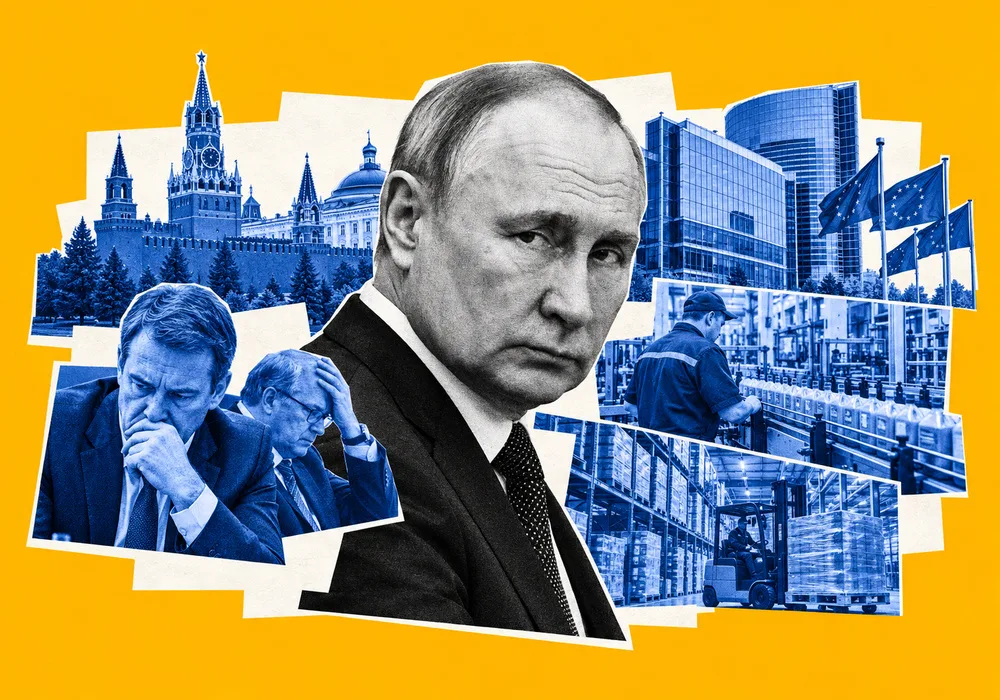
Moscow has placed the Russian assets of several more European companies under temporary state management, widening the risks for Western investors as the Kremlin links economic retaliation to the EU’s support for Ukraine. The move adds pressure on European businesses still operating in Russia and raises further questions about the protection of foreign property, the future of frozen Russian assets and the economic consequences of the confrontation between Moscow and the West.
Russia has moved to place the Russian assets of several European companies under temporary state management, extending a policy that has increasingly exposed foreign businesses to political decisions by the Kremlin. A decree signed by President Vladimir Putin on 15 October covers assets associated with French flooring manufacturer Tarkett, German packaging company Menshen, Swedish company Sverige International Holdings and Dutch packaging business Sonoco. The measure was announced on 16 October, as European Union leaders gathered in Brussels for a summit attended by Ukrainian President Volodymyr Zelenskyy.
The latest decision follows similar interventions affecting major international businesses in Russia. In September, Russian authorities placed assets associated with Swiss food producer Nestlé and French retailer Auchan under temporary management, alongside other foreign-owned operations, including German retailer Metro. The expansion of the measures across different industries indicates that European corporate ownership remains exposed to the deteriorating political relationship between Moscow and Western governments, even where the companies involved are not directly connected to defence or energy.
Temporary management is distinct from a formal nationalisation of assets, but its practical consequences can be significant. Once the Russian state intervenes in a company's local operations, the foreign owner may lose effective control over management decisions, the use of facilities and the commercial direction of its business. The ultimate outcome can depend on subsequent government decisions, including whether the assets are returned, sold or remain under external administration.
The Kremlin has described the measures as reversible and presented them as a response to European countries' role in the war in Ukraine. However, the prospect of eventual reversal does not eliminate the immediate uncertainty facing affected companies. For investors, the central concern is whether ownership rights can be exercised independently of political developments and whether assets can be recovered without substantial financial losses.
From Corporate Exits to State Intervention
The latest decree illustrates the growing difficulty of disentangling European business interests from the political confrontation between Russia and the West. Since Russia launched its full-scale invasion of Ukraine in February 2022, international companies have faced mounting pressure to reconsider their presence in the Russian market. Some withdrew, others sold local subsidiaries, and several reduced their operations while attempting to protect employees, contractual commitments and remaining investments.
Leaving Russia has not always been straightforward. Companies have had to navigate restrictions on transactions, requirements for government approval, potential discounts on the sale of assets and uncertainty over whether proceeds could be transferred abroad. In some cases, businesses that sought to withdraw have faced conditions that substantially reduced the value they could recover. For those that remained, the risks have increasingly included direct state intervention.
This has created a difficult choice for companies with significant local operations. An early exit can mean accepting substantial losses, particularly when a business has invested heavily in production facilities, distribution networks and local infrastructure. Remaining in the market, however, can leave those investments vulnerable to further political decisions. The longer the confrontation continues, the more difficult it becomes to calculate the commercial value of maintaining a Russian presence.
The distinction between companies that have withdrawn and those that continue operating is also becoming less decisive. Even businesses that have attempted to restructure their ownership or reduce their exposure may find that their Russian assets remain subject to state action. The latest measures reinforce the possibility that commercial arrangements, corporate structures and the nationality of an ultimate owner may not provide sufficient protection against political intervention.
For European executives, this changes the calculation behind future investment decisions. Russia is not simply a market where sanctions increase compliance costs or where demand becomes difficult to predict. It is a jurisdiction in which geopolitical confrontation can directly affect control over property. That risk is likely to influence decisions about investment in other markets where governments have the capacity to intervene in foreign-owned businesses during periods of political tension.
Why the Measures Extend Beyond Energy and Defence
The companies affected operate in sectors that are not usually associated with the centre of the geopolitical confrontation. Tarkett manufactures flooring, while Menshen and Sonoco are involved in packaging. The inclusion of businesses in manufacturing and consumer-related supply chains demonstrates that the exposure of European firms in Russia extends well beyond industries directly connected to military capabilities or strategic energy resources.
This matters because industrial businesses often depend on long-term investment and specialised production infrastructure. Manufacturing facilities, equipment, distribution systems and established relationships with suppliers and customers cannot always be transferred quickly to another country. If control over such assets is restricted, the owner may lose not only the value of the property itself but also the commercial relationships and operational capabilities built around it.
Packaging and other industrial products also form part of broader supply chains. State intervention in local operations can disrupt production planning, contracts and the supply of goods to customers. The consequences may remain largely concentrated within Russia, but companies with international operations must also assess the implications for their wider business structures, particularly where subsidiaries, licensing arrangements or shared production networks connect different markets.
The inclusion of companies from France, Germany, Sweden and the Netherlands also gives the measures a broader European dimension. The affected businesses represent different national economies and industrial sectors, making it harder for governments to treat the issue as an isolated dispute involving one company or one bilateral relationship.
For European policymakers, the challenge is therefore both political and economic. Governments must maintain pressure on Russia over its invasion of Ukraine while addressing the risks faced by businesses whose assets remain in the country. They must also consider how these interventions affect the willingness of European companies to invest abroad and how future disputes over property rights could influence the broader European investment environment.
Frozen Russian Assets Add Another Layer to the Dispute
The expansion of Russian control over European corporate assets comes amid continuing tensions over Russian sovereign assets frozen in Western jurisdictions. The European Union has immobilised approximately €210 billion in Russian sovereign assets following the invasion of Ukraine. Their potential use to support Ukraine, including through arrangements involving the proceeds generated by the assets, has become a major legal, financial and political issue for European governments.
Moscow has repeatedly objected to Western measures against Russian property and financial resources. The Kremlin's latest intervention in foreign-owned businesses reinforces the retaliatory dimension of the dispute, in which assets located within the jurisdiction of opposing parties can become instruments of economic pressure.
The legal distinction between the two categories remains important. Frozen Russian sovereign assets are not equivalent to privately owned European companies operating in Russia. Sovereign reserves are subject to a different legal framework, while corporate assets involve ownership rights, commercial obligations, employees and local business operations. Nevertheless, both issues have become part of the wider struggle over the economic consequences of the war.
The possibility that Washington could seek a role in controlling some Russian assets frozen in Europe adds further uncertainty. Any such initiative would raise questions about the relationship between European control over assets held within EU jurisdictions and potential US involvement in future arrangements concerning Russia. It could also complicate coordination among Western governments if their preferred approaches to the use of frozen assets diverge.
For Moscow, the issue provides a means of framing its own interventions as retaliation for Western actions. For European governments, however, the challenge is to distinguish between lawful sanctions and financial restrictions on the one hand and the broader risks created by arbitrary intervention in private property on the other. The fact that both sides are using economic measures to exert pressure does not make their legal status or consequences identical.
The dispute also has implications for international financial confidence. Governments and companies monitor how states handle foreign property because such decisions affect expectations about legal certainty, investment protection and the political conditions under which capital can move across borders. If economic retaliation becomes a more permanent feature of relations between Russia and Western countries, the effects may extend beyond the assets already affected.
European Unity Faces a Test as Support for Ukraine Continues
The decree was announced ahead of Zelenskyy's appearance at the European Council summit in Brussels on 16 October. European leaders are confronting several interconnected challenges: sustaining military and financial assistance to Ukraine, preparing for further Russian attacks on Ukrainian infrastructure, strengthening European defence capabilities and maintaining political coordination as transatlantic relations become more complicated.
The timing places the measures against European companies within a wider period of confrontation between Moscow and Western capitals. However, the available reporting does not establish that the Kremlin's decision was directly coordinated with the summit or intended specifically to influence its outcome. The broader political context nevertheless highlights how economic pressure and the war in Ukraine increasingly overlap.
For the EU, continued support for Kyiv requires more than the allocation of financial assistance or the provision of military equipment. It also depends on the ability of member states to manage the wider economic consequences of the confrontation, including risks to companies, supply chains and investment. Russian interventions against European-owned assets can increase pressure on governments to consider how their policies affect national businesses, potentially creating disagreements over the balance between economic interests and strategic objectives.
Such pressures do not automatically translate into a weakening of European support for Ukraine. They do, however, create additional points of friction within the European political and economic system. Governments may differ over the appropriate response to Russian retaliation, the treatment of companies that remain active in Russia and the legal mechanisms available to protect European interests.
The issue also reinforces the importance of coordination among EU member states. If Russian authorities continue to target businesses associated with different European countries, a fragmented response could leave individual companies dependent on bilateral negotiations with Moscow. A coordinated approach could instead help governments assess common risks, exchange information and establish clearer expectations for businesses operating in high-risk jurisdictions.
At the same time, European governments face limits on what they can do to restore control over assets already placed under Russian management. Diplomatic pressure and legal action may be available, but neither guarantees a rapid resolution. The practical challenge is to protect remaining European interests while avoiding measures that undermine the legal and financial principles the EU seeks to defend.
The Long-Term Cost of Political Risk for European Business
The latest interventions point to a broader shift in the relationship between geopolitics and corporate risk. For decades, international businesses often treated access to markets, production capacity and commercial partnerships as decisions that could be assessed primarily through financial returns, regulatory requirements and operating costs. Russia's war against Ukraine has demonstrated the limits of that approach when a government's foreign policy becomes inseparable from its treatment of private enterprise.
European companies must now account for the possibility that political tensions can override ordinary commercial considerations. This affects not only decisions about whether to remain in Russia but also how businesses structure subsidiaries, protect intellectual property, diversify production and assess exposure to jurisdictions where state intervention is difficult to challenge.
The effects may also influence the behaviour of companies that have no direct presence in Russia. Businesses considering future investments in politically sensitive markets may place greater weight on legal protections, the enforceability of contracts and the ability to transfer profits or sell assets in a crisis. Those assessments can influence where new factories are built, how supply chains are organised and which countries are considered reliable long-term investment destinations.
For Russia, the use of temporary management allows the state to exercise control over foreign-owned assets while retaining the option of presenting the measures as reversible. Yet repeated intervention can further undermine investor confidence and make future efforts to attract international capital more difficult. Even if some assets are eventually returned or sold under negotiated arrangements, businesses may remain reluctant to commit new resources to a market where ownership rights appear vulnerable to political pressure.
The implications extend to the future of relations between Europe and Russia. Any eventual reduction in tensions would not automatically restore the pre-war commercial environment. Companies would have to assess whether assets could be recovered, whether outstanding disputes could be resolved and whether the legal conditions for operating in Russia had changed sufficiently to justify renewed investment. For some businesses, the costs and uncertainty associated with a return may outweigh the potential commercial benefits.
Russia's latest move therefore represents more than another intervention in a group of foreign-owned companies. It reinforces the use of corporate assets as a potential instrument of economic retaliation and adds to the uncertainty surrounding European business interests in Russia. As the EU continues to support Ukraine and debates the future of frozen Russian assets, the treatment of foreign-owned property is becoming another enduring dimension of the confrontation between Moscow and the West.
Sources: European Council, Reuters