
Putin Seizes Five More European Firms: How Russia Is Handing Western Assets to Its War Elite

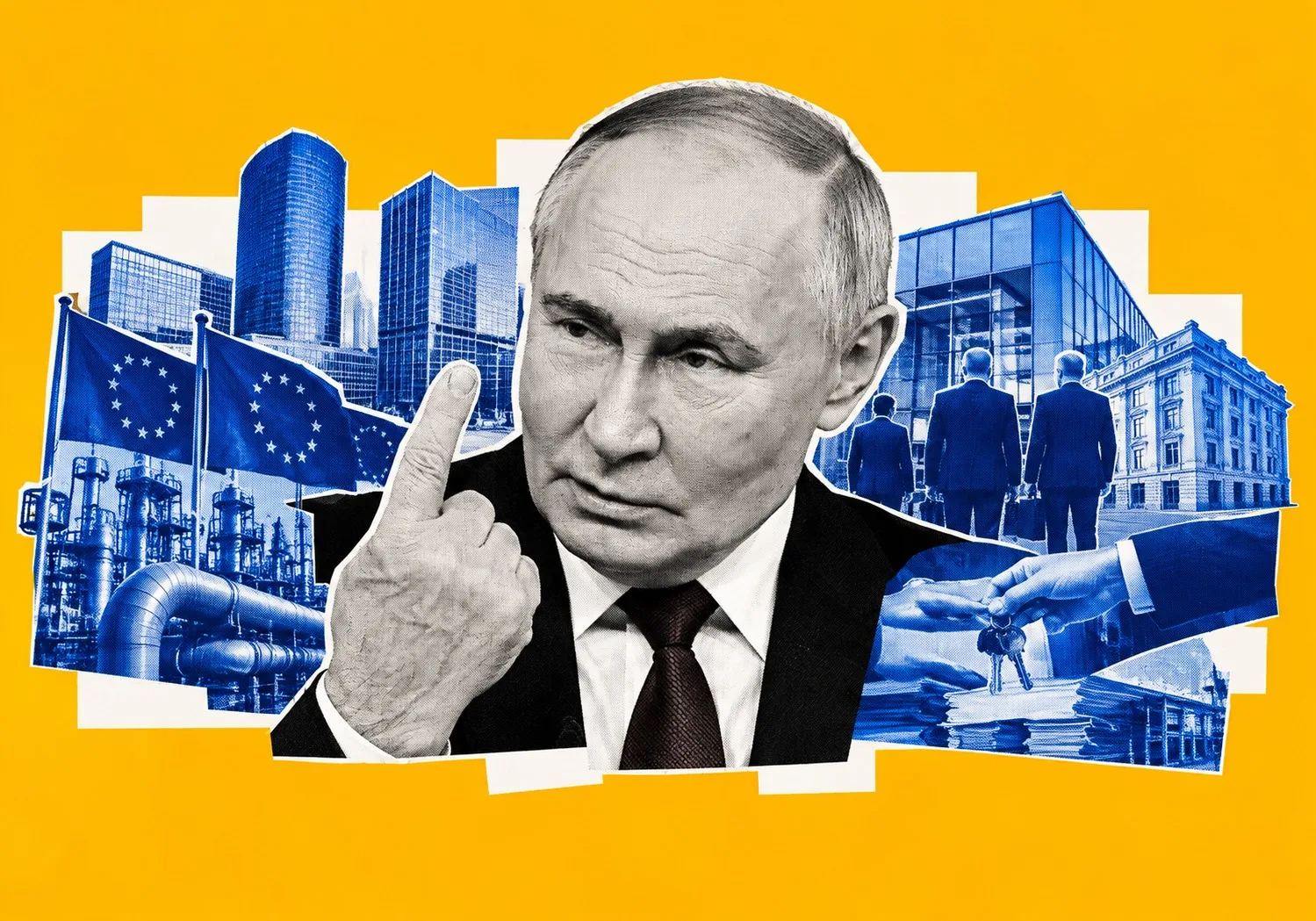
Russia’s compulsory takeover of five major European and American manufacturers on October 16 — including French flooring giant Tarkett, hygiene producer Ontex, and packaging makers Kappa Rus, Eviosys, and Menshen — marks a decisive escalation in Moscow’s campaign to expropriate Western assets. While official state media presented the presidential decree signed by Vladimir Putin as a routine administrative step, control of these multi-billion-ruble enterprises was transferred directly to Tsentr Kapital, a management company led by Marat Mirkhaydarov, a decorated veteran who recently returned from fighting in Ukraine.
Corporate executives across Europe had spent more than four years clinging to a comfortable fiction. They believed that paying local taxes, keeping a low profile, and maintaining strict regulatory compliance would somehow shield their Russian assets from state overreach following the 2022 invasion.
That strategy is now completely dead.
What the Kremlin is orchestrating today goes far beyond managing a diplomatic feud with Western capitals.
It is an aggressive, systematic redistribution of private property designed to construct a new militarised oligarchy — permanently embedding war veterans, security operatives, and political loyalists into the core of Russian industry.
From Retail to Heavy Industry
The targets of the October 16 decree signal a crucial operational pivot. In earlier phases of the crackdown, Moscow focused predominantly on high-profile consumer brands and retail chains.
Now, the state apparatus is carving up vital industrial supply chains.
Five major manufacturing operations were swept up in a single stroke: French flooring leader Tarkett, paper packaging producer Kappa Rus (formerly owned by Ireland’s Smurfit Kappa), Belgian hygiene maker Ontex RU, metal packaging unit Eviosys Packaging Kuban (a subsidiary of US-based Sonoco Products Company), and German plastics producer Menshen Packaging CIS.
The financial stakes involved are enormous.
Combined annual revenues across the five entities exceed 50 to 53 billion rubles — roughly €532 million or $633.2 million. Tarkett alone generated 19.3 billion rubles in 2025 from two massive Russian production sites, which form part of its 34-plant global network. Kappa Rus added 16.5 billion rubles to the total, Ontex RU brought in 10.3 billion, while Eviosys and Menshen accounted for 6.1 billion and 1.4 billion rubles respectively.
Unlike Western firms that staged hurried exits in early 2022, these corporations chose to remain fully operational.
They continued paying substantial taxes into the Russian federal budget and supplying domestic commercial markets, betting that their non-military, industrial profile would protect them.
It offered no protection whatsoever.
Mechanically, the Kremlin executed the seizure through the framework established by a foundational April 2023 presidential decree.
That law gives the state sweeping authority to impose "temporary administration" over assets owned by entities from designated "unfriendly countries." In reality, this terminology is mere legal camouflage. The regime strips foreign parent companies of every operational power, managerial vote, and dividend right they possess, leaving them holding worthless legal titles.
Western governments and international legal scholars naturally classify these decrees as unlawful expropriation.
But while parent companies can theoretically pursue international arbitration under bilateral investment treaties, enforcing any monetary judgment against Kremlin-backed management structures remains an exercise in futility.
The Expropriation Wave
This latest decree is not an isolated policy decision, but rather the continuation of a relentless autumn campaign. Just a month earlier, in September 2026, the Kremlin moved against Swiss food titan Nestlé and French retail giant Auchan, while simultaneously absorbing the domestic assets of German hypermarket operator Metro, home improvement chain Leroy Merlin, and packaging firm Aptar Europe Holding.

Kremlin spokesman Dmitry Peskov was uncharacteristically blunt when questioned by reporters at the time regarding the rationale behind the September seizures.
"We are talking about European companies from unfriendly countries," Peskov declared, directly linking the asset transfers to Western geopolitical backing of Kyiv and asserting that these states were "currently involved in the most active manner in military actions against our country."
Although Peskov avoided singling out Paris or Bern by name, Moscow’s broader position is that any nation supplying military hardware to Ukraine — France included — is an active participant in the hostilities.
Switzerland presents a slightly different case; while it supplies no weaponry to Ukraine, its strict mirror-alignment with European Union sanctions packages has earned it equal hostility from the Kremlin.
Responding to the seizure of its local plants, Nestlé confirmed it was assessing its options, though management declined to detail any immediate legal steps as the company's shares dropped 2.4% on global exchanges.
To manage those September targets, the state handed control of Nestlé and Auchan to L.E.V. Management.
Like many entities popping up in recent decree filings, L.E.V. is a obscure corporate vehicle set up shortly before the announcement, possessing no public operational history and widely reported by Russian media outlets to have strong ties to the federal security services.
The foundational blueprint for these takeovers was drafted back in 2023 with the high-profile seizures of Danish brewer Carlsberg and French dairy titan Danone.
Since then, the Kremlin has methodically refined its playbook.
Beyond outright seizures, authorities have used the regulatory apparatus to extract cash for state coffers through mandatory valuation discounts, exit taxes, and forced asset sales, all while handing lucrative operational mandates to regime insiders.
Estimates produced in 2025 by the Moscow law firm NSP indicate that the Russian state has seized over $50 billion worth of private property from foreign entities since the outbreak of the war.
The October decree proves beyond doubt that no foreign-owned industrial sector is safe from this pipeline of state-directed redistribution.
The Veteran Elite
If the scale of the financial seizure illustrates the depth of Russia's economic isolation, the choice of the new manager reveals its changing political order.
Operational authority over Tarkett, Kappa Rus, Ontex RU, Eviosys, and Menshen has not been entrusted to a seasoned industrialist or a career state bureaucrat.
It has been given to Tsentr Kapital Management Company — an entity registered in Moscow only eight months ago, in February 2026.
Tsentr Kapital is controlled entirely by 47-year-old Marat Mirkhaydarov.
On paper, Mirkhaydarov was a regional politician: the former deputy governor and chief of staff of the Zabaykalsky administration in Far Eastern Russia.

But in early 2024, he took a path that has since become the ultimate career fast-track in Russian public life: he volunteered for frontline deployment in Ukraine specifically by joining Chechnya’s notorious Akhmat paramilitary unit — the Kadyrovite force whose name has become synonymous with terror and brutality throughout the invasion.
Injured during a delivery mission near the front lines, Mirkhaydarov stepped down from his regional government position in March 2025 to undergo medical rehabilitation before re-emerging in Moscow to claim his commercial reward.
"I'm a patriot, I served in the special military operation. I have combat awards," Mirkhaydarov told journalists following news of the takeover, expressing understandable anxiety regarding his family's sudden exposure while making no secret of the military credentials that now command total deference in Moscow.
Handing a 53-billion-ruble manufacturing portfolio to a wounded veteran of the Kadyrovite forces is not a random administrative whim.
It is the direct, physical implementation of Vladimir Putin’s explicit command to construct a "new national elite" out of veterans returning from the Ukrainian front.
By transferring foreign industrial capital into the hands of decorated combatants, the Kremlin achieves two crucial domestic goals at once. It creates an immediate, highly visible reward system for wartime service, while simultaneously building a loyal executive class whose newfound wealth and social standing depend entirely on the survival of the current regime.
During his daily press briefing, Dmitry Peskov tied these forced transfers directly to Western policy, framing them as a necessary countermeasure against allied nations that continue to freeze between €210 billion and €300 billion in Russian sovereign assets.
"Their origin was one of the factors taken into account when making the decision," Peskov insisted to reporters. "We're talking about those countries that take part in illegally holding Russian money, Russian assets. These are countries that take part in the illegal expropriation of Russian companies' property."
Yet beneath Peskov’s predictable geopolitical posturing lies a far more aggressive domestic reality: the permanent, state-sanctioned destruction of property rights inside the Russian Federation.
Closed-Loop Economy
All of this property shuffling is taking place against the backdrop of a domestic economy operating under intense structural strain.
Nearly half of Russia's federal budget is currently gobbled up by military and security allocations.
To fund this massive war effort, the Kremlin has been forced to slash social programs and hike taxes across the board, pushing the main corporate profit tax rate from 20% to 25% in 2025, while layering on additional windfall taxes for heavy industry and fresh levies on securities trading.
Meanwhile, traditional corporate finance and equity markets are in a state of advanced decay.
Russia's benchmark MOEX stock index has shed 13.6% of its value in 2026 alone, extending a brutal 37% decline since late 2021 that included an unprecedented 19-week losing streak earlier this year.
The domestic stock market's total capitalization relative to GDP has cratered to roughly 20% — a staggering decline during four years of war that effectively kills off Putin's stated ambition of expanding equity markets to 66% of GDP by 2030.
Blue-chip, state-backed giants like VTB and Gazprom have seen their equity values plunge to multi-decade lows.
With global institutional capital gone for good and domestic retail investors lacking the deep pockets needed to anchor major capital raises, the Kremlin has largely abandoned normal market mechanisms.
Both Central Bank Governor Elvira Nabiullina and Finance Minister Anton Siluanov have repeatedly warned that investor confidence is fundamental to financial stability. Yet their warnings carry little weight against a political leadership determined to carry out arbitrary corporate takeovers.
In place of transparent markets, Russia is building a self-contained, closed-loop war economy.
Seized foreign factories provide ready-made industrial output, crucial packaging materials, and immediate cash flow. These assets are then directed through state-aligned entities and veteran executives to keep domestic supply chains functioning and help bankroll the war effort.
The lesson for any Western corporation still trying to navigate the Russian market could not be clearer. Paying your taxes won't save you. Obeying local laws won't save you. In today's Moscow, quiet neutrality is simply an invitation to expropriation.
Point of No Return
The strategic consequences for Western boardrooms and European capitals are permanent and irreversible.
Handing over critical manufacturing infrastructure to military veterans and security-linked management firms like Tsentr Kapital and L.E.V. Management officially closes the book on three decades of post-Cold War economic integration between Russia and the West.
Foreign companies cannot simply look forward to a time when diplomatic relations thaw, sanctions ease, and normal commercial operations resume. The physical facilities, corporate structures, and operational control that Western firms built over thirty years are being systematically dismantled and handed out as political spoils.
The new owners of these assets are people whose personal fortunes and social status are directly tied to the continuation of the war and the regime that waged it.
Sources: Euronews, Reuters, The Moscow Time