
Romania Faces Economic Contraction as Black Sea Security Concerns Grow

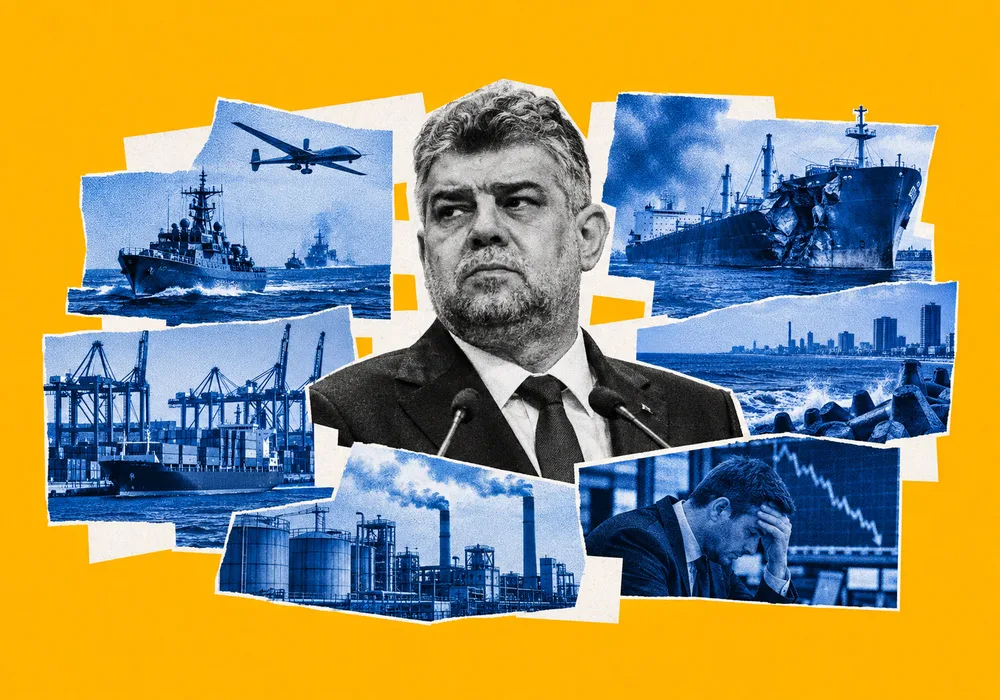
Romania faces a difficult combination of economic contraction, political uncertainty and growing security risks in the Black Sea. As Bucharest attempts to form a new government, pressure is mounting to stabilise public finances, strengthen regional security and maintain cooperation with European and transatlantic partners.
Romania is facing a challenging economic outlook, with the International Monetary Fund projecting a 0.5% contraction in 2026, a significant downgrade from the 0.7% growth forecast in April. Higher energy costs and fiscal consolidation measures are weighing on economic activity, while the country continues to struggle with a substantial external imbalance. The IMF expects Romania’s current account deficit to narrow only to around 7% of GDP this year, while unemployment is projected to rise from 6.1% in 2025 to 6.5% in 2026.
The revised outlook places additional pressure on Romania’s next government, which will have to balance the need to restore fiscal stability with the economic consequences of tighter public spending and higher costs for households and businesses. Fiscal consolidation is necessary to address persistent imbalances, but its effects can be particularly difficult to absorb when growth is already weakening. The government will also need to preserve investor confidence and ensure that budgetary constraints do not undermine essential public services or strategic investment.
The IMF expects the Romanian economy to return to growth of more than 2% in 2027, supported by recovering real incomes and easing inflation. However, this anticipated recovery remains dependent on economic conditions improving and the government managing the adjustment without creating further instability. For the European Union, Romania’s trajectory is relevant beyond its national economy: prolonged weakness in a member state on the Union’s eastern flank could complicate regional investment, infrastructure development and efforts to strengthen economic resilience.
Political uncertainty complicates economic decisions
The economic challenges coincide with a prolonged political impasse in Bucharest. Prime Minister-designate Luca Niculescu is expected to submit his governing programme and proposed cabinet to Parliament on 15 October, following consultations with political parties. He is the fourth candidate nominated since the minority government led by Ilie Bolojan was removed by a no-confidence vote on 5 May.
President Nicușor Dan has given Niculescu flexibility to negotiate a political coalition, a technocratic administration or a mixed government. The repeated failure of previous nominations to secure parliamentary approval has exposed the difficulty of building a stable governing majority. The immediate challenge is not simply to appoint ministers, but to establish a parliamentary arrangement capable of supporting decisions on the budget, economic reform and the country's broader strategic priorities.
The negotiations are taking place as Romania needs to revise its budget and prepare its financial plans for 2027. A government without reliable parliamentary support could struggle to deliver consistent fiscal policy, while prolonged uncertainty may complicate decisions for businesses and investors. The proposed administration will therefore face a dual test: securing enough political backing to govern and demonstrating that it can implement measures to address the economic downturn.
The structure of the new government will also influence how quickly Bucharest can respond to external security pressures. Romania's position on the Black Sea, its NATO membership and its role as a neighbouring state to Ukraine make political continuity particularly important. Economic recovery and security planning are not separate challenges when both depend on sustained public investment and a government capable of making long-term commitments.
Attacks on commercial shipping raise Black Sea security concerns
Security risks in the Black Sea have added another layer of pressure. Two separate attacks against commercial vessels near Bulgaria's coast overnight on 12 October prompted concern in Bucharest and across European and NATO institutions. Romania's acting prime minister, Ilie Bolojan, condemned the incidents as unacceptable violations of maritime and international law. Romanian President Nicușor Dan and Bulgaria's President Iliana Yotova were also expected to discuss the attacks directly.
The incidents highlight the vulnerability of commercial shipping in a region already affected by Russia's full-scale war against Ukraine. The Black Sea is an important corridor for trade, energy-related transport and agricultural exports, linking the economies of the wider region with international markets. Threats to civilian vessels can raise insurance costs, disrupt commercial planning and increase uncertainty for shipping operators even when the immediate damage is geographically limited.
The European Union has expressed solidarity with Bulgaria and warned that attacks on civilian and merchant shipping are escalating. European Council President António Costa also indicated that the issue, alongside the intensification of Russia's hybrid campaigns, would be addressed at the European Council meeting later in the week. This places maritime security within a wider debate about the protection of critical infrastructure and the ability of European countries to respond collectively to pressure on their eastern and south-eastern approaches.
The available information does not establish responsibility for the attacks. Nevertheless, the incidents reinforce the need for reliable maritime surveillance, information-sharing among coastal states and coordination between NATO and EU members. For Romania and Bulgaria, the challenge is to protect commercial activity without allowing repeated incidents to undermine confidence in Black Sea shipping routes. For the wider European economy, the stability of these routes remains important to trade and regional connectivity.
US military cooperation remains a strategic asset
Romania's security posture also continues to rely on close cooperation with the United States. On 14 October, Romanian officials received a C-130H Hercules transport aircraft transferred by the US government through the Excess Defense Articles programme. It is the eighth aircraft of this type to enter Romanian military service through the programme.
Transport aircraft are important for moving personnel and equipment, supporting logistics and responding to operational requirements across a large area. Their value extends beyond individual missions: military mobility and logistical capacity are essential components of a country's ability to sustain defence commitments and cooperate with allies. For a NATO member situated near Ukraine and the Black Sea, these capabilities contribute to the broader infrastructure underpinning collective defence.
The transfer also illustrates the practical dimension of the Romanian-American strategic partnership. Romania's security depends not only on diplomatic commitments but also on the equipment, infrastructure and operational cooperation that allow its armed forces to work with allied militaries. At a time of heightened concern about maritime security, continued investment in these capabilities remains relevant to the country's role on NATO's eastern flank.
At the same time, military cooperation cannot substitute for regional coordination. The recent attacks on commercial vessels demonstrate that the security of the Black Sea involves civilian shipping, economic infrastructure and international law as well as military preparedness. Romania's response will therefore require both sustained defence cooperation and effective coordination with Bulgaria and other regional partners.
Ukraine's minority-language reforms add a bilateral dimension
Romania's regional agenda also includes relations with Ukraine. President Nicușor Dan welcomed legislative changes enacted by Ukrainian President Volodymyr Zelenskyy concerning the right of national minorities to receive education in their mother tongue. The changes are intended to enable children from Romania's community in Ukraine to study in Romanian, with the legislation clarifying the circumstances in which minority languages may be used.
The issue has been an important element of bilateral relations, particularly as Ukraine pursues European Union membership. The implementation of minority-language rights is relevant both to the protection of national communities and to Ukraine's broader engagement with European standards. Romania has indicated that it will continue working with Ukrainian authorities and the Romanian-speaking community to ensure that the new provisions are implemented, including at upper-secondary level.
The practical impact will depend on how the legislation is applied in schools and whether pupils can access consistent education in their native language. Legal changes provide a framework, but their effectiveness will ultimately be measured through implementation, educational provision and cooperation between the authorities.
For Bucharest and Kyiv, the question is therefore not limited to a single legislative decision. Sustained progress could support bilateral trust at a time when Ukraine's European integration requires cooperation with neighbouring member states. It also demonstrates how issues involving minority rights can intersect with enlargement policy, regional diplomacy and the relationship between national legislation and European commitments.
Romania's current challenges are closely connected: economic weakness increases pressure on public finances, political uncertainty complicates policy decisions, and security incidents in the Black Sea demand sustained attention from the government and its allies. The next administration will have to manage these pressures simultaneously. Its ability to establish political stability and maintain consistent economic and security policies will shape Romania's capacity to remain a reliable partner within the EU and NATO at a time of heightened uncertainty along Europe's eastern frontier.
Sources: Radio Romania International, Radio România Actualități