
Oleg Levushkin and the GRU: How a Failed Drone Bombing in Leipzig Exposed Russia’s European Sabotage Network

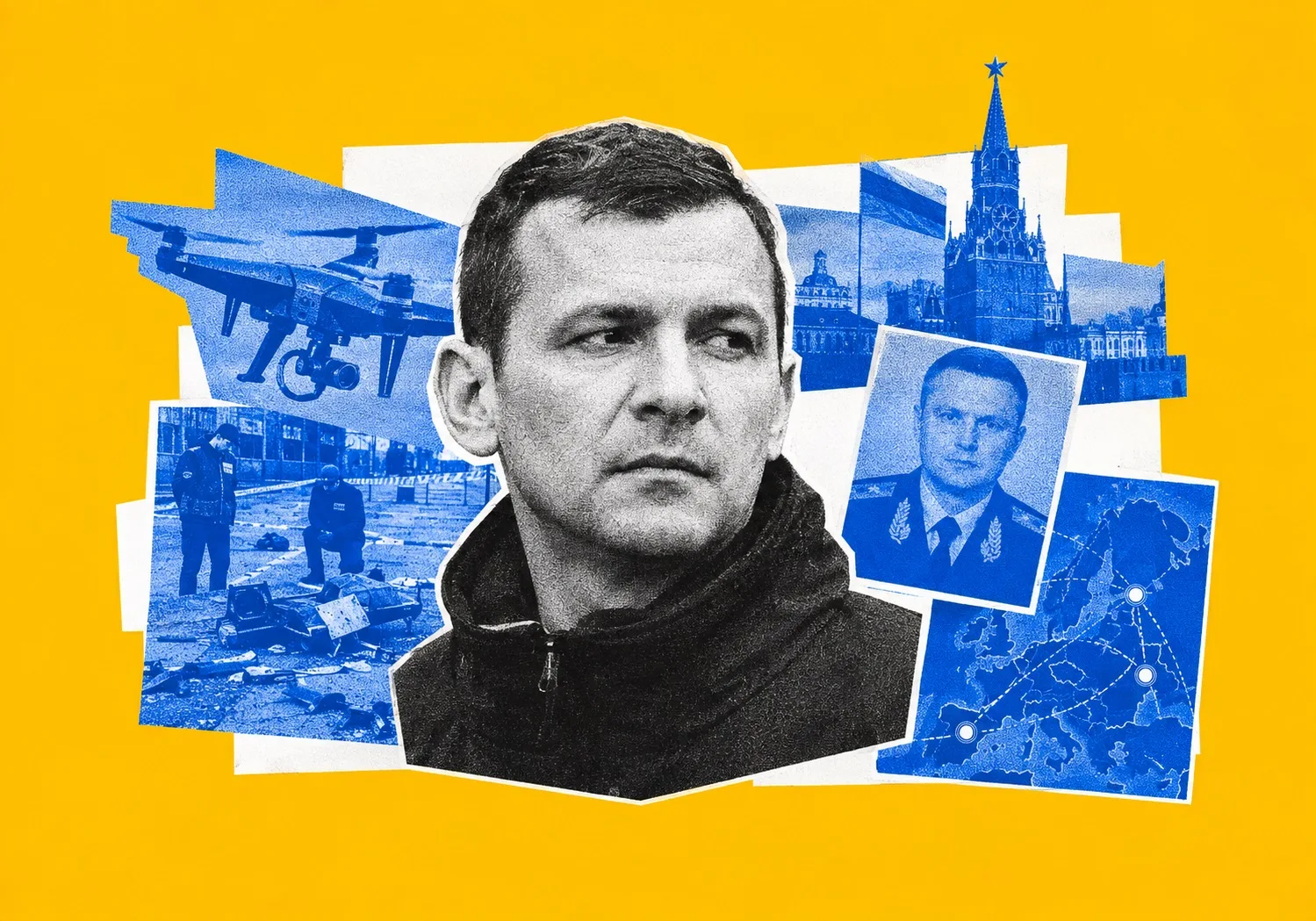
A failed Russian GRU drone attack on a Ukrainian Antonov An-124 at Germany’s Leipzig/Halle Airport has revealed the inner workings of Moscow’s proxy sabotage strategy in Europe. Operated by Russian handler Oleg Levushkin and a Belarusian criminal proxy, the thwarted Semtex bombing exposes critical intelligence failures and marks a dangerous escalation in attacks on NATO’s civilian-military logistics.
That mechanical failure may have prevented a major disaster. It also left German investigators with something Moscow would have preferred to keep invisible: the hardware, DNA, telemetry and other traces of a sabotage chain extending across several European countries.
A civilian airport became a military target
Leipzig/Halle is not simply another European airport. It is a major logistics point for the Strategic Airlift International Solution, or SALIS, which uses Ukrainian Antonov An-124 aircraft to provide heavy-lift transport for NATO and EU militaries. Since 2022, the airport has also been an important base for moving military and humanitarian materiel connected with Ukraine.

That makes the choice of target significant.
The operation was designed around the vulnerabilities of a dual-use facility: a civilian air-freight environment performing functions with direct military relevance. The aircraft was parked and being fuelled when the drone approached. A successful detonation could have ignited the fuel, destroying the An-124 and potentially killing ground personnel while inflicting extensive damage on a critical European logistics junction.
The weapon itself was strikingly unsophisticated. The drone was a quadcopter carrying a modified tin packed with Semtex. Yet the combination of cheap commercial technology, military explosives and access to an important logistics site created a disproportionate threat.
This is the central change in Europe's security environment. The target no longer needs to be a military base in the conventional sense. An airport, parcel warehouse or transport depot can become an operational theatre when its commercial infrastructure supports the movement of military supplies.
The GRU's disposable layer
The people behind the operation are as important as the device.
Oleg Levushkin, a Russian national, entered Germany through Turkey in late July 2026, rented a car at Berlin Airport and collected the explosives. Location data later placed him at Leipzig/Halle on July 31, conducting reconnaissance around the terminals and perimeter.
Levushkin was not an unknown quantity to German intelligence. Authorities were aware of his arrival and his connections to the GRU. Yet he was not placed under active surveillance.

That gap matters because the operation did not depend on a conventional intelligence officer penetrating a Western institution. Levushkin functioned as an intermediary: identifying the target, organising logistics and directing the final operation.
The direct attacker was Andrei Karshakou, a Belarusian national with a criminal background and previous links to a state-sponsored arson operation in Poland. He was, in effect, expendable.
This division of labour offers the GRU a useful form of insulation. A professional intelligence service can identify targets and organise material without placing senior personnel physically at the scene. A low-level proxy can then carry out the dangerous part of the operation, leaving investigators to pursue someone whose value to the network is limited.
The model also fits the wider activity attributed to GRU units 29155 and 52659. Their European operations have involved arson, explosions and other forms of sabotage, with recruits drawn through encrypted platforms and used for individual tasks rather than integrated into a traditional espionage hierarchy.
For European counter-intelligence, that is a different problem from tracking diplomatic personnel or identifying deep-cover agents.
An open border, a closed security gap
The explosives themselves illustrate another vulnerability.
The 1.8kg of Semtex was smuggled into Germany from Serbia and Bulgaria inside modified cavities in trucks. By the time the material reached the intended target, the operation had crossed several jurisdictions and exploited the movement of goods through an open European environment.
The Leipzig device subsequently provided investigators with unusually valuable forensic evidence.

Police recovered debris from two additional quadcopters and an improvised signal-booster antenna attached to a nearby tree. DNA from a glove fragment on the antenna matched Karshakou. A third explosive-laden drone was found in a field near Kabelsketal on August 14.
Most significantly, investigators identified a distinctive technical signature in the bomb itself. The metal lid used on the explosive had seven circular indentations designed to increase fragmentation. The same manufacturing technique was found on explosive devices recovered from cemetery caches in Lithuania and on components associated with earlier attacks in Poland and elsewhere.
That connection reaches beyond Leipzig.
The same specialised tooling has been linked to GRU-backed parcel-bomb operations involving a DHL facility in Birmingham, an Ikea location in Vilnius and transport infrastructure near Warsaw. What might otherwise appear to be isolated acts of arson or improvised sabotage instead form part of a recognisable logistical and technical ecosystem.
The importance of the Leipzig investigation therefore lies partly in what failed. The unexploded charge became evidence of how the network sources, transports and assembles its weapons.
The intelligence problem is harder than the bomb
The most uncomfortable question for Germany is not why the drone was able to reach the aircraft. It is why the person organising the operation was able to reach the airport in the first place.
German authorities knew Levushkin had entered the country. They knew of his GRU connections. They also had location data showing that he had conducted reconnaissance at the airport.
Yet no active surveillance followed.
The case exposes the difficulty of countering an intelligence operation whose personnel do not look like conventional spies. A motorcycle enthusiast or minor criminal can attract far less attention than a known intelligence officer. A disposable proxy can move through commercial infrastructure while the person giving instructions remains elsewhere.
The technology makes that asymmetry sharper. Commercial drones are inexpensive and readily available. Telegram can facilitate recruitment. Explosives can move through freight networks. Schengen's open internal borders reduce the number of obvious control points.
None of these systems was designed around the assumption that a foreign military intelligence service might combine them for physical attacks inside European logistics infrastructure.
That assumption is now harder to avoid.
From counter-espionage to counter-sabotage
The Leipzig operation therefore creates a problem that sits awkwardly between policing, intelligence and military defence.
Traditional counter-intelligence is built around identifying hostile officers, agents and networks. Counter-sabotage requires something more immediate: detecting reconnaissance, following suspicious movements, protecting vulnerable sites and connecting apparently minor incidents across borders before an attack takes place.
For civilian airports and freight hubs, the implications are substantial. Physical security can no longer be considered separately from the intelligence picture. A drone approaching an aircraft is not necessarily an isolated aviation-security incident if the aircraft itself forms part of Europe's military supply chain.

The same logic applies to warehouses, rail facilities and parcel networks.
European authorities also face a coordination problem. The Leipzig operation crossed Russia, Belarus, Germany, Turkey, Serbia, Bulgaria, Lithuania, Poland and the UK through different elements of the network and its forensic history. No single national service possesses the entire picture.
That makes intelligence-sharing increasingly important, particularly when an operation remains below the threshold of a conventional armed attack. The absence of a destroyed aircraft does not erase the strategic purpose of the operation. Nor does the use of a proxy make it a purely criminal matter.
Germany formally attributed the Leipzig attack to Russia on September 1 and responded by expelling diplomats and closing Russian consular facilities in Bonn and Berlin. But the operational question is broader than diplomatic retaliation.
The difficulty for NATO countries is deciding where responsibility for these incidents begins and ends when military intelligence, organised crime, commercial technology and civilian infrastructure overlap.
The evidence Moscow left behind
The failure of the Leipzig bomb may ultimately prove more damaging to the operation's secrecy than a successful detonation would have been.
The identities of Levushkin and Karshakou, their respective roles, the movement of the explosive material and the technical similarities between the Leipzig device and earlier weapons have exposed a network that depends on repetition. Standardised components create operational efficiency, but they also create forensic signatures.
That is the paradox of this model of sabotage. The use of disposable agents makes individual operations harder to attribute in advance, while repeated methods make the wider network easier to map after an attack.
For European security services, the decisive question is therefore no longer simply whether a drone can be stopped over an airport perimeter. It is whether the person who launched it should have been identified days earlier, whether the explosive material should have been detected months earlier, and whether a suspicious parcel operation in one European country can be recognised as part of the same campaign as an unexploded device beside a military cargo aircraft in another.
The Leipzig case shows how much can depend on the answer to those questions before the next detonator works.
Sources: The Telegraph, Politico, Ground, Bloomberg