
Russian GRU Sabotage Networks Target EU Defence Companies in Germany and Slovakia

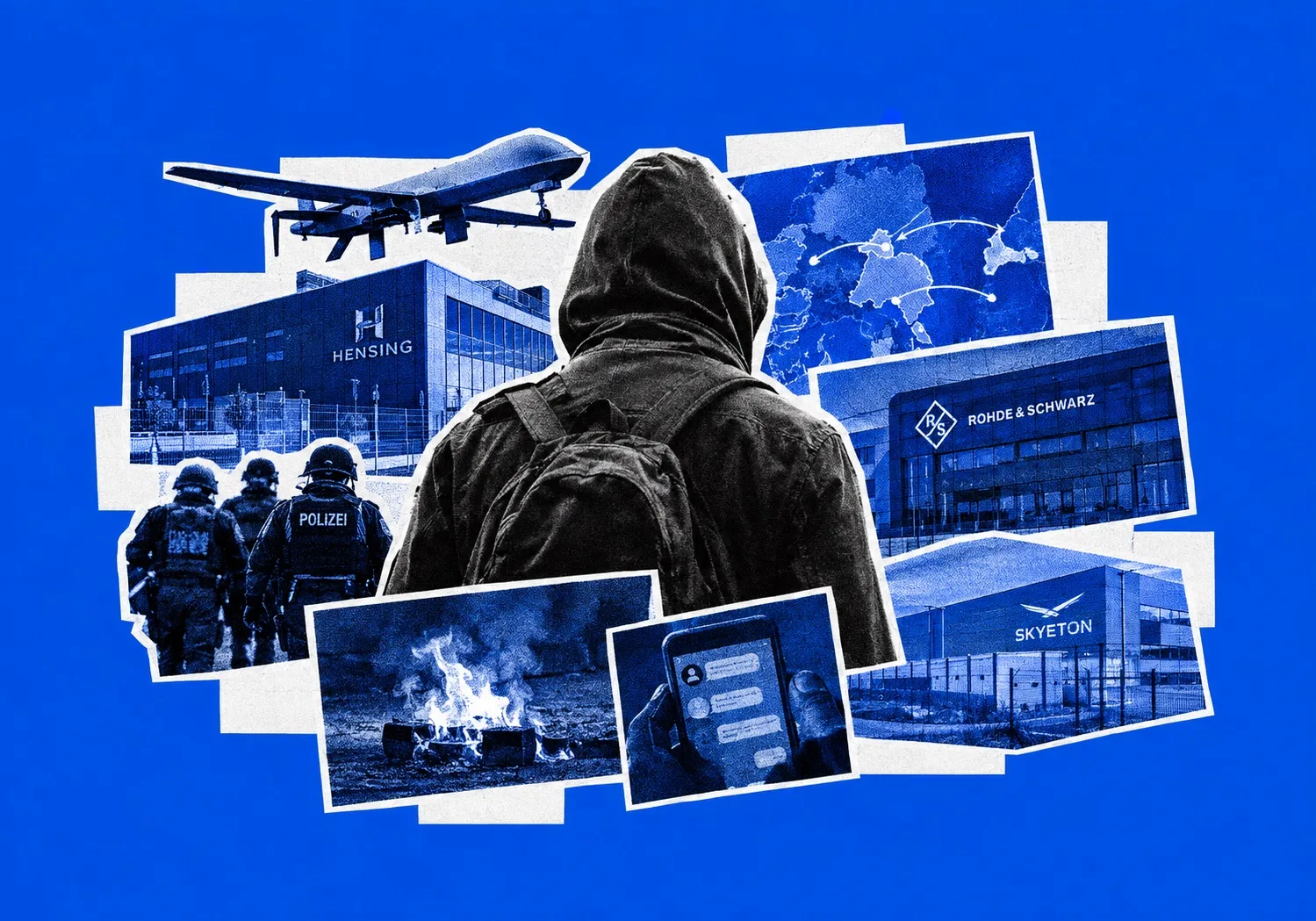
The disruption of arson plots against defense suppliers Helsing, Rohde & Schwarz, and Skyeton reveals an expanding Russian GRU proxy sabotage network operating inside the EU. German and Slovak intelligence now link attacks in Munich and Slovakia to a shared coordination hub.
Neither operation caused significant physical damage. That is precisely why the cases matter.
The immediate effect of these attacks was limited. The security challenge they reveal is not.
From espionage to physical disruption
European governments have spent much of the period since Russia’s full-scale invasion of Ukraine dismantling the intelligence infrastructure that Moscow built through diplomatic missions. More than 400 Russian diplomatic personnel were expelled across Europe after 2022, according to the briefing.
The result was not the disappearance of Russian intelligence activity. It changed the way it could be conducted.
The network now being investigated by German authorities appears to rely on a more fragmented model. Rather than requiring a Russian intelligence officer to establish direct contact with an operative in Europe, investigators believe recruits can be found remotely through online messaging platforms and social networks.
The people carrying out the most exposed part of an operation may therefore have little knowledge of the organisation behind it.
In the Munich case, German investigators describe the Bulgarian suspects as low-level or “disposable” agents. They were allegedly recruited remotely, paid relatively small amounts and used for localised tasks, without direct physical contact with GRU officers.
That changes the economics of sabotage.
A traditional intelligence operation requires trained personnel, secure communications and protection of the agent network. A decentralised model can instead distribute risk across a large number of individuals. If one operative is arrested, the organisation can potentially replace them without exposing the wider structure.
For European counter-intelligence services, the problem is correspondingly different. The person caught carrying an incendiary device may be the easiest part of the operation to identify, while the command structure sits several jurisdictions and layers of digital communication away.
The battlefield reaches the supply chain
The choice of targets is also significant.
Helsing develops autonomous, AI-enabled attack drones supplied to Ukrainian forces. Rohde & Schwarz produces military communications and radar systems, as well as counter-UAS technology. Skyeton manufactures long-range reconnaissance and uncrewed aerial systems in Slovakia.
These are not symbolic targets unrelated to the war. They form part of the industrial infrastructure supporting Ukraine's military capability.
That creates a new category of vulnerability for Europe. Defence production is no longer simply an issue of factories, procurement contracts and export controls. The physical security of production sites, logistics facilities and associated infrastructure becomes part of the wider defence equation.
A small fire does not need to destroy a factory to impose a cost. Security measures, inspections, surveillance, insurance and disruption can all become more expensive when industrial facilities have to operate under the assumption that foreign intelligence services may seek to penetrate or damage them.
The Leipzig/Halle airport case adds another dimension. On August 5, an explosives-carrying drone detonated near or collided with a DHL cargo aircraft carrying shipments bound for Ukraine. On September 1, the German government officially attributed the incident to Russian state structures.
German authorities are now assessing that case alongside the Munich and Slovakian operations, and September sabotage attempts targeting German power infrastructure.
The significance lies in the convergence of targets: defence manufacturing, military technology and logistics.
Why Central Europe matters to the network
The investigations also point towards a geographical feature of the emerging campaign.
German security sources cited by Frankfurter Allgemeine Zeitung on September 25 assessed that the Munich and Skyeton operations were coordinated from a shared operational hub in Slovakia. German investigators suspect that the attacks were organised by a specialised GRU unit.
Slovakia's role in the cases illustrates one of the central difficulties of combating decentralised foreign operations. The people carrying out an attack, the person arranging logistics and the intelligence service suspected of directing it may all be located in different countries.
The Skyeton case itself involved a 26-year-old Latvian national and a Ukrainian national arrested in Slovakia, while another Latvian suspect was apprehended in Hamburg under a Slovak arrest warrant.
The Munich suspects were Bulgarian nationals.
The Leipzig investigation, meanwhile, identified a key logistics operative as Oleg L., a dual Russian-Latvian citizen. German investigative outlets reported that he had maintained communications over several years with GRU Colonel Denis Smolyaninov.
The result is a counter-intelligence problem that does not fit neatly inside national borders.
Police may arrest the person physically present at a target. Prosecutors must then establish the chain connecting that individual to organisers, intermediaries and ultimately a foreign state. Each additional jurisdiction introduces another legal and investigative layer.
The Smolyaninov connection
The name of Denis Smolyaninov gives the investigations a potentially important institutional dimension.
The GRU colonel was sanctioned by the EU in December 2024 over activities involving psychological operations, Ukrainian-focused subversion and the remote recruitment of sabotage agents across Europe. The same EU sanctions framework also targeted GRU Unit 29155 and associated operatives.
The current cases therefore raise questions about whether Europe is confronting a continuation of an established intelligence capability rather than a series of improvised criminal ventures.
There is an important distinction, however. The operational model described by German investigators relies heavily on distance and deniability. The person recruited for a particular task does not necessarily need to understand the wider network, while the intelligence service can maintain separation from the physical operation.
That is different from the classic image of an intelligence officer running an agent network directly.
It is closer to outsourcing.
The arrangement also creates ambiguity that can be useful to the organiser. Russia has denied involvement in the European sabotage incidents, with its Foreign Ministry calling the German allegations fabricated and politically motivated. Germany, by contrast, has formally attributed the Leipzig attack to Russian state structures and is investigating the Munich case for possible state involvement.
Attribution therefore becomes more than a political statement. It is the point at which a criminal incident becomes an act of state-sponsored aggression, with consequences for sanctions, diplomacy and counter-intelligence policy.
Defence companies are now part of the security perimeter
For European defence manufacturers, the implications are immediate even where attacks fail.
Rohde & Schwarz said its Munich facilities suffered no operational damage. Helsing declined detailed public comment. Skyeton's Slovak facility was protected before the planned arson could take place.
The companies nonetheless occupy a different security environment from the one they faced before the expansion of the war in Ukraine.
The vulnerability is not limited to major weapons factories. It extends across the ecosystem that produces, moves and maintains military technology.
That is particularly relevant for a European defence industry already under pressure to expand production and accelerate support for Ukraine. Every additional layer of physical protection competes for resources with the central task of producing equipment.
The proxy model makes the problem harder because it does not require sophisticated military capability at the point of attack. A locally recruited operative with basic instructions can potentially create a security incident at a strategically important facility.
The cost of defending against that possibility is consequently disproportionate to the apparent simplicity of the attack.
Europe’s attribution problem
The arrests give European services something they rarely get from covert sabotage: people, devices, communications and cross-border evidence that can potentially be connected.
But the emerging cases also demonstrate why disrupting an operation and proving who ordered it are different tasks.
Germany has already moved beyond investigation in the Leipzig case, formally attributing the attack to Russian state structures and responding diplomatically by expelling personnel, closing Russia's Consulate-General in Bonn and terminating the agreement governing the Russian Cultural Center in Berlin. Berlin is also seeking expanded EU sanctions.
The Munich case remains at the investigative stage as authorities examine whether the suspected proxy operation can be tied to a Russian state structure.
That distinction matters because the decentralised model is designed to create precisely this gap between the visible act and the invisible sponsor.
Europe has spent four years strengthening its ability to identify Russian intelligence activity after the expulsion of diplomatic personnel. The new challenge is harder: preventing a system in which the operative may be recruited from another country, the logistics organised somewhere else, the target located deep inside NATO territory and the suspected command structure separated from the attack by several layers of intermediaries.
The physical attacks in Munich and Slovakia failed to disrupt defence production.
The more consequential question is whether Europe's security architecture can keep pace with a form of sabotage in which the distance between a state intelligence service and the person carrying out the attack is itself part of the weapon.
Sources: Frankfurter Allgemeine, Reuters, DW, Tagesschau