
Nepal Floods Knock Out 1,000 MW of Hydropower, Exposing Infrastructure Fragility

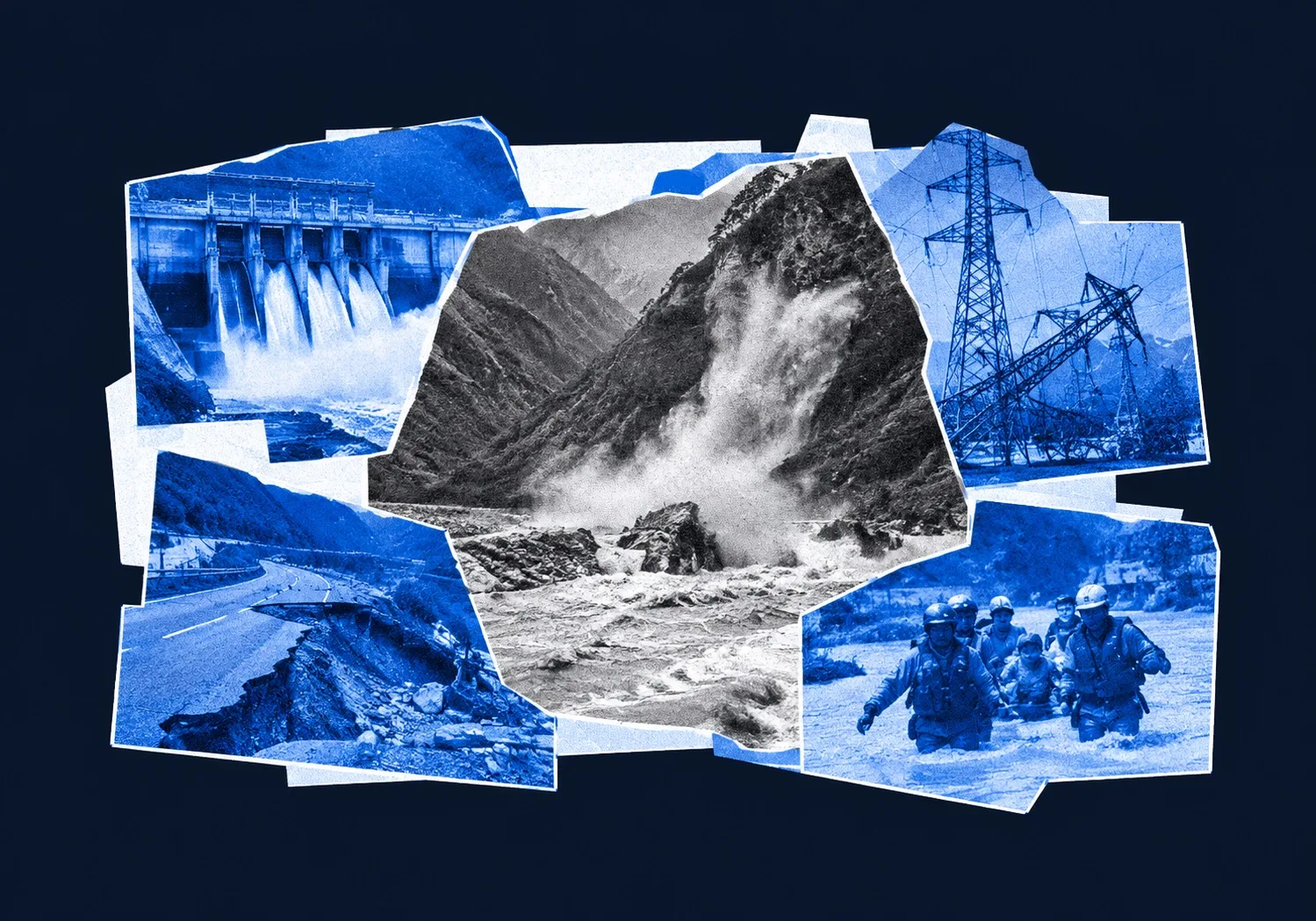
Severe floods and landslides across Nepal have killed at least 24 people and knocked out roughly 1,000 MW of hydropower generation - nearly a third of the country's capacity. As major highways collapse and key transmission lines fail, a late-September monsoon crisis has laid bare the structural risks of concentrating Nepal’s energy and transport infrastructure in narrow Himalayan valleys.
The fundamental problem is not simply that extreme rainfall can damage infrastructure. It is that so much of Nepal’s grid, highways, and generation facilities occupy the very same narrow, unstable corridors.
When the grid fails with the landscape
Across 27 hydropower projects, approximately 1,000 MW of generation has been disrupted. Damage along the Kali Gandaki corridor alone brought 12 power plants with a combined capacity of 358.2 MW offline after towers on the Dana–Kushma 220 kV transmission line were damaged.
Among them are Nilgiri-1, Nilgiri-2, Mistri Khola and the newly grid-connected Rahughat, where river erosion damaged the switchyard. Seven damaged plants, representing about 190 MW, are expected to remain out of service for several months.
The pattern matters more than any individual plant.

Nepal has built much of its electricity system around run-of-the-river hydropower, exploiting the country's steep terrain and powerful river systems. That has allowed generation capacity to expand while making the Himalayan water network an economic asset. But the same geography concentrates generation, transmission, and transport in narrow valleys where there are few alternative routes.
When a river rises sharply, or a slope gives way, several systems can fail together.
The Marsyangdi corridor illustrates the exposure. Kaligandaki A, a 140 MW plant, stopped generation as water levels surged and all three dam gates at Mirmi were opened. Middle Marsyangdi, Marsyangdi, Upper Marsyangdi, Super Madi, Seti River, Upper Madi, Upper Dordi, and Namarjun Madi were also forced offline.
This is not a conventional power-station failure. It is a corridor failure.
A transmission line can be technically sound and still be unusable if the ground supporting its towers disappears. A functioning power station cannot supply electricity if the line connecting it to the grid has been severed. And a repair crew cannot easily reach either site if the road running through the same valley has been washed away.
That creates a form of infrastructure dependency in which the failure of one physical system magnifies the failure of another.
The roads are part of the same problem
The transport network has suffered a parallel breakdown.
Landslides and bridge failures have blocked or restricted the Prithvi Highway, the Narayangadh–Muglin Road, the Kaligandaki Corridor and the Mid-Hill Highway. Other critical routes, including the Karnali, Siddhartha, Mahakali and Kanti Lokpath highways, have also been affected. The Jomsom–Korala road towards China and routes linking Besisahar with Manang and Beni with Jomsom have been disrupted.

A concrete bridge connecting Syangja and Gulmi was swept away. In Beni, four government offices were inundated and a key bridge was damaged.
The significance extends beyond inconvenience. These are the same roads needed to move rescue teams, equipment, fuel, food and construction materials into affected areas. When transport links are severed simultaneously with power infrastructure, recovery itself becomes harder.
Security forces carried out 439 rescue operations over five days and rescued 1,284 people. Yet the scale of the response also shows how dependent disaster management is on infrastructure that the disaster can destroy.
Night-time driving restrictions imposed by local authorities add another constraint when roads are already limited. A damaged highway does not merely slow commerce; it reduces the number of hours in which relief and repair operations can take place.
For communities in the Himalayan valleys, the result is a double isolation: electricity becomes unreliable while physical access becomes uncertain.
A second disaster before the first was repaired
The timing makes the disruption more serious.
The late-September rainfall arrived less than four weeks after the catastrophic August 26 floods along the Nepal–China border, which killed more than 1,000 people and left thousands missing. Infrastructure damaged during that disaster had not yet been fully repaired when the new monsoon system arrived.
That changes the economics of disaster recovery.
A government rebuilding one damaged road can plan around a defined repair cycle. A government facing repeated damage before the previous reconstruction is complete is dealing with a moving target. Equipment, public finances, engineering capacity and emergency personnel are being redirected from one crisis to the next.
The same is true for energy developers. Power plants that require months of repairs are not simply losing output during one difficult week. Their owners face prolonged revenue losses while the wider system must find ways to compensate for missing generation.
For the Nepal Electricity Authority and independent power producers, the immediate damage therefore extends beyond physical assets. Generation revenues are lost, repair costs rise, and the cost of maintaining a grid exposed to repeated disruption becomes harder to absorb.
The national treasury faces a parallel burden through emergency relief and reconstruction.
The vulnerability is built into the geography
Nepal's geology makes the concentration of infrastructure particularly consequential. The Himalayas are geologically young and characterised by steep slopes, complex fault lines and easily eroded rock formations. Prolonged rainfall saturates the terrain and reduces slope stability.
That means the risk is not limited to water flowing over roads.
The ground beneath roads, transmission towers, bridges and power facilities can itself become unstable.
Yet mountainous geography leaves Nepal with limited options. Highways and transmission lines naturally follow valleys and river corridors because those routes offer the most practical connections through difficult terrain. Hydropower projects are likewise tied to the rivers that provide their energy.
The result is a structural trade-off. The infrastructure is located where it is most efficient to build and operate, but those same locations can become the most dangerous during extreme rainfall.
That trade-off becomes harder to sustain when disasters arrive close together.

The question for Nepal’s energy strategy
Hydropower remains central to Nepal's economic model, industrial ambitions and electricity exports to India and Bangladesh. But the September disaster raises a narrower and more difficult question: how much concentration can that model safely tolerate?
The issue is not whether Nepal should use its rivers. It is whether generation and transmission can continue to be designed around the assumption that individual corridors will remain available when extreme weather strikes.
The simultaneous loss of roughly 1,000 MW shows the consequence of relying on infrastructure whose components are physically connected to the same vulnerable landscape.
A more resilient system would require the risk to be treated at corridor level rather than project by project. Transmission routes, generation sites and roads cannot be assessed independently when their failures are linked by the same river basin and terrain.
That points towards greater redundancy, more resilient engineering, stronger risk modelling and less dependence on single transport and transmission corridors. Decentralised electricity systems could also reduce the consequences of losing a major hydro corridor, while climate-hardened infrastructure could make individual failures less likely to cascade across the wider network.
For Nepal, however, resilience comes with a cost.
The country's hydroelectric expansion has been driven partly by the economic logic of exploiting abundant water resources and connecting generation to larger markets. Building multiple alternative transmission routes, reinforcing infrastructure against extreme geological events, and distributing generation more widely can make the system more expensive.
The September crisis puts that cost into sharper focus.
The mountain slope that collapsed into the Kali Gandaki River was an instantaneous event. The vulnerability that allowed one landscape to disrupt electricity generation, transmission, highways, and emergency access at the same time was built over years.
That distinction matters because rebuilding what was destroyed may restore the system without changing its underlying exposure. If the same corridors remain the country's energy and transport arteries, reconstruction alone can leave Nepal preparing for the next failure with the same architecture that produced the last one.
Sources: Online Khabar, The Daily Pioneer, Reuters, The Kathmandu Post, Ratopati