
Lithuania Hardens Power Grid Link Near Russian Border

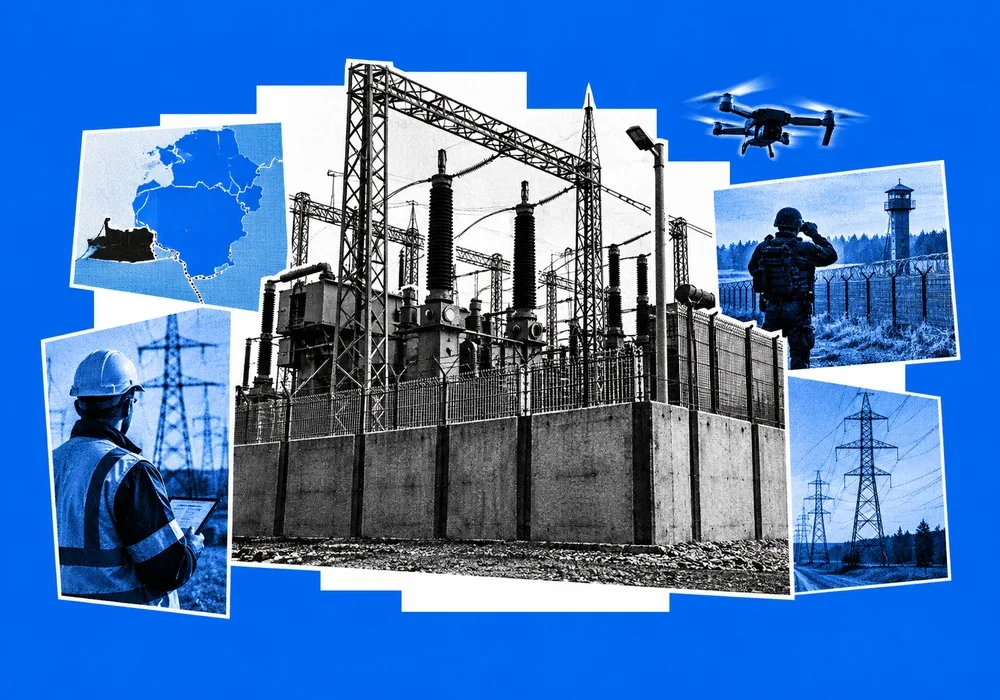
Lithuania is designing a new electricity substation near Kaliningrad to withstand drone strikes, sabotage and other hybrid threats. The Gižai facility will form part of the Harmony Link connection with Poland, while its reinforced design is expected to add at least €48 million to the project’s cost.
Lithuania is designing a new electricity substation near the Russian exclave of Kaliningrad to withstand drone strikes, sabotage and other forms of hybrid attack, reflecting a broader shift in how critical energy infrastructure is being built on NATO’s eastern flank. The Gižai substation will form part of the Harmony Link connection between the Baltic electricity systems and Poland, making it a key element of the region’s post-Russian energy architecture.
The facility is planned around 30 kilometres west of Kaliningrad and will cover approximately 35 hectares. Its layout is intended to limit the consequences of a single attack, while critical equipment will be physically separated and duplicated where possible. The project is also being designed to remain operational if individual components are damaged or destroyed, an approach increasingly shaped by lessons from Russia’s attacks on Ukraine’s energy system.
Infrastructure designed for a different threat environment
The protection measures go beyond conventional perimeter security. The plans include reinforced fencing capable of resisting an explosives-laden vehicle, underground sensors to detect possible tunnels and reinforced-concrete structures around transformers and other vulnerable equipment. The concrete is being specially engineered with reinforcing fibres, while equipment enclosed in protective structures will require artificial cooling.
The design specifically takes into account the possibility of attacks involving Shahed-type drones carrying large explosive payloads. Lithuania’s grid operator Litgrid has said that the new facility is being designed around a wider range of hybrid and conventional threats than would previously have been considered when planning electricity infrastructure.
This reflects a broader change in Lithuania’s approach to critical infrastructure. Earlier this month, the government said that protecting energy networks, cybersecurity, border surveillance and resilience against hybrid threats should be treated as part of the wider security architecture of the EU’s eastern flank.
A critical part of Harmony Link
Gižai will be a key node in Harmony Link, the electricity interconnection being developed between Lithuania and Poland. The project is intended to reinforce the Baltic states’ connection with the wider European electricity system after Lithuania, Latvia and Estonia synchronised with the continental European grid in February 2025, ending their dependence on the Russian and Belarusian electricity system.
The geography makes the infrastructure particularly sensitive. The Lithuania-Poland connection passes through the Suwałki Gap, the narrow land corridor between Kaliningrad and Belarus that has long been regarded as strategically important for NATO’s eastern flank. Any disruption to critical infrastructure in the area could therefore have consequences extending beyond the electricity network itself.
Lithuanian officials have also linked the decision to strengthen the facility with a wider deterioration in the regional security environment and increased concerns over sabotage. Reuters reported that intelligence sources have warned of the possibility of a staged or false-flag drone incident intended to test NATO cohesion. Russia has denied involvement in sabotage allegations.
Security is increasing the cost of energy independence
The additional protection comes with a significant financial cost. Litgrid estimates that securing the Gižai substation will add at least €48 million to the project's previously planned expenditure, with the final figure potentially increasing if the regional security situation deteriorates further.
Lithuania plans to ask the EU to cover at least half of these additional costs. Polish officials have backed the argument that countries bordering Russia should not be expected to absorb the full cost of protecting infrastructure that also serves the wider European electricity system.
The issue is broader than Harmony Link. Lithuania, Latvia and Estonia, together with Poland, previously requested €382 million in EU support for protecting existing electricity infrastructure. Only €112 million was approved, according to Reuters. Lithuanian officials are now pushing for a larger EU role in financing the physical resilience of energy networks.
Lithuania’s Energy Ministry has separately identified the protection and financing of critical energy infrastructure as one of its priorities for the country’s upcoming EU Council presidency in the first half of 2027. It has also called for a dedicated funding mechanism under the EU’s TEN-E framework for critical infrastructure protection.
From energy independence to energy resilience
The Gižai project illustrates a second phase of the Baltic states’ energy-security strategy. Disconnecting from Russia’s electricity system removed a major source of strategic dependence, but the physical infrastructure connecting the region to the European grid has itself become a security asset that needs protection.
Lithuania is increasingly applying the experience of Ukraine, where repeated Russian strikes have demonstrated that electricity networks can become targets alongside military and industrial facilities. The Lithuanian government has explicitly said that Ukraine’s experience in drones, air defence, cybersecurity and energy resilience is now informing its own preparations.
For the Baltic region, this means that the cost of energy integration is no longer limited to transmission lines, substations and interconnectors. Physical fortification, redundancy, surveillance and protection against drones and sabotage are becoming part of the infrastructure itself — and Lithuania is seeking to make that security investment a European responsibility rather than a cost borne primarily by the states closest to Russia.
Sources: Reuters, Government of Lithuania