
How Putin is Forcing Russia’s Billionaires to Fund the War Budget

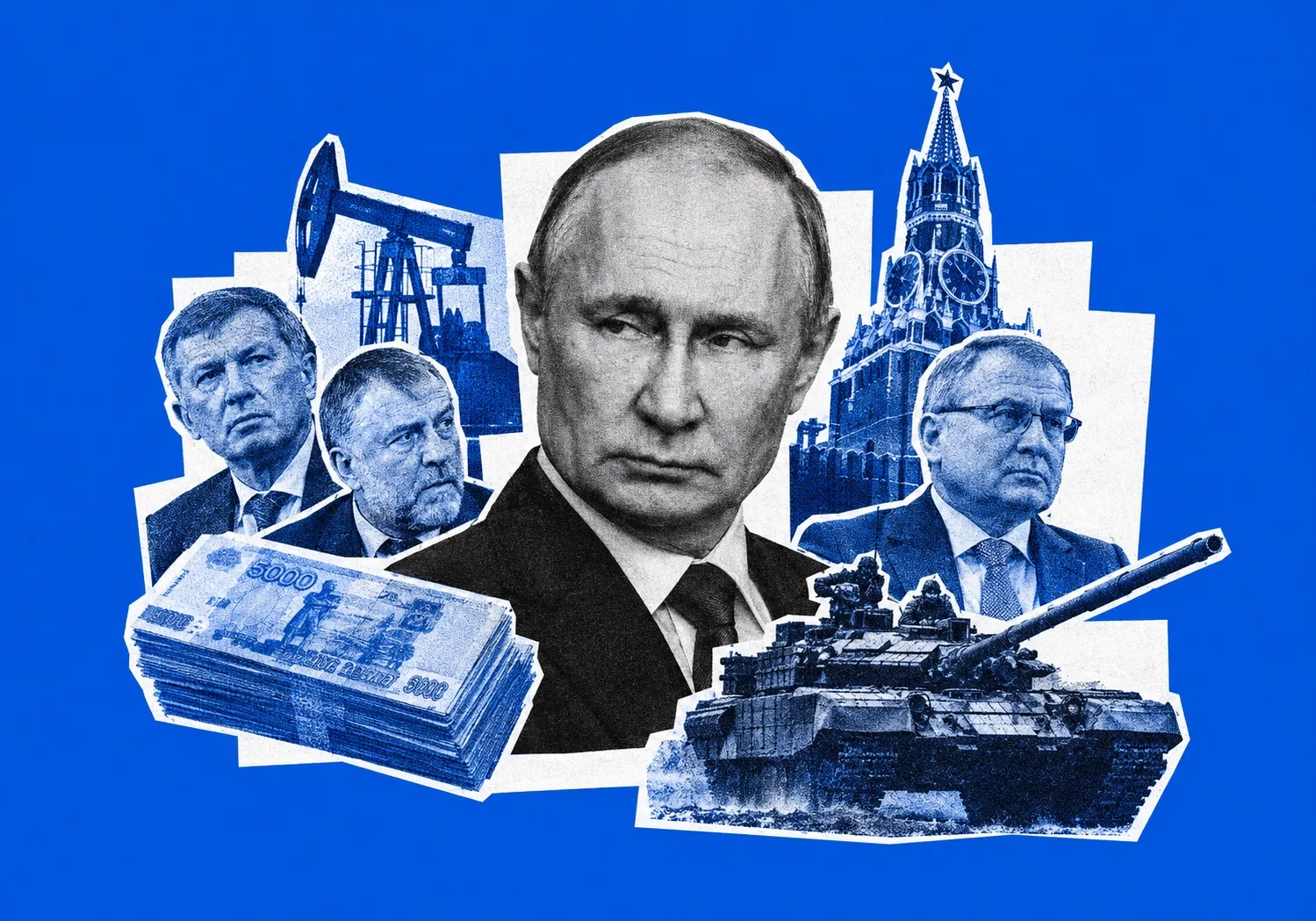
Russia’s wealthiest oligarchs have quietly funnelled over 471 billion roubles ($5.6 billion) into the Kremlin's coffers through so-called "voluntary contributions." As Western sanctions limit their options abroad, Russia's billionaires have little choice but to plug the government’s widening war deficit - only to find that even billions in payments cannot buy them protection from the state.
The turning point came after a congress of the Russian Union of Industrialists and Entrepreneurs, when Putin met leading businessmen behind closed doors on 26 March.
According to reports by The Bell and Reuters, several prominent billionaires helped negotiate contributions intended to cover up to 460bn roubles. Suleiman Kerimov reportedly pledged 100bn roubles, worth around $1.2bn-$1.3bn, during the meeting. Vladimir Potanin and Oleg Deripaska were also among the businessmen associated with the fundraising effort.
The reported motivation was not simply patriotism. Business leaders were seeking to head off a broader windfall tax, an additional charge on companies or individuals benefiting from exceptional financial gains. A large payment made upfront offered a possible alternative to a more formal and potentially recurring demand on corporate earnings.
The strategy did not deliver the protection they wanted. The government continued to advance plans for a windfall tax in 2027, alongside measures targeting interest on bank deposits and other passive income.
That outcome reveals the imbalance at the heart of the arrangement. The businessmen could negotiate the scale and timing of their initial contributions, but they could not secure an exemption from subsequent demands. Their payments bought the state immediate fiscal relief, not a lasting agreement over the limits of its authority.
For the Kremlin, there was little reason to surrender that advantage. If private wealth could be mobilised quickly to meet an urgent budgetary need, a negotiated contribution need not prevent the state from returning for more.
The money arrived in stages
The accumulation of payments throughout 2026 offers a clearer picture of how the mechanism developed.
Transfers stood at 15.6bn roubles before March. By June, the total had reached 220bn; by August, it was 384bn. In October, the figure rose to 471bn roubles, or approximately $5.6bn.
The steady increase matters because it indicates that the arrangement was not confined to a single meeting or one-off pledge. The March gathering established the political expectation, while subsequent transfers turned that expectation into a substantial source of revenue.
The Kremlin has rejected the suggestion that Putin directly demanded the money. Presidential spokesman Dmitry Peskov has maintained that the initiative came from business leaders. The official justification rests partly on the origins of their fortunes: wealthy Russians who accumulated assets during the privatisations of the 1990s, often through connections with the state, have a duty to support the national budget.
That argument serves a political purpose. It presents the transfers as repayment of a historical debt rather than an exceptional demand imposed by the government. Yet it also leaves the definition of that debt largely in the hands of the state.
There is no clear boundary, in this arrangement, between an obligation to contribute and a decision to do so. Nor is there an obvious point at which a businessman can consider the obligation discharged.
The payments are not ordinary corporate philanthropy. Their significance lies in the circumstances that produced them and in the possibility that similar demands can be repeated whenever the budget requires additional cash.
A war budget with fewer easy options
Russia's fiscal position helps explain why the Kremlin has found this arrangement useful.
The federal budget deficit for 2026 is projected at 7.3 trillion roubles, equivalent to 3.2% of gross domestic product. That is twice the original target of 1.6% of GDP. Without the additional contributions, the deficit could have reached 3.4% of GDP.
Defence and security account for around 38% of total government expenditure. Such a large commitment narrows the room for manoeuvre elsewhere in the budget, particularly when conventional revenues fail to keep pace with spending.
The 471bn roubles from business leaders cover more than 1% of total planned government expenditure. They do not resolve the underlying fiscal problem, but they provide cash without requiring the government to introduce an equivalent amount of new taxation immediately.
The Kremlin is pursuing several other sources of funding in parallel. The government plans to raise 385bn roubles through the sale of seized private assets. It is also preparing higher taxes on bank deposit interest and passive income, additional import fees and increased borrowing. Government borrowing is projected to reach 6.1 trillion roubles in 2027.
These measures differ in form, but they point in the same direction: the state is drawing on a wider range of domestic resources to sustain its spending commitments.
The voluntary payments are particularly useful because they can be negotiated with a relatively small group of wealthy individuals. Raising comparable sums through broad-based taxation would distribute the immediate burden more widely and could make the costs of the war more visible to ordinary Russians.
This does not mean the public will escape higher taxes or other economic pressures. The planned changes to passive income taxation suggest otherwise. The distinction is that the Kremlin can choose the order in which different groups are asked to pay, using private contributions to ease the immediate pressure before other measures take effect.
Sanctions have changed the balance of power
The arrangement also marks a further stage in the evolution of the relationship between the Russian state and its largest fortunes.
The privatisations of the 1990s created a class of businessmen whose wealth rested on major industrial, mining, energy and financial assets. Under Putin, political loyalty became increasingly important to their continued position. The implicit bargain offered security and access to state power in exchange for political compliance.
Russia's invasion of Ukraine and the resulting Western sanctions changed the economic setting. For sanctioned businessmen, access to international markets and the ability to move or deploy wealth abroad became more constrained. Domestic assets remained valuable, but their owners had fewer ways to protect them from political decisions taken in Moscow.
That leaves the state in a stronger position when it needs money.
The reported contributions from Kerimov, Potanin and Deripaska illustrate the problem. Their wealth gives them the capacity to provide the government with large sums, but it does not necessarily give them influence over the government's broader fiscal choices. Indeed, the failure to prevent the planned windfall tax suggests that even substantial financial concessions cannot guarantee favourable treatment.
The burden is also unlikely to fall evenly across the private sector. Mining, metallurgy and other raw-material industries are particularly exposed because of the scale of their historical asset bases and export revenues. Their resources make them attractive sources of additional state income, while the concentration of wealth in large companies makes the demands easier to target than a general tax increase.
For the government, this is a practical advantage. For business, it changes the calculation behind investment, asset ownership and political loyalty.
When private wealth becomes a state resource
The sale of seized assets adds another dimension to the same process. Alongside cash contributions from wealthy individuals, the government can generate revenue by taking control of private property and disposing of it. The planned 385bn roubles from such sales would provide another source of funding without relying exclusively on conventional taxation.
The distinction between these mechanisms remains important. A contribution transfers money while leaving the underlying assets in private hands. A seizure can permanently alter who owns an asset and who benefits from its future income. But both expand the state's ability to mobilise private wealth in response to fiscal pressure.
The longer-term implications extend beyond the billionaires directly involved. If private fortunes can be called upon whenever the government faces a budgetary shortfall, ownership becomes less a guarantee of control than a position conditional on political circumstances.
That does not mean Russia has abandoned private enterprise. Businesses still produce goods, employ workers and generate profits. The change is in the terms under which they operate. Commercial success can create resources that the state subsequently claims, while political compliance offers no firm assurance against further demands.
The Kremlin's insistence on voluntarism helps preserve the appearance of an agreement between the state and business. Yet the planned windfall tax, the use of seized assets and the prospect of further fiscal measures suggest that the March payments did not establish a limit on government power.
For Russia's remaining private capital, the question is no longer simply how much tax the state will impose. It is whether any payment, however large, can establish a boundary that the state is obliged to respect.
Sources: Reuters, ChatHam House, The Kyiv Independent