
From Biosecurity to Political Crisis: How the EU Live Export Ban Sparked Protests in Romania

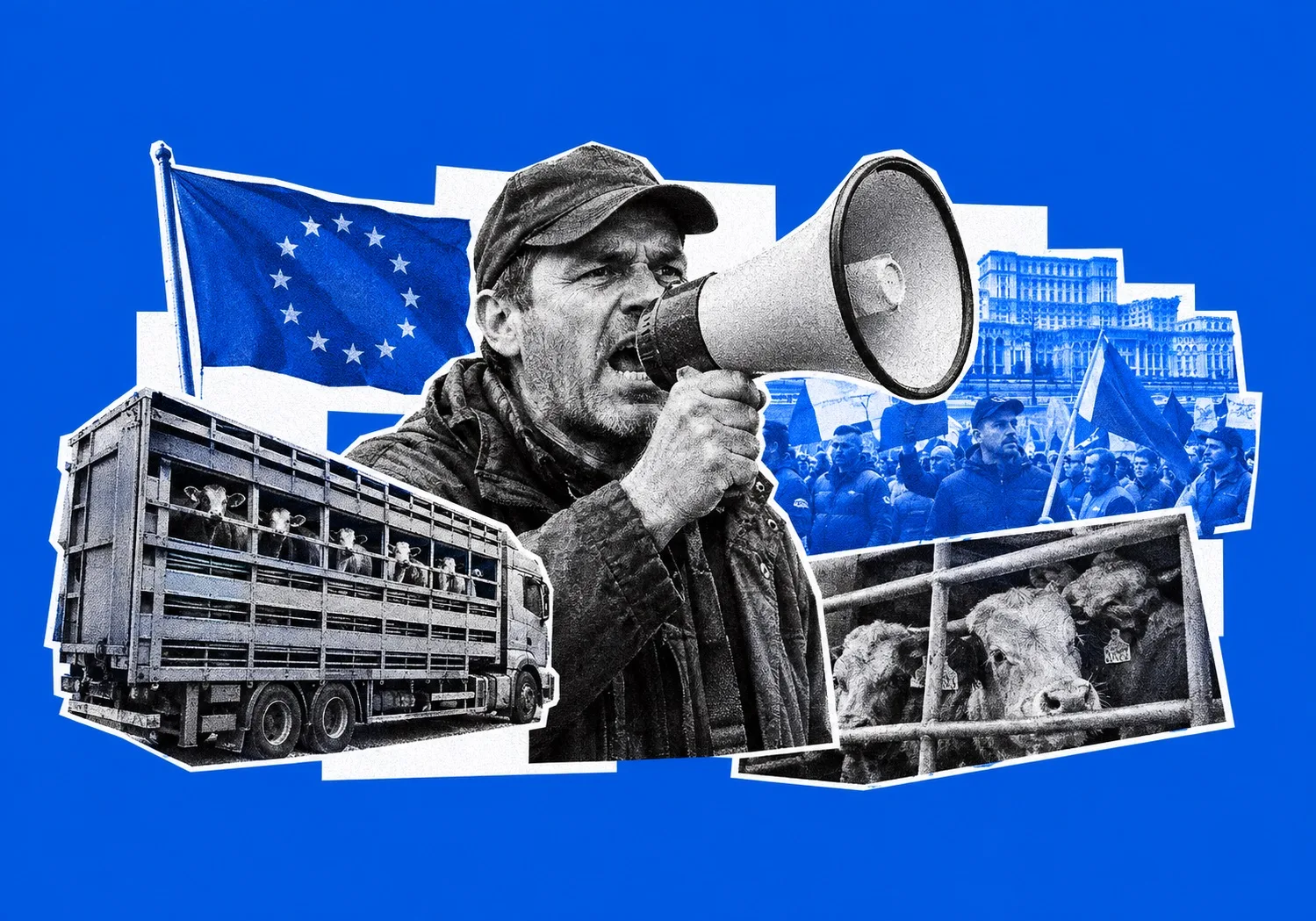
Violent clashes in Bucharest between police and 2,000 protesting farmers have exposed how EU biosecurity measures can trigger deep political volatility. The September 15 demonstration at Victoria Square, which left 24 injured and 26 detained, was sparked by an EU ban on live sheep exports following small ruminant plague (PPR) outbreaks. However, as radical far-right groups mobilize around rural frustration, a technical veterinary rule has evolved into a high-stakes challenge for Romania’s government and its relations with Brussels.
That is the more consequential story behind the clashes.
When veterinary policy reaches the streets
Romania is dealing with repeated outbreaks of peste des petits ruminants, or PPR, a highly contagious disease affecting sheep and goats. The disease does not threaten humans, but its economic consequences can be severe.
After a new outbreak in Mureș county in June, the European Commission extended emergency restrictions on Romania until December 31, 2026. The measures prevent live sheep and goats from being moved to other EU member states, restrict transit through EU territory towards third countries and halt direct live exports to countries outside the bloc.
For Brussels, the logic is straightforward: containing an infectious animal disease requires preventing its movement across borders.
For a shepherd whose animals were destined for export, the logic is very different. An animal that cannot leave the country does not stop consuming feed. It still needs shelter and care. A farmer facing restrictions on movement therefore absorbs costs every day while losing access to the market that was supposed to pay for those costs.
That is where a technical regulatory measure starts acquiring political consequences.
Romanian producers are demanding that restrictions be applied only in confirmed infection zones rather than across the entire country. The principle is not alien to EU disease-control policy. Regionalised restrictions have been used in other recent outbreaks involving sheep and goats, including in Greece, Croatia and Bulgaria.
Romania has faced a nationwide embargo because of recurring outbreaks and difficulties in tracking animal movements across county borders. Hungary, by contrast, succeeded in clearing its restrictions in February 2026 after demonstrating eradication.
The distinction matters because the economic burden of a national restriction is much broader than that of a targeted quarantine.
The compensation gap is becoming political fuel
The disease restrictions arrived at an especially difficult moment for Romanian agriculture.
The country has recorded the highest inflation rate in the EU during 2026, while prolonged drought has damaged fodder production. Grain and livestock farmers expected drought compensation of about €100 per hectare. The government allocated roughly €19.
For producers already carrying livestock that cannot be exported, the mismatch is even more severe. Compensation for culled animals, they argue, should reflect market prices rather than fixed administrative tables. Farmers are also seeking relief from feed and maintenance costs, lower sanitary fees and greater transparency over how infected zones are established.
The numbers give the dispute its political force.
A farmer does not experience an EU biosecurity rule as an abstract measure protecting the Single Market. The policy is experienced through animals that cannot be sold, feed bills that continue to arrive and compensation that covers only part of the expected loss.
This creates an unusually effective opening for political movements that want to turn economic frustration into a broader confrontation with government institutions.
The far right does not need to create the grievance
Romania’s far right did not have to invent the farmers’ anger. It had to give it a political direction.
Demonstrators repeatedly invoked Călin Georgescu, the former far-right presidential candidate who remains on trial over alleged offences against the constitutional order following the annulment of the 2024 presidential election. His supporters used social media networks to mobilise attendance.
Activists linked to the Alliance for the Union of Romanians also joined the demonstration. AUR leader George Simion publicly declared support for farmers and working Romanians while calling for a peaceful protest.
That positioning gives the party room to benefit from the mobilisation without directly owning the violence that followed.
The political transformation is important. A dispute over veterinary restrictions can be resolved, at least in principle, through disease surveillance, compensation, vaccination and negotiations over trade. Once the same dispute becomes a vehicle for demands that the president and prime minister resign, it belongs to a much larger political conflict.
The protest thus moved across several layers at once: agricultural policy, household economics, distrust of government and opposition to perceived external control.
Brussels became part of that narrative almost automatically.
The EU’s regulatory dilemma
The European Commission has provided Romania with 1.3 million free PPR vaccine doses, while Bucharest has submitted a technical roadmap seeking a move from nationwide restrictions towards regionalised controls.
The Romanian proposal is designed around trade corridors through the ports of Tulcea and Constanța and bilateral export arrangements with Saudi Arabia, Jordan, Morocco, Kuwait and Libya.
That roadmap could provide a way out, but it also reveals a difficult institutional problem.
Disease control and market access do not always point in the same direction. Vaccination can help contain an outbreak, but some international markets impose requirements linked to vaccine-free livestock. A policy intended to restore trade can therefore create additional complications depending on the requirements of destination countries.
Romania is consequently trying to solve several problems simultaneously: demonstrate disease control, establish credible regional surveillance, protect the wider EU market and reopen access to important non-EU buyers.
The December 31 deadline gives the process political urgency.
If regionalisation cannot be achieved, the economic pressure on producers will continue. If it is achieved without credible disease containment, the underlying reason for the restrictions remains. And if vaccination or other control measures complicate access to external markets, reopening the border will not necessarily restore the trade flows farmers depend on.
From agricultural policy to internal security
This is where Romania’s crisis becomes relevant beyond agriculture.
For years, animal disease controls could be treated largely as technical administration. Veterinary authorities imposed restrictions, farmers complained, ministries negotiated and the issue rarely became a question of national political stability.
That separation is becoming harder to sustain.
Romania combines high inflation, fiscal austerity, reduced agricultural support and a fractured political system. Its pro-European coalition collapsed after a no-confidence vote in May 2024, while the country has remained politically unsettled since the annulment of the presidential election.
Under those conditions, even a narrowly targeted regulatory dispute can become a national political confrontation.
The same pattern could matter elsewhere in the EU. Frontline member states are often the places where European regulatory decisions meet weaker fiscal capacity and greater exposure to economic shocks. A rule designed to protect the Single Market may be technically justified while still imposing costs that national governments cannot easily absorb.
That gap is politically exploitable.
The danger is not simply that farmers become angry. It is that legitimate sectoral grievances become attached to a political narrative in which Brussels is portrayed as imposing economic punishment, national governments as incapable of defending their citizens, and radical movements as the only credible representatives of those left behind.
Once that narrative takes hold, the distinction between a veterinary emergency and an anti-establishment campaign becomes increasingly difficult to maintain.
Romania is testing a different route
Bucharest is now attempting to construct an alternative based on vaccination, regionalisation and controlled trade corridors. It wants restrictions concentrated around affected areas while reopening routes through Tulcea and Constanța and negotiating access to non-EU markets.
That approach offers a potential compromise between disease containment and economic survival. But its success depends on whether Romania can establish enough confidence in its surveillance and eradication measures to persuade both European authorities and external buyers.
The political timetable is less forgiving.
Every additional month of restricted exports leaves farmers carrying costs that the state is already struggling to compensate. Every failure to demonstrate progress gives political movements another opportunity to present the restrictions as evidence that the government cannot protect rural producers.
The violence at Victoria Square therefore matters less for the objects thrown at police than for the institutional chain behind them. A disease outbreak led to trade restrictions; trade restrictions collided with weak compensation; economic pressure entered a politically fractured country; and organised political networks turned that frustration into a wider confrontation over who governs Romania and in whose interests.
That chain is no longer confined to the farm sector. It is becoming a test of whether European biosecurity rules can remain technically credible when the economic costs of enforcing them begin to threaten political stability.
Sources: France24, Euronews, Agroberichten Buitenland, BalkanInsight