
EU Drought 2026: How a 19-Year Low in Maize Harvest Is Driving Food Inflation and Water Scarcity

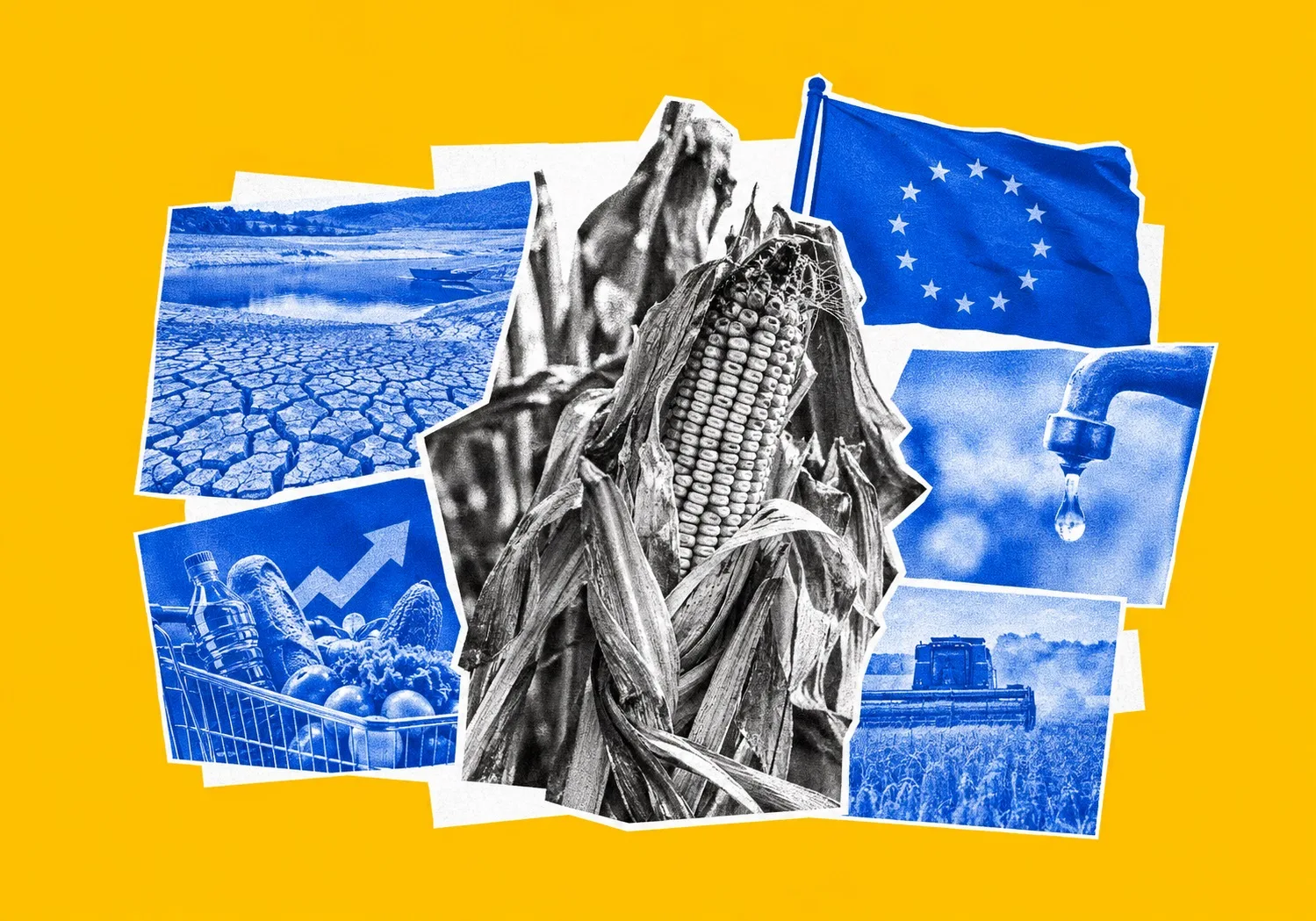
Prolonged summer heat and severe water deficits have pushed the European Union’s maize harvest to a 19-year low, turning an agricultural disaster into a broader economic shock. Across France, Germany, Italy, Central and South-Eastern Europe, sharp crop losses are threatening feed supplies, raising food inflation risks for central banks, and exposing structural gaps in Europe's water governance.
The European Commission’s Joint Research Centre has sharply reduced its outlook for EU summer crops, with forecasts for some crops as much as 14 per cent below the five-year average. Overall EU grain production is projected at 264.8mn tonnes, an 8 per cent decline. Winter cereals offer some protection because much of their harvest was completed before the worst heat arrived. Summer agriculture has had no such buffer.
The summer crop has become the weak point
The geography of the damage matters. The worst conditions have been concentrated in the belt running through central and south-eastern Europe, where high temperatures arrived alongside persistent rainfall deficits and depleted soil moisture.
Hungary provides the clearest measure of the shock. Its maize harvest is expected at about 2.5mn tonnes, less than a third of its 2018-19 level. Yields have fallen to roughly 3.85 tonnes per hectare, 34 per cent below the multi-year average. Some farmers have had to cut crops prematurely for green silage rather than wait for a grain harvest that would no longer justify the cost of keeping the fields standing.
Romania has suffered a similar national decline, with maize output around 8mn tonnes, more than 50 per cent below its earlier peak. But national figures conceal the scale of local destruction. In Bihor county, yields on 40,000 hectares fell below 10 per cent of normal, with output of about 350kg per hectare against a usual six tonnes. Some farms have been pushed towards bankruptcy.
Austria and Slovakia have also recorded major grain losses, while severe stress has affected parts of France, northern and central Italy, southern Germany and Czechia.
This is not simply a matter of insufficient rain.
World Weather Attribution described the 2026 European drought as a compound event in which prolonged precipitation deficits were intensified by extreme heat and rising evaporative demand. Its analysis found that warming had substantially increased the likelihood and intensity of the agricultural drought conditions observed this year.
That distinction is important. A farm can survive an unusually dry season. It becomes much harder to operate when high temperatures simultaneously increase the atmosphere’s demand for water, drain soil moisture faster and arrive during flowering and grain formation.
The result is a different risk profile from the droughts on which much of European agricultural planning has traditionally been based.
From maize fields to supermarket prices
The first economic transmission channel is feed.
Maize is not simply another crop in the European balance sheet. It is an important input for livestock production, so a sharp fall in domestic supply increases pressure on feed markets. Producers of meat, dairy and eggs then face higher input costs, while farms already dealing with poor pasture conditions have fewer alternatives.

Grassland has also suffered across central and western Europe, reducing fodder availability for livestock. The pressure therefore does not stop with grain producers. It spreads through the agricultural supply chain.
The eventual effect on consumers is unlikely to be confined to one commodity. Feed shortages can raise production costs across several livestock sectors, creating another source of food-price pressure after a period in which European policymakers have been trying to bring inflation under control.
Hungary offers an unusually direct example of the monetary-policy problem. The country’s central bank is considering incorporating climate-risk scenarios into its policy framework after extreme heat and drought damaged agriculture and raised concerns about future inflation. A senior MNB official warned in September that recent food-price improvements might not prove durable as weather shocks and other global cost pressures build.
That changes the role of agricultural data for central banks.
A poor harvest used to be treated primarily as a supply-side disturbance. If drought becomes more frequent and severe, monetary authorities have to consider whether such disturbances are temporary enough to ignore or persistent enough to alter inflation expectations and the path of interest rates.
The problem is especially awkward for central bankers because monetary policy works over a much shorter horizon than climate adaptation. A crop failure occurs within months; irrigation networks, crop substitution and water infrastructure take years.
Europe has a water-governance problem
The institutional weakness is becoming harder to separate from the agricultural one.
The EU Water Framework Directive provides the broad legal framework for water management, but drought preparedness remains uneven between member states. World Weather Attribution has pointed specifically to the absence of mandatory drought-management plans as a source of inconsistent preparedness.
The European Commission has already recognised that the problem is broader than emergency relief. Its Water Resilience Strategy, adopted in 2025, aims to improve water management, restore the water cycle, modernise infrastructure and reduce water consumption. More than 50 actions are planned across governance, investment, digitalisation, research and security.
The political difficulty is that water cannot be managed as a purely agricultural resource. Drinking water, ecosystems, energy, industry and farming compete for the same reserves.
That makes drought policy fundamentally different from a conventional farm-support scheme. Paying farmers after a harvest failure compensates for the consequences. It does not change the exposure that produced the loss.
The Commission’s own implementation agenda points towards water-scarcity indicators, technical guidance on drought-management plans, water-efficiency targets, infrastructure investment and greater water reuse. Those measures are now being developed through the Water Resilience Strategy.
The question is whether they can move quickly enough relative to the agricultural adjustment already under way.
The farm model is changing before policy catches up
For farms in the most exposed regions, adaptation increasingly means changing what is grown and how water is used.
Unirrigated grain maize is particularly vulnerable because its commercial value depends on reliable water availability during the summer. Farmers in high-risk areas are therefore being pushed towards drought-tolerant crops such as sorghum and sunflower, earlier-maturing varieties and different rotations. Soil-conservation practices, including no-till systems, can also help retain moisture.

Irrigation is the more obvious solution, but simply expanding irrigation would not resolve the underlying scarcity. The question is whether farms can deliver more crop per unit of water rather than simply consume more water.
That is where precision irrigation, soil-moisture monitoring and improved crop genetics become economic infrastructure rather than optional technology. The European Parliament has explicitly called for support for innovative irrigation, including drip systems, as well as regionally adapted and more drought-resistant crops.
The financial architecture around farmers will have to change alongside the agronomy.
Repeated emergency payouts are difficult to budget when the underlying hazard is no longer exceptional. Public support is likely to become more structured around insurance, shock-responsive protection and co-financed investment in adaptation. World Weather Attribution notes that such mechanisms are already part of Europe’s drought-response landscape, alongside EU agricultural reserve funds.
That still leaves a distributional problem.
A well-capitalised farm with access to irrigation, sensors, resilient seed varieties and insurance can adapt. A smaller unirrigated operation facing a failed harvest, higher borrowing costs and falling land productivity has much less room to manoeuvre.
Climate adaptation can therefore widen the gap between European farms before it closes it.
A new import dependency
There is another adjustment that will take place beyond Europe’s fields.
If EU maize production remains structurally below previous levels, the single market will need more feed from outside the bloc. Exporters in the Americas and non-EU Black Sea markets stand to gain market share, while European buyers become more exposed to international grain prices, shipping costs and currency movements.
That does not mean European food production becomes insecure overnight. The EU has a large internal market and winter cereal production has provided a temporary buffer in 2026. But the distinction between temporary imports during a bad harvest and permanent reliance on external feed supplies is economically significant.
It changes the strategic value of water.
The Commission already describes water security as essential to Europe’s economy, food and energy systems, while its resilience strategy links water management to investment, competitiveness and security.
The 2026 harvest is putting that principle under pressure in a particularly tangible way. Water scarcity is no longer confined to environmental policy departments. It is becoming a variable in food supply, agricultural finance, trade exposure and monetary policy.
The unresolved question is therefore not whether Europe can compensate farmers for one disastrous summer. It is whether the bloc is prepared to redesign production, water allocation and financial risk around a climate in which the disastrous summer is no longer an outlier.
Sources: Miller Magazine, Carbon Brief, Reuters, Europa