
France and Spain push for a more integrated and protected Europe

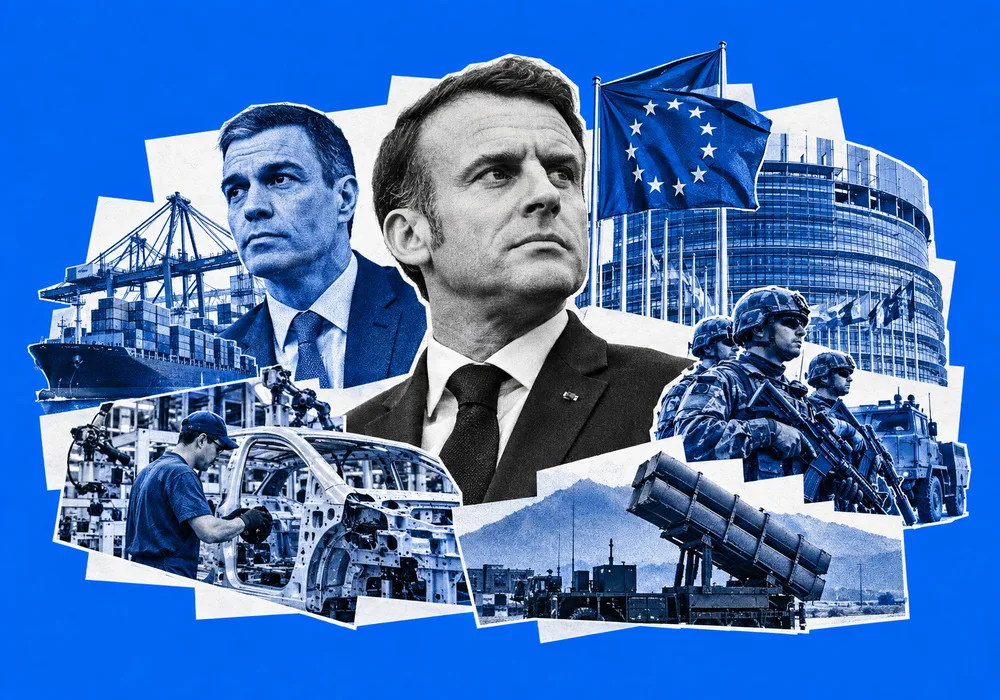
France and Spain are pushing for a stronger and more integrated European Union, combining closer cooperation with Britain with tougher trade safeguards against China. The Franco-Spanish position reflects a wider debate over how the EU can protect its industrial base while remaining open to foreign investment and global trade.
The European Union is gradually moving away from the assumption that economic openness alone can secure prosperity. The emerging model is more defensive: Europe still wants trade, investment and access to global markets, but increasingly wants to control the conditions under which foreign capital, technology and goods enter its economy. The alignment between France and Spain on China and Britain illustrates this shift, linking questions that are rarely discussed together but increasingly form part of the same debate about Europe's economic weight and strategic resilience.
During French President Emmanuel Macron’s state visit to Spain on September 29–30, Macron and Spanish Prime Minister Pedro Sánchez backed stronger European trade defences against China while also welcoming the possibility of Britain moving closer to, or eventually returning to, the EU. There is no immediate process under way for British membership, but the political message from Paris and Madrid is significant: European integration is increasingly being discussed as a source of economic and strategic leverage rather than only as an institutional project.
From free trade to economic security
For much of the post-Cold War period, the EU’s economic model was built around market openness. The bloc expanded the single market, reduced internal barriers and integrated European companies into global supply chains, while access to foreign markets and investment was generally treated as an economic advantage. That model has not disappeared, but the assumptions behind it have changed as geopolitical tensions, industrial competition and supply-chain vulnerabilities have become more important to economic policy.
The European Commission now describes its approach to China as “de-risking, not decoupling”. Brussels continues to support economic engagement with Beijing, but is simultaneously seeking to reduce critical dependencies, address market distortions and strengthen the EU's ability to respond when foreign competition is considered unfair. The result is a gradual expansion of the economic-security agenda into areas that were previously treated primarily as questions of trade policy.
The scale of the imbalance is one reason the issue has become harder to treat as a conventional trade dispute. In the second quarter of 2026, the EU recorded a goods trade deficit of €103 billion with China, according to Eurostat. Machinery, electrical equipment and other manufactured goods are central to this relationship, placing China's industrial capacity directly alongside Europe's debate about competitiveness and the future of its own manufacturing base.
China is testing Europe's industrial capacity
The central concern for European policymakers is not simply that Chinese goods are entering the European market. It is whether European companies can continue competing in sectors that Brussels considers strategically important, particularly as Chinese firms have expanded rapidly in electric vehicles, batteries, machinery, renewable technologies and other advanced manufacturing industries. The question is therefore shifting from how much Europe trades with China to whether that trade strengthens or weakens Europe's own productive capacity.
Spain illustrates the tension particularly clearly. Madrid has sought to attract Chinese investment, including in the automotive and industrial sectors, because such projects can bring capital, manufacturing capacity and employment to the country. At the same time, greater Chinese production inside Europe raises questions about the position of European manufacturers and about how much of the value generated by these investments remains within the European economy.
This is why the emerging European approach is more complicated than simple protectionism. The objective is to continue attracting foreign investment while ensuring that Europe does not become dependent on external companies for technologies, supply chains and production capabilities that are considered strategically important. Trade-defence instruments, investment screening, procurement rules and industrial subsidies are consequently becoming part of the same policy framework.
The China problem is also a scale problem
The difficulty is that individual European states have limited leverage when negotiating with major economic powers. France can pursue its own industrial policy, Spain can compete for foreign investment and Germany can defend its exporters, but divergent national approaches can also reduce the bargaining power of the EU as a whole. The single market gives Europe considerable economic weight, but that weight is most effective when member states use it collectively.
This logic is increasingly visible in European trade policy. A common European instrument can change the incentives facing foreign companies in ways that national measures often cannot, whether through tariffs, procurement rules, investment conditions or access to the single market. The result is a gradual shift towards using the EU's market size as an instrument of economic policy rather than simply treating it as an open marketplace.
The political challenge is that member states do not have identical interests. Countries differ in their dependence on Chinese investment, their exposure to Chinese imports and the importance of exports to their economies. A common China policy therefore requires governments to accept rules that may impose different costs on different national industries.
Britain exposes another weakness in Europe's economic architecture
The discussion about Britain returning to the EU belongs to the same broader story, even though it is politically different from the China debate. British Prime Minister Andy Burnham has said that London should examine different long-term options for its relationship with the EU, while Macron and Sánchez have responded positively to the prospect of Britain moving closer to the bloc. Neither development represents an imminent British return to EU membership, but the discussion reflects a reassessment of the costs of long-term economic and political fragmentation.
Britain remains deeply connected to Europe through trade, defence, energy, technology and security cooperation. Brexit changed the institutional framework governing those relationships, but it did not remove the underlying economic and strategic interdependence. For the EU, the question is therefore not simply whether Britain should rejoin, but how much of the previous level of integration can be restored without reversing Brexit itself.
That distinction matters because closer UK-EU cooperation could become part of a broader effort to rebuild European scale. Britain would not automatically solve the EU's industrial or geopolitical vulnerabilities, and rejoining the bloc would involve substantial political and legal questions. But reducing unnecessary fragmentation between two closely connected economies could increase the efficiency of the wider European economic space.
A larger Europe is becoming an economic argument
This makes the British question more significant than a debate about the legacy of the 2016 referendum. If Europe is entering a period in which market size, industrial capacity and collective bargaining power matter more, fragmentation becomes more costly. The EU remains one of the world's largest markets, but its ability to translate that size into economic influence depends on how effectively its members coordinate.
The same principle is visible in the EU's approach to China. Brussels is increasingly trying to use the scale of the single market as an instrument of economic policy rather than treating it merely as an arena in which European and foreign companies compete. The objective is to preserve the benefits of openness while making access to the European market part of a broader framework of reciprocity and economic security.
This represents an important change in the philosophy of integration. The European project was historically associated with removing barriers between European economies and creating a larger common market. Increasingly, integration is also being presented as a way of giving Europe enough scale to negotiate with much larger economic powers and to protect industries that individual member states would struggle to defend alone.
The next phase of integration may be about resilience
Europe's economic debate is therefore moving towards resilience. The issue is no longer simply whether globalisation produces cheaper goods or greater investment, but whether the European economy can absorb external shocks without losing control over strategically important sectors. That has made policies such as industrial subsidies, investment screening, supply-chain diversification and trade-defence measures more central to the EU's economic agenda.
This does not mean that Europe is abandoning free trade. The EU remains dependent on global markets and continues to seek economic engagement with China, while its relationship with Britain is likely to remain economically significant regardless of the country's formal membership status. What is changing is the definition of acceptable interdependence: Europe increasingly wants to remain connected to global markets without allowing critical dependencies to become strategic vulnerabilities.
France and Spain are placing themselves at the centre of this discussion by connecting stronger European trade defences with a more integrated European political and economic space. Their position suggests that the next stage of European integration may be driven less by the traditional question of expanding the single market and more by the need to make that market a source of resilience and bargaining power.
The debate over Britain's future relationship with the EU and the debate over China's role in the European economy are therefore part of the same structural transition. Europe is moving towards a model in which openness is balanced by industrial capacity, reciprocity and strategic resilience, with the size of the European market itself becoming one of the bloc's most important economic tools.
Sources: European Commission, Eurostat