
Fire Destroys Marché des Enfants Rouges, Paris’s Oldest Covered Market

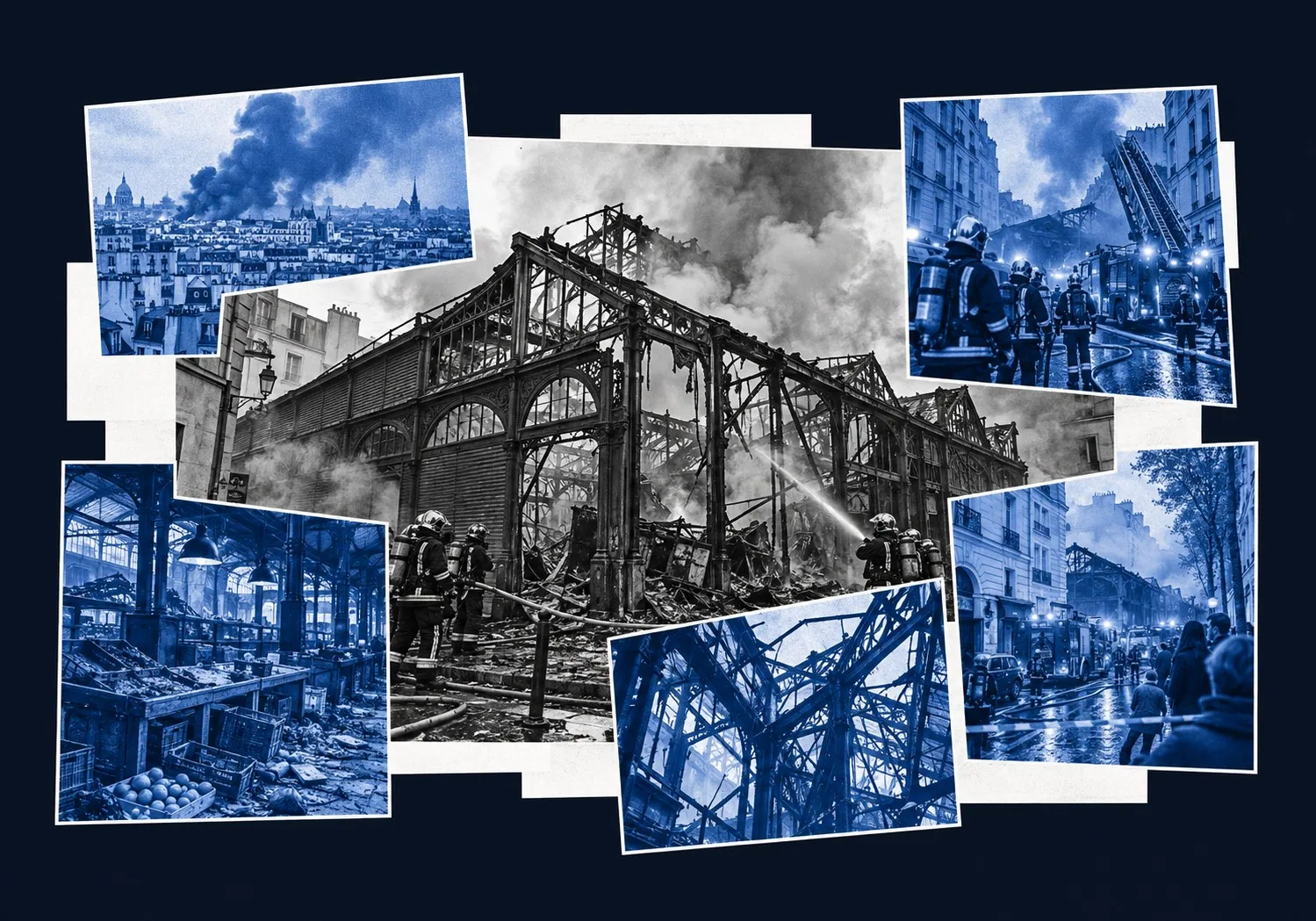
A fire destroyed the Marché Couvert des Enfants Rouges in the Marais district of Paris shortly after 03:00 on Monday. It was the capital's oldest covered food market. By daybreak, fire service officials confirmed that the internal metal frame had partially collapsed. Lieutenant Colonel Pierre de Bouvier told reporters at the scene that nothing was left of the roofed structure. Crews kept the flames from spreading to nearby housing blocks, and only one firefighter suffered minor injuries. The cause remains unknown. What the incident makes clear, however, is the recurring difficulty City Hall faces when trying to safeguard working historical structures.

The site carried centuries of history.
Its name came from a hospice founded in 1534 by Marguerite de Navarre, sister of King François I, where abandoned children wore red clothes that signified Christian charity.
When the market opened in 1615 under King Louis XIII, people kept the name.

The venue outlasted French kings, revolutions, and the heavy urban planning of the 19th century before overnight flames brought it down.
In recent years, it had built an international reputation alongside its local trade; Food & Wine ranked it fifth globally for street food, just behind spots in London, Bangkok, Lyon, and Mexico City.
Today, stallholders, local shoppers, and the wider neighbourhood trade are left coping with a sudden loss that shows just how fragile timber and iron landmarks remain in dense urban streets.
Notre-Dame was no isolated case
Monday's fire fits into a wider series of losses.
Over the past decade, flames have repeatedly damaged old architecture across the capital.
In April 2019, a major fire hit Notre-Dame Cathedral, destroying its 13th-century wooden roof framework and sending the 96-metre spire crashing down on live television. Firefighters saved the main stone towers and key relics, allowing a five-year rebuild that ended with the cathedral reopening in December 2024.
Then, in January 2025, an overnight fire broke out at the 19th-century town hall of Paris's 12th arrondissement.
The blaze gutted the upper floors and destroyed the 35-metre belfry built in 1887. Coming alongside the destruction of the Marché des Enfants Rouges, these events point to an ongoing problem for city authorities: keeping historic structures safe while they remain in active daily use.

The conflict between heritage and daily use
France relies heavily on legal rules to protect historical spaces from real estate developers.
During the early 20th century, the Marché des Enfants Rouges lost trade as consumer habits changed and Baron Haussmann modernized the city's street layout. By the 1980s, the site was marked for redevelopment.
A campaign by local residents and shopkeepers turned things around, saving the venue and securing its official status as a historical monument in 1982. Renovations in the 1990s rebuilt the frame and brought in updated utilities.
Yet heritage status does not stop physical accidents.
Working markets come with real practical risks. Kitchen equipment, heavy electricity use, constant food preparation, and steady crowds place daily stress on old buildings. Fitting modern safety systems into 17th-century wood and metal framing creates tough engineering problems. Museum spaces can be locked up at night; working food halls cannot simply be turned into static exhibits.
Displaced trade in the Marais
The immediate impact falls on independent traders and food artisans who lost their stalls, equipment, and stock overnight. For people living in the Marais, the market was simply part of daily life—a place to buy fresh food and meet neighbours.
It was also a major pull for visitors.
By drawing tourists into the district, the market helped support smaller businesses nearby. Surrounding cafes and shops may catch some of the displaced foot traffic in the coming weeks. Rebuilding a specialized hub of independent stallholders inside a historic frame, however, is a far harder task for the local council.
Ariel Weil, mayor of the central Paris district, said he was relieved that neighbouring residential blocks were saved.
Fire crews managed to hold the perimeter. Even so, local officials now face difficult legal and structural questions over how to rebuild a listed monument that has been stripped back to ruined metal.

Rethinking safety in ancient spaces
This fire forces a fresh look at safety standards and risk management across aging municipal sites in European cities.
Urban planners often encourage turning old buildings into active commercial venues to keep city centres lively. Yet standard fire rules and heating regulations frequently run into conflict with strict preservation laws that limit changes to 17th-century structures.
Moving forward, city planners and conservation bodies will have to rethink how they manage fire risks in older commercial properties. Preserving historic buildings means little if the safety systems inside them cannot handle the demands of modern trade. Without better technical solutions, historic markets in older European capitals will stay exposed to sudden fires.