
Fico’s Article 5 Refusal: How Slovakia Is Testing NATO’s Eastern Flank

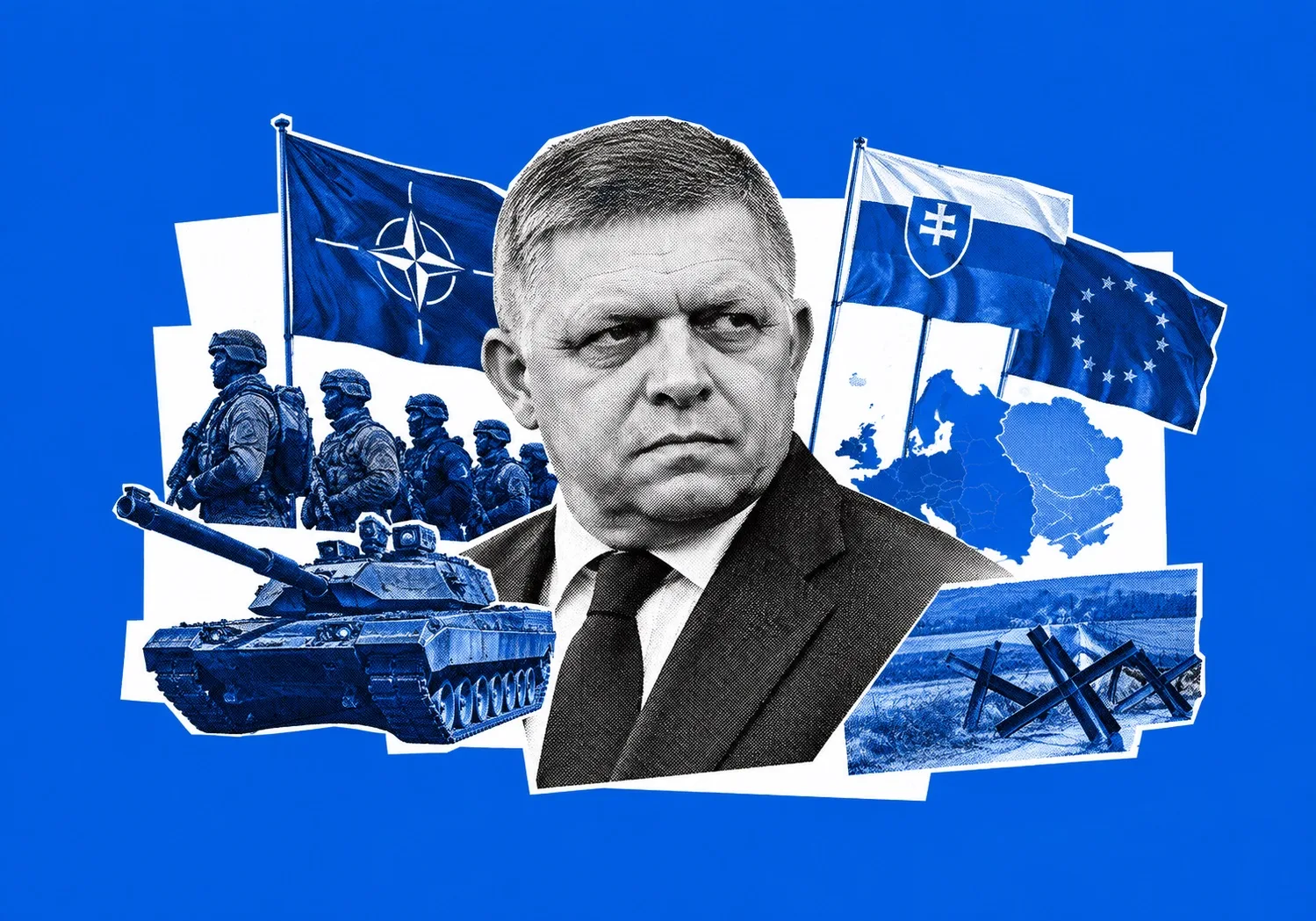
Slovak Prime Minister Robert Fico has declared that Slovakia will not participate in defending NATO allies if Russia attacks, directly questioning the Alliance’s collective defence obligations. Speaking in Prešov ahead of a trip to Kyiv, Fico promised to keep his country out of any conflict triggered “because of some Article 5.” While Slovakia cannot legally bypass its treaty duties through rhetoric alone, the Prime Minister's stance exposes a critical political rift on NATO's eastern frontier.
Fico presented Article 5 as though an attack on a NATO member could automatically result in demands for thousands of Slovak troops to fight a war whose purpose Bratislava had not accepted. He cited hypothetical deployments of 5,000 to 10,000 soldiers and questioned why Slovak forces should be committed in such circumstances.
That is not how Article 5 works.
The North Atlantic Treaty establishes that an armed attack against one member is considered an attack against all. But the assistance each ally provides is determined nationally. The treaty requires members to take “such action as it deems necessary”, rather than prescribing a fixed military contribution.
That distinction matters. An ally responding to an Article 5 situation could provide ground forces, air defence, intelligence, logistics, cyber support or other forms of assistance. The provision does not create an automatic requirement to send a specified number of soldiers, nor does it amount to an automatic declaration of war.
Fico's criticism therefore rests partly on a description of Article 5 that is legally inaccurate. Yet the political problem created by his remarks remains even after that correction.
The flexibility built into Article 5 gives governments room to determine the form of their response. It does not make the underlying commitment politically meaningless. If a member's prime minister publicly says that he intends to prevent his country from participating in collective defence, other allies have to consider what that declaration means when translating NATO plans into real military assumptions.
NATO has no simple disciplinary answer
There is also a striking institutional asymmetry at work.
The treaty contains a mechanism for leaving NATO. Under Article 13, a member can withdraw by submitting formal notice to the United States, with the withdrawal taking effect one year later. Fico has not done this.
The treaty does not, however, provide a corresponding mechanism for expelling a member because its government publicly rejects the political or military expectations of collective defence. There is no straightforward procedure by which NATO could declare Slovakia out, impose a formal treaty penalty or strip it of membership rights because of Fico's speech.
That leaves the Alliance with political rather than judicial tools.
NATO can isolate governments politically. Allies can adjust the degree to which they rely on a particular partner. Military planners can develop contingencies that assume less political cooperation from an unreliable member. Intelligence, logistics and operational planning can be organised with greater emphasis on alternative routes and forces.
None of those measures changes the treaty.
That is precisely why the issue is more consequential than a dispute over Fico's wording. The Alliance can preserve the formal architecture of collective defence while quietly changing the assumptions underpinning its operational planning.
Geography turns political uncertainty into a military problem
For Slovakia's neighbours, this is not simply a question of diplomatic credibility.
An eastern European crisis would depend heavily on the movement of forces, supplies, intelligence and air-defence capabilities across national territory. Slovakia's position places it within the broader network connecting NATO's eastern members and military infrastructure.
If Bratislava were politically reluctant to support an allied response, neighbouring states such as Poland, Czechia and the Baltic countries would have to account for that uncertainty. The issue would not necessarily be whether Slovakia formally blocked a particular operation. It would be whether military planners could confidently assume access to Slovak territory, airspace, logistics networks and other forms of support in a rapidly developing emergency.
That is the practical meaning of a politically fragmented eastern flank.
NATO's deterrence model works most effectively when potential adversaries have to calculate against a coherent set of capabilities and political commitments. Once individual governments begin signalling that their participation could depend on domestic political considerations, the calculation becomes more complicated.
The danger is not that every NATO operation suddenly becomes impossible. It is that the Alliance has to plan around uncertainty that did not previously need to be treated as a central variable.
Slovakia's political split adds another layer
Fico's position is not synonymous with the position of the Slovak state as a whole.
President Peter Pellegrini has continued to emphasise the importance of Slovakia's relationships with NATO and the EU. The contrast creates a visible division within the country's leadership over the role Slovakia should play in Europe's security architecture.
That matters because Fico's statement was made not as an opposition politician but as prime minister. His government controls the executive machinery through which foreign and security policy is implemented. At the same time, Pellegrini's position shows that Slovakia's political institutions do not speak with one voice on the country's relationship with its allies.
The disagreement also follows a broader trajectory in Fico's foreign policy since his return to power in autumn 2023. His government halted Slovak state military aid to Ukraine, opposed Ukraine's NATO membership and repeatedly challenged European military and financial support for Kyiv. Fico has also met Vladimir Putin in Moscow and used Slovakia's dependence on Russian energy, including oil delivered through the Druzhba pipeline, as political leverage in disputes over sanctions.
The latest statement takes that approach into a different arena.
Opposition to support for Ukraine can be presented as a national policy choice. Questioning whether Slovakia would defend another NATO member raises the issue of Slovakia's own place within the collective security system.
The contrast with Britain's military posture is revealing
The political fracture is becoming more visible because it exists alongside efforts by other allies to reinforce the eastern flank.
NATO Secretary General Mark Rutte has warned that Russian strikes near NATO territory are intended to spread fear and fracture Allied solidarity. Britain, meanwhile, has reaffirmed that the overwhelming majority of its armed forces are committed to NATO collective defence plans, including preparations to secure vulnerable areas such as the Suwalki Gap.
The contrast is between two different approaches to the same security environment.
One treats military integration and credible readiness as the means of deterring a wider conflict. The other places national political control over participation at the centre of the debate.
Both positions can exist within NATO's legal framework. That is what makes the problem difficult.
The Kremlin does not need Slovakia to leave NATO
For Moscow, the strategic value of the dispute does not depend on Slovakia formally abandoning the Alliance.
A NATO member publicly questioning Article 5 already creates a political problem. It gives Russia evidence that the Alliance's internal cohesion can be contested from within, without any treaty withdrawal or formal institutional rupture.
That does not mean Slovakia has ceased to be a NATO ally, nor that Fico's remarks automatically alter the Alliance's legal commitments. It means that deterrence has acquired an additional political variable.
NATO headquarters had issued no direct public response or disciplinary measure over Fico's speech as of September 18. That silence is significant less as an indication of acceptance than because the Alliance has few formal mechanisms for disciplining a member over such a declaration.
The practical response is therefore likely to be found in planning rather than treaty law: ensuring that collective defence does not depend on every government making identical political calculations at the moment of crisis.
That creates an uncomfortable possibility for NATO's eastern flank. The Alliance may remain formally indivisible while its military planners increasingly have to distinguish between members whose political commitments can be assumed and members whose participation may need to be treated as conditional.
The treaty can accommodate national discretion. Deterrence is less forgiving.
Sources: Slovak Prime Minister Robert Fico during a speech to students, NATO, London Loves Business, Kyiv Independent