
Europe’s Ukraine Coalition Moves Into a More Permanent Security Role

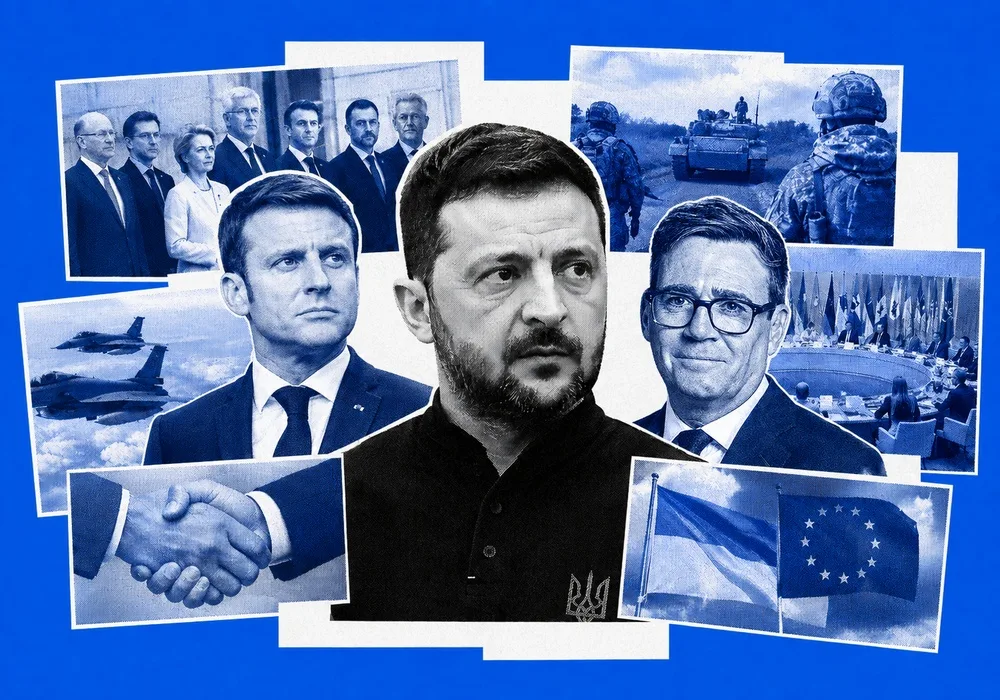
Europe’s Coalition of the Willing is evolving from a diplomatic grouping into a long-term European security mechanism, with France, Britain and Germany taking a central role in coordinating military support and planning security guarantees for Ukraine.
France, Britain and Germany will take the lead in another meeting of the Coalition of the Willing on Monday, bringing Europe’s main military and political powers together with Ukraine as the war enters another critical phase.
French President Emmanuel Macron, British Prime Minister Andy Burnham and German Chancellor Friedrich Merz will co-chair the meeting, while Ukrainian President Volodymyr Zelenskyy will participate from Kyiv. European Council President António Costa is expected to attend in person, with NATO Deputy Secretary General Radmila Šekerinska joining remotely.
The format itself has become increasingly important. What began as a political grouping focused on preparing security arrangements for Ukraine after a potential ceasefire is evolving into one of Europe’s main mechanisms for coordinating military support, diplomatic pressure and longer-term security planning.
The coalition is becoming Europe’s security platform
The significance of Monday’s meeting lies less in the individual participants than in the role the coalition is beginning to play.
The European states supporting Ukraine face a strategic problem that extends beyond the immediate battlefield. They need to maintain military assistance while preparing for a possible settlement with Russia, including decisions over security guarantees, defence production and the future European military presence in and around Ukraine.
The E3 — France, Britain and Germany — has increasingly functioned as the political core of this effort. The three governments have already stressed that Europe must have a central role in any future settlement and that Ukraine’s security cannot be separated from European security.
Monday’s meeting therefore comes at a point when the coalition is being asked to move from declarations towards mechanisms that can survive political uncertainty.
Kyiv remains at the centre of the discussions
Zelenskyy’s participation from Kyiv is particularly significant after a series of heavy Russian attacks on the capital. His government has continued to press European partners for stronger air defence, greater military assistance and more pressure on Moscow.
The message from the European side is expected to remain centred on maintaining Ukraine’s ability to defend itself. Macron’s office said the leaders would reaffirm their determination to strengthen support for Ukraine in response to Russian aggression.
That focus reflects a broader calculation in European capitals: negotiations cannot become a substitute for military capacity. If Ukraine enters any future talks from a position of weakness, European governments would have less influence over the terms of a settlement and fewer tools to deter Russia from using a pause in fighting to rebuild its forces.
This is why support for Ukraine is increasingly being treated as a long-term European security policy rather than solely as emergency wartime assistance.
The difficult part comes after the political statements
Europe has already agreed on many of the principles surrounding a possible peace settlement. Earlier E3 discussions with Zelenskyy stressed the need for a ceasefire, credible security guarantees for Ukraine, continued European involvement and the preservation of frozen Russian assets until Moscow meets its obligations.
The harder question is implementation.
A credible security architecture would require decisions about who provides guarantees, what military capabilities remain available to Ukraine, how European forces could contribute after a ceasefire and how quickly European defence industries can replace equipment and ammunition used during the war.
Those questions cannot be solved through a single summit. They require sustained coordination between national governments, the EU, NATO and Ukraine.
The Coalition of the Willing is increasingly filling precisely that gap. It operates outside the formal structures of NATO and the EU, allowing governments that are prepared to act more quickly to coordinate directly while still connecting their efforts to wider European and transatlantic institutions.
Europe is preparing for a war that may outlast the diplomacy
The renewed meeting also highlights a central reality of the European security debate: diplomatic activity has not removed the military dimension of the war.
European governments are simultaneously preparing for negotiations and for the possibility that fighting will continue. That dual-track approach is becoming the foundation of the coalition's strategy.
The objective is not simply to demonstrate political unity around Ukraine. It is to make European support sufficiently durable that Russia cannot assume that military pressure, prolonged negotiations or political fatigue will eventually fracture the coalition.
For France, Britain and Germany, Monday’s meeting is therefore another test of whether Europe can translate its increasingly explicit responsibility for Ukraine’s security into a functioning system of long-term military and political coordination.
The coalition’s importance will ultimately be measured not by the statement issued after the meeting, but by what European governments are prepared to commit once the cameras are gone.
Sources: UK Parliament, Office of the President of Ukraine, Reuters, Kyiv Independent