
EU Duty on Temu and Shein: How New Customs Fees Are Ending Europe’s Cheap Online Shopping Era

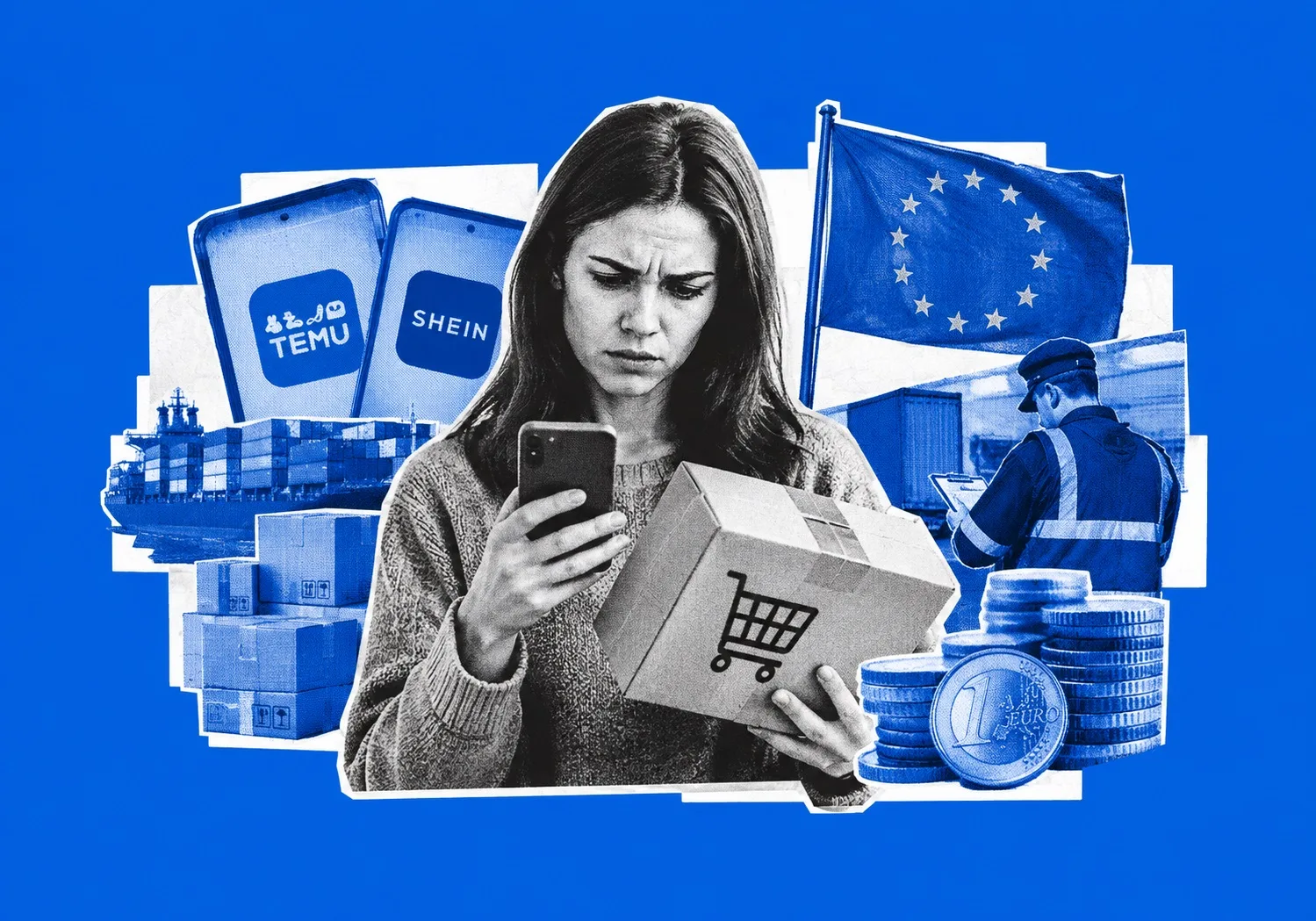
New EU customs fees targeting low-value parcels from platforms like Temu, Shein, and AliExpress are reshaping the economics of cross-border online shopping. Following a €3 customs duty introduced in July on imported packages under €150, an additional €2 handling fee takes effect on 1 November. For major Asian e-commerce giants, these fixed levies do more than raise prices for consumers - they fundamentally threaten the direct-from-factory business model that previously relied on tax-free loopholes.
For consumers, the immediate impact depends on what they buy and how an order is assembled. The €3 duty applies to each product category within a package, rather than to every individual item. Three T-shirts in the same category therefore attract €3 in customs duty, while adding a toy creates a second category and raises the duty to €6. From November, the additional €2 handling fee per item position increases the total cost further.
These fixed charges are particularly significant for inexpensive goods. A small gadget or garment priced at €3–€5 can become considerably more expensive once the new levies are passed on to the customer. The fees are formally payable by sellers or importers, but platforms have been transferring the costs into retail prices.
That creates a political complication for the EU. The policy is intended to correct an imbalance between overseas platforms and European retailers, which must account for customs procedures, product safety obligations and other regulatory costs. Yet some of the immediate burden falls on consumers who rely on low-priced clothing, household accessories and everyday goods.
The distribution of the costs matters. Established retailers may regain some room to compete, but the advantage is not automatically theirs. Consumers can buy less, switch platforms or change their shopping habits. Foreign sellers can also reorganise their distribution networks.
The EU is therefore testing whether a modest charge, applied at scale, can alter commercial behaviour across an enormous market.

Brussels is targeting the business model, not just the parcel
The previous €150 customs duty exemption was designed for low-value trade, when the administrative cost of collecting duties could outweigh the revenue involved. The rapid expansion of direct-to-consumer e-commerce changed the calculation. A concession intended to simplify small transactions became a significant competitive advantage for platforms shipping vast numbers of inexpensive products into Europe.
The new charges are an interim measure in a wider customs overhaul. The longer-term plan, scheduled for full implementation after 2028, removes the duty-free threshold altogether and moves towards taxation from the first euro. A central European Digital Customs Data Hub is intended to support that system.
The fiscal argument is straightforward: low-value goods should no longer enjoy a special customs treatment simply because they arrive in small packages. But the institutional change is just as important.
Brussels is also seeking to make online marketplaces legally responsible for the products they organise for sale. Rather than treating platforms as digital intermediaries connecting buyers and sellers, the emerging framework places them in the position of importers, with direct obligations relating to product safety and regulatory compliance.
That shift changes the relationship between scale and accountability. A platform can operate across borders, reach millions of customers and control the terms of a transaction without maintaining the same physical presence as a conventional retailer. Importer liability makes that separation harder to sustain.
The €200 million fine imposed on Temu over failures to comply with product safety requirements illustrates the financial consequences of regulatory enforcement. Customs charges and product compliance are separate issues, but together they point towards the same direction of travel: access to the European market is increasingly tied to accepting European rules.
Warehouses become a strategic necessity
The platforms are not waiting passively for the full reform. Temu, Shein and AliExpress are expanding their use of distribution warehouses inside the EU, shifting away from a model dominated by individual shipments from outside the bloc.
The distinction is important. A platform that imports goods in bulk into European warehouses must absorb storage and distribution costs, but it can then fulfil customer orders from within the Single Market. This changes the economics of the final delivery and the way customs costs are incurred.
It also creates a new set of commercial dependencies. Local warehousing requires inventory management, physical infrastructure and a greater commitment of capital. The direct-from-factory model minimised some of those requirements by allowing products to move towards individual customers only after an order was placed.
A shift towards European fulfilment could consequently benefit local warehouse operators and logistics businesses even as direct postal and air-cargo volumes decline. The policy is not simply reducing trade. It is changing where goods enter the market, how they are stored and which businesses capture the value of moving them.
For European governments, that is an attractive prospect. A greater share of the supply chain becomes visible to customs authorities and easier to regulate. For the platforms, however, the choice is increasingly between absorbing additional costs and building a more conventional European operating model.
Germany’s retail industry association, HDE, argues that the €3 duty will not be enough to curb the platforms over the longer term. Warehouses within the EU could weaken the effect of charges aimed at direct cross-border parcels, while the underlying differences in business costs remain. The association favours stricter enforcement and the complete removal of duty-free thresholds.
Its position exposes a limit to the interim policy. A charge on the route by which goods arrive is not necessarily a lasting constraint on the businesses selling them. If platforms adapt their logistics successfully, the competitive contest will shift towards the costs of compliance, distribution and inventory rather than the customs treatment of individual packages.
France adds an environmental test
France has gone further by introducing a national surcharge targeting ultra-fast fashion, effective from September 2026. Unlike the general EU measures, which address customs and handling, the French system targets products according to factors including high turnover and the relationship between repair costs and purchase prices.
The charges vary by garment. Underwear attracts an additional €0.50 per item, T-shirts €2, jeans €9 and jackets or coats €12 in 2026. The charge on jackets and coats is scheduled to rise to €19.50 per unit by 2030, subject to a cap of 50% of the retail price before VAT.
A coat shipped directly to a French customer can therefore face €17 in combined EU duties and fees and national surcharges before VAT, assuming the relevant EU charges apply to that shipment.
The French approach turns a customs dispute into a broader argument about the environmental and economic costs of disposable fashion. It also creates a potential source of friction between national policy and the EU’s common trade framework.
China’s Ministry of Commerce has condemned the French measure as discriminatory, arguing that it could conflict with World Trade Organization principles. Beijing has taken a more restrained approach to the wider EU customs duty. Chinese Commerce Minister Wang Wentao and European Commission trade commissioner Maroš Šefčovič have agreed to establish a joint mechanism to monitor trade flows, without an immediate move towards retaliatory tariffs.
That distinction leaves room for negotiation, but it also shows how quickly domestic industrial and environmental policies can become international trade disputes.
The political price of a more equal market
The economic case for reform is strongest where it addresses a genuine difference in regulatory treatment. European retailers have long argued that direct-shipping platforms can compete on prices while avoiding some of the costs imposed on businesses importing and selling goods through conventional channels. The decline in parcel volumes and platform traffic indicates that even relatively small charges can change consumer behaviour.
In Germany, sales for Temu, Shein and AliExpress fell by 35.5% following implementation, while July web traffic across the EU dropped by 36.4% for Temu and 42.3% for Shein. AliExpress recorded a smaller decline of 10.4%. Hungary also saw approximately 750,000 fewer cross-border consumer orders from outside the EU in the second quarter of 2026 than in the first.
These figures point to a sharp adjustment, although they do not establish that customs charges alone account for every decline. They nevertheless suggest that the direct-shipping model is vulnerable to changes in its cost structure.
The gains are uneven. Traditional retailers and domestic e-commerce businesses may find it easier to compete, while member-state budgets stand to collect additional revenue. Low-income households, meanwhile, face higher prices on goods for which affordability is often the principal attraction. Businesses involved in direct parcel delivery could lose volume even as European fulfilment centres gain new customers.
The EU is also following a wider international movement away from preferential customs treatment for low-value imports. The United States has moved to restrict and eliminate its own de minimis threshold, reinforcing the direction of European policy. What was once treated as a practical accommodation for small purchases is increasingly viewed as a loophole that large digital businesses can exploit at scale.
The next test will come as the EU moves towards its post-2028 customs regime. Taxation from the first euro, supported by centralised data collection, would make the current €3 duty and €2 handling fee part of a transitional system rather than the final settlement.
For Brussels, the challenge is to ensure that the new rules apply consistently across member states and business models. For the platforms, the central calculation is changing: the question is no longer how cheaply an individual parcel can cross a border, but how much European infrastructure, regulatory responsibility and inventory a business must maintain to keep selling into the market.
Sources: European Commission, Der Spiegel, Euronews, Le Monde, AA,