
Dodik Says He Sought Schmidt’s Removal During US Sanctions Talks

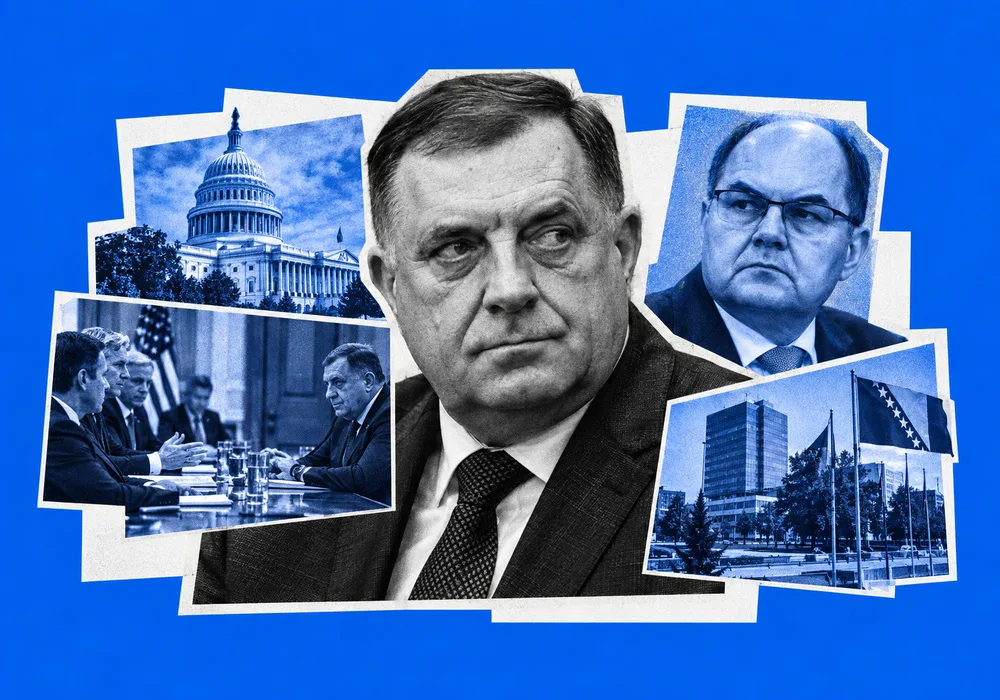
Milorad Dodik says he asked the Trump administration to secure Christian Schmidt’s departure during negotiations over US sanctions relief. The claim comes amid growing divisions between Washington and European partners over international oversight and Bosnia and Herzegovina’s fragile post-war political settlement.
Milorad Dodik’s account of negotiations with the Trump administration raises questions about Washington’s shifting approach to Bosnia and Herzegovina and the future of international oversight in the Western Balkans.
Milorad Dodik, the former president of Republika Srpska, has claimed that he asked the Trump administration to secure the departure of Christian Schmidt, the former international High Representative for Bosnia and Herzegovina, during negotiations that led to the lifting of US sanctions against him. The remarks, made in an interview with Serbia’s Radio Television of Serbia (RTS) on 12 October, offer a new account of the political bargaining surrounding the sanctions decision and Schmidt’s departure.
Dodik said US officials had asked Republika Srpska to repeal several laws that had been annulled by Bosnia and Herzegovina’s Constitutional Court. He claimed he agreed to the request but considered it insufficient and demanded that Washington also act against Schmidt. Dodik subsequently suggested that he could not establish whether US officials had followed his request directly, arguing instead that circumstances had developed in a way that led to the High Representative’s departure.
He did not identify the American officials allegedly involved in the discussions or provide evidence that Schmidt’s departure had been agreed as part of the sanctions negotiations. His account therefore remains an unverified claim rather than an established explanation for the decisions taken in Washington or Schmidt’s resignation.
From sanctions to political concessions
The US Treasury removed Dodik, members of his family, political associates and affiliated companies from its sanctions list on 29 October 2025. The restrictions had been imposed in response to actions that Washington considered to undermine Bosnia and Herzegovina’s constitutional order and the implementation of the Dayton Peace Agreement, which ended the Bosnian war in 1995.
Dodik had first been sanctioned by the United States in 2017, with further measures introduced in 2022. His confrontation with state institutions intensified as Republika Srpska’s leadership challenged the authority of Bosnia and Herzegovina’s central institutions and rejected decisions issued by the international High Representative.
The lifting of sanctions followed steps by Republika Srpska’s authorities to reverse some of the measures that had challenged state-level institutions. Washington welcomed the moves as contributing to de-escalation, although the Treasury’s announcement did not provide a detailed explanation of the decision to remove the sanctions.
Dodik’s latest statements frame the outcome as a negotiation in which he sought concessions beyond the reversal of the disputed laws. If his account accurately reflects the issues raised during the discussions, it would suggest that the future of international oversight in Bosnia and Herzegovina became part of the political calculations surrounding sanctions relief. However, the available information does not independently establish that Washington accepted such a condition.
Schmidt’s departure and the role of Washington
Schmidt announced his resignation in May 2026, after serving as High Representative since 2021. He initially described his departure as a personal decision but later said he had faced substantial and unexpected pressure from the United States to leave earlier than planned.
His departure has consequently become part of a wider debate over the Trump administration’s policy towards Bosnia and Herzegovina. Schmidt had repeatedly clashed with Dodik over the latter’s efforts to weaken the authority of state institutions and challenge the international framework established after the war.
The Office of the High Representative (OHR) was created under the post-war arrangements to oversee implementation of the Dayton Peace Agreement. Its powers have made it a central institution in Bosnia and Herzegovina’s political system, allowing the High Representative to intervene when local authorities obstruct the implementation of the peace settlement.
Dodik has long rejected Schmidt’s legitimacy and sought to reduce or eliminate the office’s influence. His political campaign against the High Representative has formed part of a broader confrontation over the distribution of powers between Bosnia and Herzegovina’s central government and Republika Srpska, one of the country’s two constituent entities.
Schmidt’s resignation does not, in itself, mean that the OHR has been abolished. The office remains part of the international framework for safeguarding the peace settlement, and the selection of a successor has implications for the future of international involvement in the country.
The circumstances of Schmidt’s departure have nevertheless raised questions about the degree to which US policy may be shifting away from the previous emphasis on institutional enforcement and towards a more transactional approach to regional diplomacy.
Republika Srpska’s strategy and the wider regional stakes
Dodik’s account also needs to be viewed against Republika Srpska’s sustained efforts to influence decision-making in Washington. Its authorities have invested substantial public funds in lobbying and political consultancy in the United States, seeking sanctions relief and greater international acceptance of their position in the dispute over Bosnia and Herzegovina’s constitutional structure.
The lifting of sanctions was a significant political victory for Dodik, who remains influential despite being barred from holding the presidency of Republika Srpska. He continues to lead the ruling Alliance of Independent Social Democrats (SNSD), retaining a central role in the entity’s political life.
His position has also attracted scrutiny because of his longstanding ties with Russia and his opposition to Western policies that support Bosnia and Herzegovina’s territorial integrity. Moscow has consistently challenged aspects of international oversight in the country, while Dodik has maintained close political relations with Russian President Vladimir Putin.
For European governments, the central issue is whether changes in Washington’s approach could weaken the international mechanisms that have helped contain political disputes in Bosnia and Herzegovina since the 1990s. A reduced willingness by the United States to support those mechanisms could place greater responsibility on the European Union to defend the Dayton framework and respond to attempts to undermine state institutions.
The EU already faces a difficult balance between supporting Bosnia and Herzegovina’s European integration and managing political obstruction by leaders who oppose the central government’s authority. If US policy becomes more focused on bilateral concessions and political deals, European governments may find it harder to maintain a coordinated Western position.
Dodik’s statements do not prove that Schmidt’s departure was exchanged for sanctions relief. They do, however, bring renewed attention to the relationship between US diplomatic decisions, lobbying efforts and the future of international supervision in Bosnia and Herzegovina. The broader question is whether the Western approach to the country will continue to prioritise the implementation of the Dayton Peace Agreement or increasingly accommodate political actors seeking to reshape its institutional balance.
Sources: European Western Balkans, Office of the High Representative