
Bosnia Raises Serbia and Republika Srpska Concerns at UN

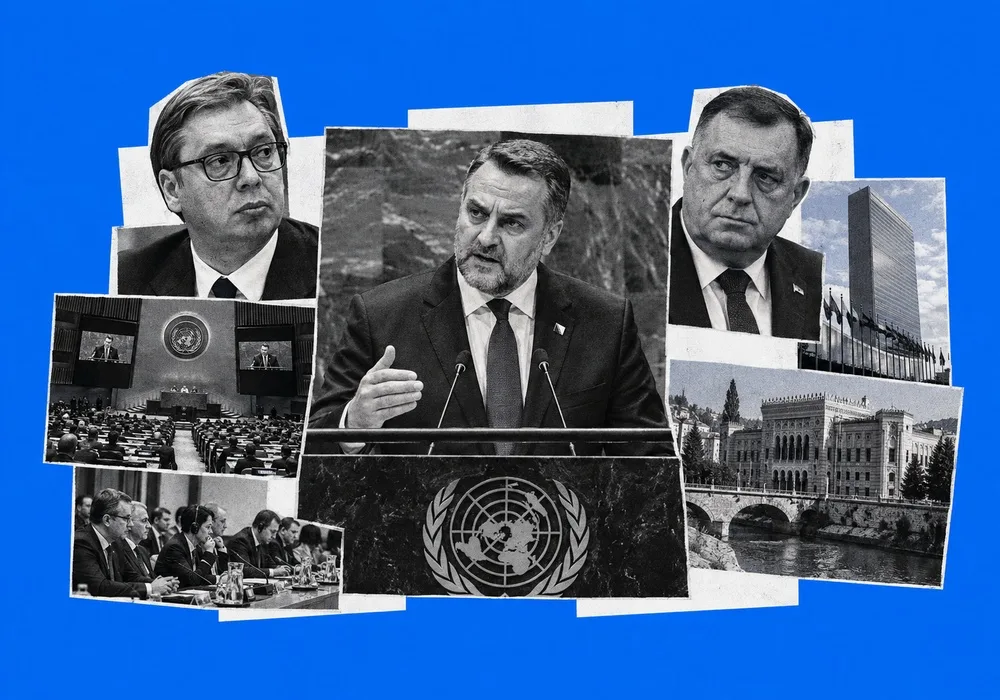
Bosnia and Herzegovina used the UN General Assembly to criticise Serbia over the public and institutional glorification of convicted war criminal Ratko Mladić while warning that political challenges from Republika Srpska continue to raise concerns over the country's constitutional order and regional stability.
Bosnia and Herzegovina used the opening days of the UN General Assembly to raise concerns over Serbia’s treatment of convicted war criminal Ratko Mladić and renewed political tensions surrounding Republika Srpska, linking both issues to the wider question of regional stability and respect for international law.
Addressing the 81st UN General Assembly in New York on September 23, Denis Bećirović, chairman of the tripartite Presidency of Bosnia and Herzegovina, said the public and institutional glorification of Mladić represented a challenge to the international legal order. He called on the UN, the EU and other international actors to respond to the practice of honouring individuals convicted by international courts.
Mladić’s funeral brings the war legacy back into focus
The dispute follows the death of Mladić, the former commander of the Bosnian Serb Army, who died in August while serving a life sentence. He was convicted by the International Criminal Tribunal for the former Yugoslavia in 2017 of genocide, crimes against humanity and violations of the laws or customs of war. His conviction and life sentence were upheld on appeal in 2021.
Mladić was subsequently buried in Belgrade on September 7 in a ceremony that included military and official elements. The event drew criticism from Bosnia and Herzegovina and other governments and institutions across the region, with concerns focused on the public presentation of a person whose responsibility for some of the worst crimes of the Bosnian war had been established by final international judgments.
The UN had already expressed concern over the public commemoration of Mladić. On September 9, UN Special Adviser on the Prevention of Genocide Chaloka Beyani said that the large-scale public commemoration, including the participation of political figures and official ceremonial elements, was deeply inappropriate. He warned that glorification and genocide denial undermine accountability, reconciliation and sustainable peace in the region.
The issue was subsequently raised directly at the highest level of the UN. During a September 21 meeting with Bećirović, Secretary-General António Guterres reiterated that the organisation had condemned the glorification of Mladić and said such actions were incompatible with legal and civilisational norms.
Sarajevo links Mladić’s glorification to international justice
For Sarajevo, the controversy is not limited to the funeral itself. Bećirović presented the treatment of Mladić as part of a broader dispute over whether the findings of international courts and the established facts of the Bosnian war are being respected.
He referred to the UN General Assembly resolution adopted in May 2024 establishing July 11 as the International Day of Reflection and Commemoration of the 1995 Genocide in Srebrenica. The resolution was presented by Bosnia and Herzegovina as an international recognition of the judicially established facts surrounding the genocide. The UN continues to mark the day annually, including through official remembrance and educational events.
Bećirović also recalled the judgments of international courts concerning the war in Bosnia and Herzegovina and argued that respect for their findings is essential to the credibility of international law. He called for international actors to take concrete measures against the institutional glorification of convicted war criminals rather than treating the issue solely as a matter of historical disagreement.
The dispute has also acquired a European dimension because Serbia remains an EU candidate country. Questions surrounding the recognition of war-crimes judgments, relations with Kosovo, domestic democratic standards and regional reconciliation continue to form part of the broader political environment in which Serbia's European integration is assessed.
Republika Srpska remains a separate source of tension
Bećirović used his UN address to connect the dispute over Mladić with the political situation inside Bosnia and Herzegovina, particularly developments in Republika Srpska, the Serb-majority entity that forms one of the country's two main constitutional entities.
He accused the entity's leadership of continuing to challenge Bosnia and Herzegovina's state institutions and warned of attempts that could weaken the authority of the international High Representative, undermine the Constitutional Court and challenge the status of state property. He also warned about what he described as efforts to create conditions for the secession of Republika Srpska. These are Bećirović's political assessments and warnings rather than independently established conclusions about future developments.
The Bosnian presidency chairman also raised allegations concerning pressure on survivors of the Srebrenica genocide and employees of the Srebrenica Memorial Centre. He argued that institutions responsible for preserving the memory of the victims should be protected from political and institutional pressure.
The issue is particularly sensitive because Bosnia's post-war constitutional structure gives substantial powers to the country's entities while maintaining a single sovereign state. Disputes over the balance between state-level institutions and entity authorities have repeatedly produced political crises since the signing of the Dayton Peace Agreement in 1995.
Dayton framework remains central to Bosnia’s political stability
The current dispute takes place within a political system created by the Dayton Peace Agreement, which ended the 1992–1995 war and established Bosnia and Herzegovina as a state consisting of two entities — the Federation of Bosnia and Herzegovina and Republika Srpska — alongside state-level institutions.
The arrangement brought an end to the armed conflict but left a highly decentralised political system. Questions over the division of powers between the central government and the entities remain among the country's most persistent political disputes.
The Office of the High Representative continues to oversee implementation of the civilian aspects of the peace agreement. Its continued role has itself become controversial, particularly among Republika Srpska authorities, who have challenged aspects of the international supervisory framework.
For Sarajevo, attempts to weaken state-level institutions therefore have implications beyond individual political disputes. Bećirović presented them as part of a broader challenge to Bosnia and Herzegovina's sovereignty, territorial integrity and constitutional order.
EU and NATO integration remains Sarajevo’s strategic objective
Against this background, Bećirović reaffirmed Bosnia and Herzegovina's ambitions to join both the EU and NATO. He described Euro-Atlantic integration as a strategic foreign-policy objective and argued that political obstruction should not prevent the country from moving towards European and transatlantic institutions.
The EU track is particularly important because Bosnia and Herzegovina has sought to advance its accession process while dealing with persistent political divisions and institutional reforms. Progress depends not only on domestic reforms but also on the country's ability to maintain functioning state institutions and implement the conditions associated with membership.
NATO integration has an additional security dimension. Bosnia and Herzegovina has a formal relationship with the alliance and participates in its Partnership for Peace framework, while NATO has repeatedly stressed the importance of the country's sovereignty, territorial integrity and functioning state institutions.
The combination of EU and NATO aspirations with unresolved constitutional disputes places Bosnia and Herzegovina at the intersection of the Western Balkans' political and security dynamics.
Serbia faces renewed scrutiny over its regional role
The controversy over Mladić has also placed renewed attention on Serbia's role in the region. Belgrade maintains close political, economic and cultural ties with Republika Srpska, while Bosnia and Herzegovina remains particularly sensitive to Serbian statements and policies concerning the status of its Serb-majority entity.
The Serbian government's approach to Mladić's funeral has therefore been interpreted in Sarajevo as more than a question of commemorative policy. Bećirović argued at the UN that the institutional treatment of Mladić demonstrated that Serbia had not sufficiently distanced itself from the political ideology associated with the Bosnian war. That is his assessment, and it has been rejected by Serbian political figures who have presented the issue differently.
The controversy also comes as Serbia seeks to maintain its EU accession path while balancing relations with Russia, China, the EU and neighbouring Western Balkan states. The question of historical reconciliation remains one of several areas in which Serbia's domestic and foreign policies are closely watched by neighbouring countries and European institutions.
The issue extends beyond Bosnia and Serbia
The Mladić dispute has not remained confined to relations between Sarajevo and Belgrade. Croatian Prime Minister Andrej Plenković also criticised the honours given to Mladić during his address to the UN General Assembly, placing the issue within a broader regional debate over the treatment of convicted war criminals and reconciliation after the Yugoslav wars.
That regional dimension is significant because the legacy of the 1990s conflicts continues to influence political relations between Bosnia and Herzegovina, Serbia, Croatia and Kosovo. Questions surrounding historical responsibility, minority rights, borders and the interpretation of wartime events remain politically sensitive across the Western Balkans.
For the EU, these disputes also matter because the Western Balkans remains part of its enlargement agenda. The bloc has repeatedly linked regional reconciliation, rule of law and good-neighbourly relations to the accession process.
UN seeks to keep accountability separate from political revisionism
The UN's response has increasingly focused on preserving the distinction between political narratives and judicially established facts. Its statements following Mladić's death and the subsequent public commemorations have emphasised that the findings of international courts concerning genocide and war crimes cannot be erased through political commemoration or denial.
The organisation's position also reflects a wider concern about the relationship between accountability and long-term peace. In Bosnia and Herzegovina, the question is particularly important because political disagreements over the interpretation of the war remain intertwined with contemporary institutional disputes.
Bećirović's appearance at the General Assembly therefore combined two closely connected messages: that Bosnia and Herzegovina expects international institutions to defend the authority of international law, and that the country's post-war constitutional order should remain protected against attempts to weaken state institutions.
A broader test for regional stability
The confrontation at the UN comes at a time when the Western Balkans remains closely linked to Europe's wider security environment. The region sits between the EU and NATO on one side and a network of political, economic and security relationships involving Serbia, Russia, China and other external actors on the other.
For Bosnia and Herzegovina, the immediate concern is the preservation of its sovereignty and institutional framework. For Serbia, the controversy adds another point of tension to its relationship with neighbouring states and European institutions.
The latest exchange at the UN does not resolve either dispute. It instead demonstrates how unresolved questions from the 1990s continue to intersect with present-day debates over European integration, constitutional authority and regional security.
The treatment of Mladić has once again placed historical accountability at the centre of Balkan diplomacy, while the dispute over Republika Srpska shows that Bosnia and Herzegovina's post-war political settlement remains an active issue rather than a closed chapter.
Sources: Presidency of Bosnia and Herzegovina, Balkan Transitional Justice, UN