
China’s $1,000-a-Ton Discount: How Subsidised Poultry Surges into the EU and UK Markets

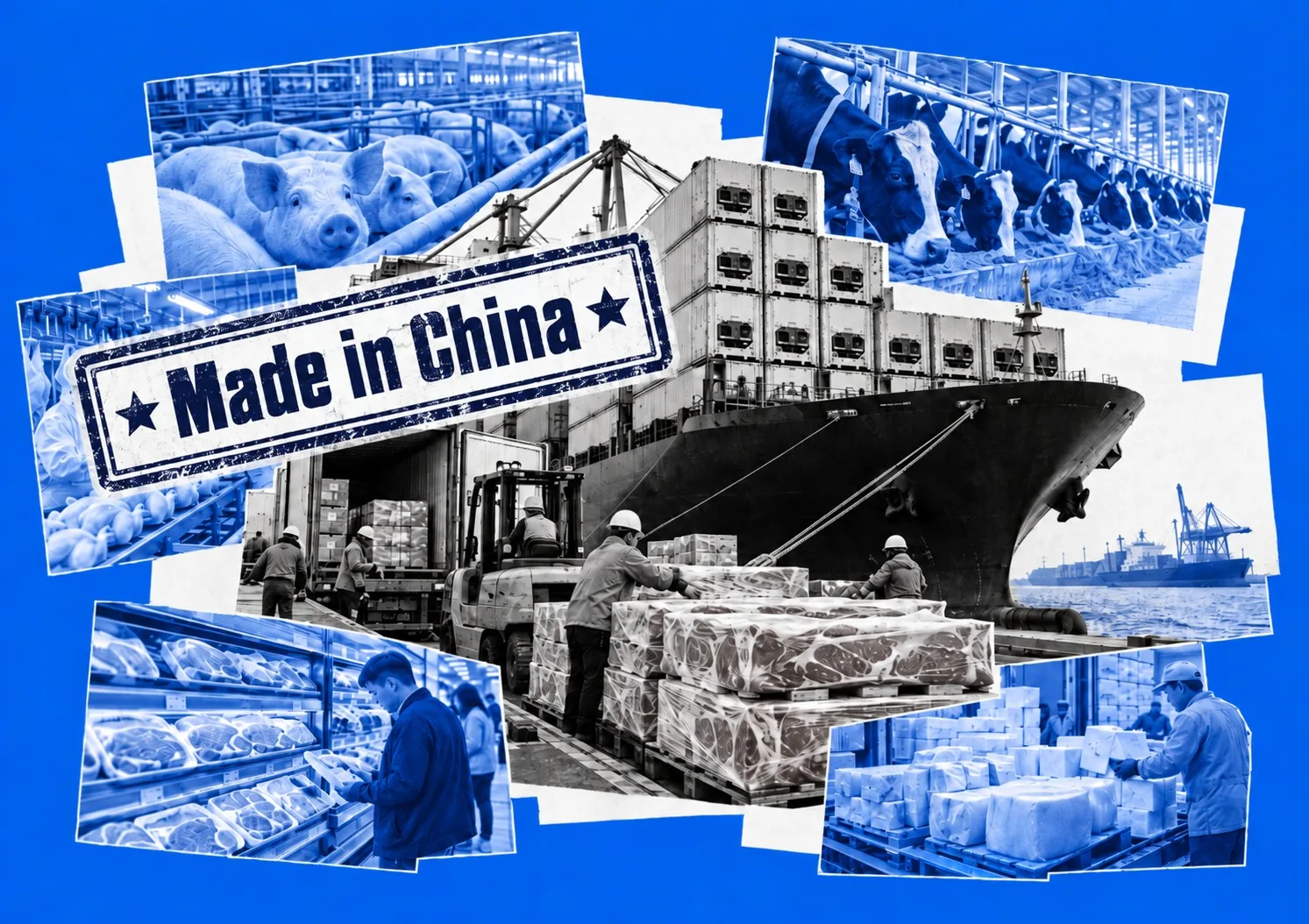
Chinese processed poultry exports have doubled their share of the European Union market to 10 per cent and tripled in the UK to over 14 per cent since 2022, driven by state subsidies and an acute domestic meat glut. Undercutting European and South American competitors by $1,000 per ton, Chinese exporters are offloading surplus production abroad as domestic pork consumption drops by 13 per cent. The influx of cheap chicken is now squeezing margins for Western farming hubs and sparking a wave of anti-dumping investigations in Brussels.
This is not an isolated commercial success. It is the leading edge of a structural shock.
Driven by Beijing's campaign for national food security, heavily backed by state agricultural subsidies, and compounded by an unprecedented slump in home demand, China’s agricultural sector has generated a monumental overcapacity crisis in meat and dairy. Unable to absorb this surplus domestically, agribusiness conglomerates are offloading excess production onto world markets.
They are applying China's familiar industrial playbook—flooding global supply chains with low-priced goods, undercutting legacy competitors, and igniting a fierce new front in international trade protectionism.

Inside the Glut
To understand how the world’s largest historical importer of agricultural commodities became an aggressive net exporter, look at the internal transformations remaking rural and urban China.
Following the 2018 African swine fever outbreak—which decimated the national hog herd—and the supply chain disruptions of the pandemic, Beijing placed food self-sufficiency at the top of its national security agenda.
Fiscal resources poured into modernizing livestock production, consolidating fragmented farming into mega-scale corporate operations, and rebuilding animal populations.
Subsidies did the heavy lifting.
Data compiled by the OECD reveals that Chinese agricultural subsidies climbed to approximately 13 per cent of gross farm receipts between 2022 and 2024. That is nearly triple the support levels recorded in the early 2000s.
In the sprawling processing plants of Shandong province, general manager Dang Yangyang of Wintop Food sees the results firsthand. Recent months have seen a revolving door of international buyers flying into Wintop from Ghana, Senegal, Nigeria, Iraq, Jordan, and Russia.
Their demand is singular: Chinese chicken.
Wintop processes 60 million chickens annually, turning out breasts, nuggets, meatballs, and dumplings for more than 20 countries. Export revenues accounted for half of the firm's profits last year, underwriting a 33-acre facility expansion.
"International clients used to distrust the quality," Dang concedes. But when processed chicken hits trading desks priced $1,000 per ton cheaper than equivalent products from Brazil or Thailand, buyers face a stark choice: source from China or surrender their margins.

Capital hit the ground running across the entire industry.
Corporate agro-industrial complexes expanded capacity with relentless efficiency, driving last year's pork production to a record 59 million metric tons. Poultry output climbed by 7 per cent. In the dairy sector, production surged so rapidly that major processors surpassed official 2025 output targets two full years early.
Then the expansion ran headlong into a changing domestic consumer landscape.
As China’s economic recovery faltered, urban dietary habits shifted.
Driven by health consciousness and financial caution among a shrinking, aging populace, traditional heavy meat consumption fractured. The fatty pork cuts that fueled industrial workers for decades fell out of favor. Per-capita pork consumption has dropped by 13 per cent since peaking in 2023.
Consumer demand pivoted toward leaner protein. Per-capita chicken intake rose by more than 50 per cent in the decade through 2024.
Yet because meat and dairy producers were locked into subsidy-driven expansion plans, overall protein output scaled upward regardless of tepid domestic demand and weak macroeconomic momentum.
Market consequences were swift.
Domestic hog prices collapsed under severe oversupply.
On the Dalian Commodity Exchange, the most active live hog futures contract plummeted to a historic low of 9,000 yuan ($1,320.25) per metric ton on April 13, before recovering marginally to 11,295 yuan amid localized foot-and-mouth disease concerns.
Smallholder farmers were crushed. Huang Weiying, who spent two decades raising pigs in Hebei province, accumulated over $75,000 in debt as local pork prices sank so low that city dwellers effectively stopped buying.
The central government intervened directly.
Agriculture Minister Han Jun convened industry executives in late April, issuing stern directives for leading enterprises to curb capacity. Minister Han demanded the industry scale back breeding sow herds, accelerate culling of aging sows and weak piglets, and abandon reckless expansion.
For corporate giants, domestic cutbacks meant financial ruin. The only way out was abroad.
As Zhang Yuan, head of baby formula marketing at dairy giant Yili, put it: "Every Chinese livestock company is planning to expand overseas. If you want to grow, you must go abroad."
Industrial Scale
The systematic manner in which Chinese protein producers are capturing international market share shows how deeply industrial engineering has permeated modern agribusiness.
Take Wintop Food in Shandong. Over the past decade, Dang Yangyang increased the density of broilers housed in a single rearing shed from 20,000 to 120,000 birds.
Through breeding innovation, Wintop’s broilers average a harvest weight of 2.5 kilograms—outstripping the 2.2-kilogram average for Brazilian broilers tracked by S&P Global.
They reach slaughter in under 42 days, closing in on the 35-day American standard.
Local government helps clear the path.
In Tengzhou, municipal authorities actively subsidize the wage bill for Wintop’s 2,000-strong workforce.
Rival poultry processors are following suit.
Sunner, another Chinese poultry titan, leaned into value-added processed products like marinated chicken and ready-to-eat meals, driving overseas sales up by 42 per cent last year to $135 million.
Sunner also developed China’s first domestic white-feather broiler breed, exporting proprietary genetics and partnering with nations like Uzbekistan to develop processing capacity in Central Asia and Africa.
Dairy tells a similar story. Yili, Asia’s largest dairy enterprise, is launching infant formula across Southeast Asia.
It is a striking reputational turn. In 2008, melamine contamination ruined domestic trust and locked Chinese milk products out of foreign markets for over a decade. Having rebuilt consumer confidence to become the top-selling brand at home, Yili—alongside competitor Feihe, which launched its AceKid brand in Indonesia and the Philippines—is using domestic scale to leap into international retail.
The trade numbers capture the scale of this pivot:
- China became a net exporter of chicken last year, with shipments reaching $2.6 billion—nearly double 2020 levels.
- Dairy exports are on track to hit $600 million this year, doubling in three years.
- China's overall export growth surged at one of its fastest monthly paces since the 2008 financial crisis, pushing its total trade surplus toward historic records while shrinking its $100 billion agricultural trade deficit.
The Price Hammer
Discounted pricing is the hammer opening foreign doors.
Chinese chicken breast and leg quarters are entering international markets at 10 to 20 per cent below Brazilian and Thai benchmarks—a direct saving of roughly $1,000 per ton.
That price gap is re-engineering trade flows.
In West Africa and the Middle East, meat traders are swapping South American supply for Chinese poultry. StoneX analyst Yifan Li notes Chinese milk powder is displacing Indian and Iranian suppliers in the Middle East while challenging New Zealand and European brands in Nigeria and Bangladesh.
In Europe, the shift is already measurable.
Data from food consultancy Gira shows China doubled its share of the European Union’s processed-poultry market to 10 per cent since 2022, while tripling its UK market share to over 14 per cent.
"It’s very worrying," says Kukrit Arepagorn of the Thai Broiler Processing Exporters Association.
International buyers now use cheap Chinese quotes as their baseline for every negotiation.
Ezequiel Pires, chairman of Lisbon-based meat trader Branexx, confirmed his firm began sourcing Chinese poultry in March after African clients demanded cheaper alternatives to Brazilian imports.
This sudden penetration has triggered alarms in Western capitals.
In July, the European Commission launched an anti-dumping investigation into Chinese Pekin duck imports following complaints from domestic producers. In September, Brussels imposed anti-dumping duties between 41 and 67 per cent on Chinese pea protein.
While chicken has escaped formal tariffs so far, European trade authorities have placed imports under active surveillance and are pushing for stricter EU-origin labeling rules by 2027.
Skeptics point out that China has not fully erased lingering food safety concerns. Gordon Butland of G&S Agriconsultants notes that building long-term confidence in traceability and quality consistency remains an uphill battle in strict Western jurisdictions.
Yet for price-sensitive importers across developing markets, discounted prices outweigh reputational hesitations.
What is happening in the global protein market is not a passing trade blip. It is a permanent reordering.
For thirty years, global agribusiness rested on one assumption: China’s population would act as a bottomless pit for surplus grain, feed, and meat from the West and South America.
That paradigm is dead.
Backed by state subsidies, high-density corporate farming, and domestic demand deficits, China’s agribusiness sector has pivoted from import reliance to export expansion. Even if Beijing succeeds in culling sow herds and curbing pig capacity at home, the industrial infrastructure built in provinces like Shandong ensures that Chinese protein will remain a permanent fixture on international trading desks.
Sources: Reuters, The New York Times