
Berlin Pride Was Meant to Be a Demonstration of Freedom. Now Germany Is Hunting a Suspect in a Fatal Attack

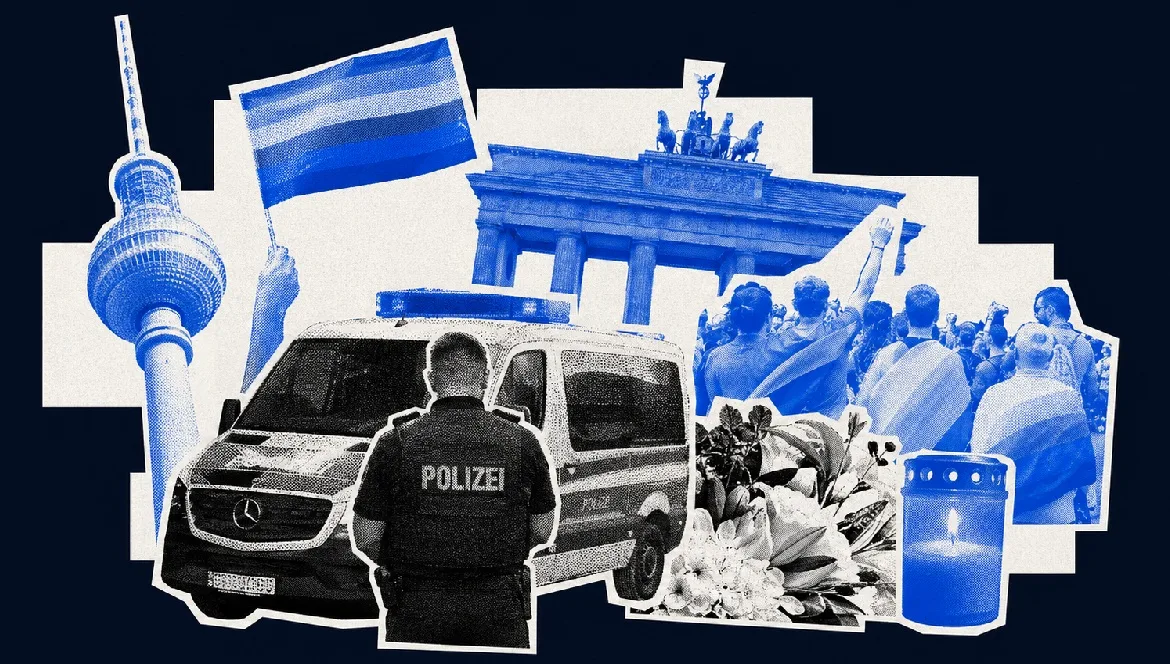
A deadly attack near Berlin Pride has turned a celebration of LGBTQ+ visibility into a test of Europe’s ability to protect open public spaces. As police search for a suspect with alleged links to Islamist circles, Germany is once again confronting the difficult intersection of radicalisation, mass-event security and the protection of minorities. The question is no longer only who carried out the attack, but whether Europe can keep its cities open without making openness itself a vulnerability.
German police are searching for 21-year-old Abdul B. after a fatal attack near Christopher Street Day in Berlin. On the evening of 25 July, a car crashed into people in the Tiergarten area, close to the Pride route. One person was killed and at least 16 were injured, with three reportedly in critical condition. Authorities also said that some victims may have suffered injuries from a bladed weapon.
Police have released the suspect’s name and photograph, warning that he may be armed and dangerous. According to law enforcement, the man was known to police and may have links to Berlin’s Islamist circles. At the same time, investigators are still establishing whether he was behind the wheel of the vehicle, who else may have been involved and what motivated the attack.

That uncertainty is now at the centre of the story. Berlin has experienced an attack not simply in a crowded public place, but in the immediate context of one of modern Europe’s most politically significant events. Christopher Street Day is not merely a parade. It is a public demonstration that the LGBTQ+ community has the right to be visible, organised and protected in the centre of a European capital.
That space has now become the scene of deadly violence.
Open Urban Space Is Becoming Increasingly Difficult to Protect
For European cities, the security of mass gatherings has long ceased to be merely a matter of crowd control. After attacks involving cars, knives and other weapons, organisers must protect people against several different types of threat at once, often without being able to fully close off the surrounding space.
Pride events are particularly difficult to secure from this perspective. Their purpose is visibility. Parades move through streets and central districts, alongside open roads and public spaces. Participants are not inside a stadium or on a site that can be completely isolated. That openness is precisely what gives such events their political significance — and what creates additional security challenges.
The Berlin attack demonstrates how quickly a peaceful mass event can turn into a major manhunt. Following the incident, police were forced to halt the event, restrict access to the area and search for a man officially described as potentially armed and dangerous.
The question now is not only whether this particular attack could have been prevented. Germany will once again have to confront a more difficult problem: how to protect open mass gatherings without destroying the openness that makes them important in the first place.
Radicalisation Remains a Problem Even When the Motive Is Still Unknown
German police have already linked the suspect to Berlin’s Islamist milieu. But that does not mean the motive for the attack has been established. Investigators must still determine whether the incident was a planned terrorist attack, a crime driven by a specific ideology, an act by an individually radicalised person or part of a wider network.

That distinction matters. European societies have repeatedly seen political debate begin before investigators have established the facts. This is particularly true of attacks in which an Islamist motive may be involved. At the same time, ignoring a suspect’s links to a radical environment would be equally dangerous.
For Germany, this is an especially sensitive issue. The country is dealing with different forms of political and ideological violence, while the debate over radicalisation has long been part of domestic politics. In such an environment, every attack quickly becomes more than a criminal investigation. It becomes a test of the state’s mechanisms for surveillance, prevention and risk assessment.
The Berlin attack raises a question that does not yet have an answer: if the suspect was indeed known to police as someone connected to an Islamist milieu, what exactly was known about his potential threat, and were there warning signs that should have demanded greater attention?
The answer will depend on the investigation. But the problem itself has already moved beyond the individual case.
The Security of LGBTQ+ Communities Can No Longer Be Treated as a Secondary Issue
Pride events across Europe are increasingly taking place in an environment where LGBTQ+ communities face several forms of pressure at once. Some threats come from far-right groups, others from religious extremism, and others from the wider normalisation of political aggression against minorities.

These threats are not identical and should not be collapsed into a single category. But for people attending a mass event, the result can be similar: security checks, a heavier police presence, barriers, restricted routes and a constant awareness of potential danger.
This creates a paradox. The more aggressively states protect Pride events, the more the events themselves begin to resemble high-risk targets. But if security measures are insufficient, any attack can demonstrate that the symbolic openness of European cities is not matched by adequate protection.
For the LGBTQ+ community, this creates another problem. Mass events such as Berlin Pride are not simply celebrations. They are public assertions of the right to exist visibly in society. If people begin avoiding them because they fear an attack, violence achieves a political effect even without further attacks taking place.
That is why protecting such events is not merely a matter of public order. It is a question of whether European states can guarantee that the freedom of assembly and the public visibility of minorities will not depend on how easy they are to attack.
Berlin Has Received More Than a Criminal Investigation. It Has Received a Political Test
The coming days will determine whether the attack near Berlin Pride becomes a case involving a single radicalised suspect or whether investigators uncover a broader context. Police are searching for Abdul B. and have urged members of the public not to approach him, warning that he may be armed and dangerous. Authorities are continuing to establish the full circumstances of the attack and whether other people may have been involved.
But regardless of the final motive, the incident has already exposed one of modern Europe’s weakest points. Mass gatherings remain among the most important spaces of democratic life — and at the same time among the most difficult targets to protect. They cannot be completely sealed off without destroying the very idea of the open city.
For Berlin, this means reviewing not only the security of Pride events but the broader system for assessing threats around mass gatherings. The questions will involve vehicle access, police coordination, work with potentially radicalised individuals and the ability to respond rapidly when a single attack can become a large-scale threat to thousands of people.
At the same time, Germany will have to avoid another mistake: allowing fear to determine who has the right to be visible in public space.
Berlin Pride was meant to be a demonstration of freedom. It has now become a reminder of how much Europe must do to protect that freedom — and how difficult the conditions under which it can remain open are becoming.
Sources: Berlin Police and Public Prosecutor’s Office, Reuters, Euronews, The Guardian