
Berlin Pride Attack: How a Released Islamist Suspect Exposed Germany’s Security Gap

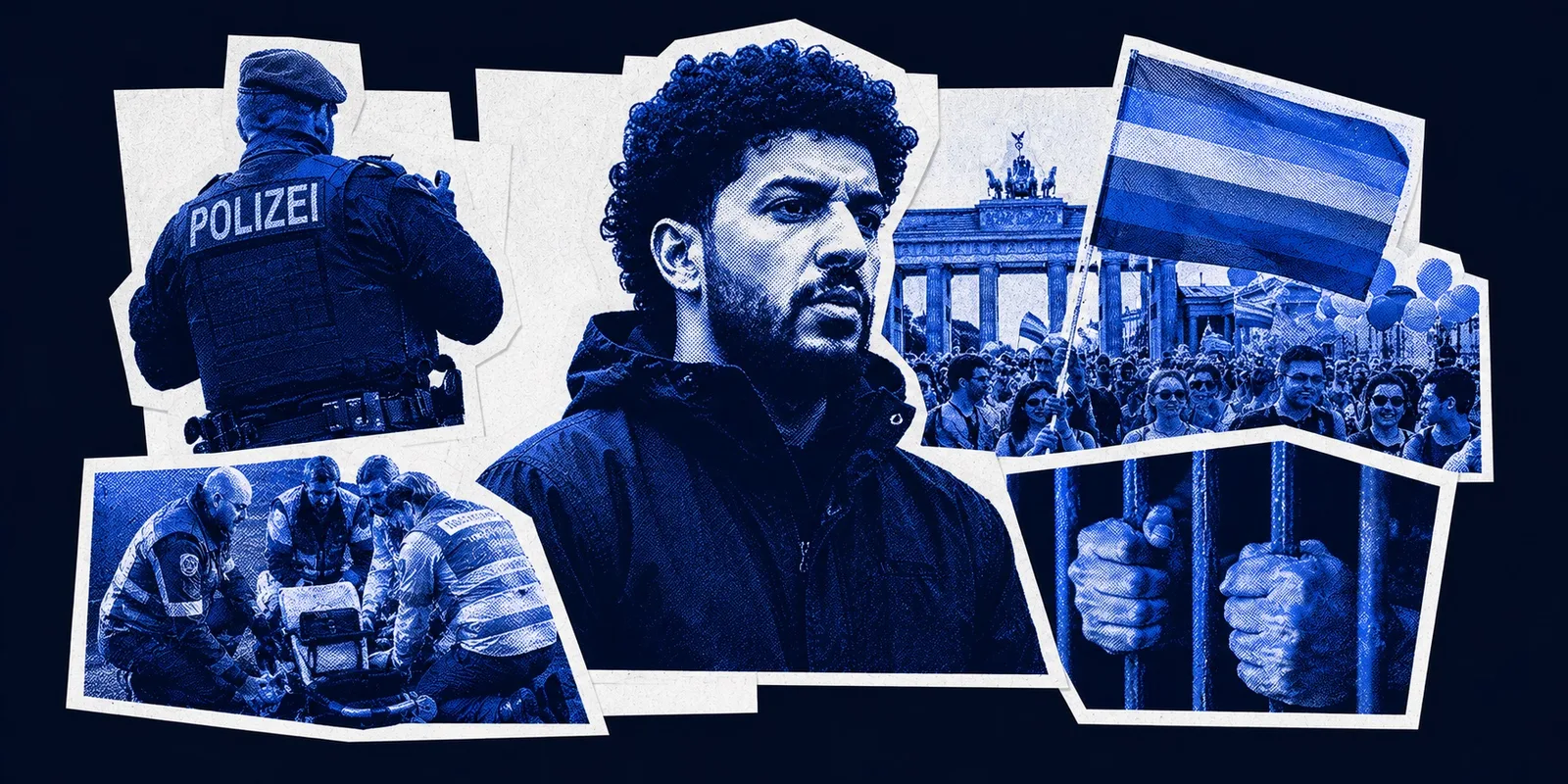
Following a deadly vehicle and knife attack at Berlin’s Christopher Street Day that left one dead and dozens injured, the suspect - 21-year-old Abdul B. - was shot dead by police. The fact that the known Islamist had been released from a youth prison just two months earlier has pushed Germany’s security services, prison rehabilitation system, and Merz's government into a fierce political crisis.
That sequence is already enough to make the case politically explosive. But the most uncomfortable question is not how the attacker was eventually found. It is what happened in the two months between his release from prison and the attack in the centre of the German capital.
A terrorist attack in a symbolic place
Christopher Street Day is not simply another mass gathering. Berlin’s Pride is one of Germany’s largest public events and among Europe’s biggest celebrations of LGBTQ+ rights. Its name recalls Christopher Street in New York, where the 1969 Stonewall uprising became a defining moment in the modern gay rights movement.
The attack therefore struck a gathering built around public visibility, political freedom and the right to occupy the city without fear.
It also happened in one of Berlin’s most recognisable spaces. The Tiergarten and the area around the Brandenburg Gate are not remote or marginal parts of the capital. They are the symbolic centre of the German state and of the open society Berlin has long presented to the world.
The method made the attack even more difficult to contain. A vehicle was used as a weapon. Sharp weapons were reportedly used as well. The combination required neither a sophisticated arsenal nor a complex logistical operation. It was the kind of low-tech assault that can be devastating precisely because the tools are ordinary and the preparation can be difficult to detect.
Berlin has seen this method before. The 2016 attack on the Christmas market at Breitscheidplatz, when Anis Amri used a truck to kill and injure people, remains the most notorious example of vehicle terrorism in the German capital.
The latest attack belongs to that broader history, but it adds another layer: the apparent involvement of a young man who had only recently passed through the criminal justice system.
The two-month gap that will dominate German politics
Abdul B. was released from a youth and young offenders’ institution in May 2026. On July 25, investigators say, he carried out a combined attack in the heart of Berlin.
That gap is now more politically important than almost any other detail in the case.
The central issue is not simply whether a prison sentence failed to change an individual. No criminal justice system can guarantee that every convicted extremist will emerge rehabilitated. The harder question is whether the institutions responsible for identifying radicalisation, assessing risk and managing the transition from prison to freedom were capable of recognising what kind of threat they were dealing with.
The briefing surrounding the case does not establish what deradicalisation programmes Abdul B. underwent, whether he completed them, or what form of post-release monitoring applied to him. Those questions cannot be answered by assumption.
They will nevertheless become unavoidable.
If a young man with documented links to Islamist circles was considered sufficiently safe to return to the streets, German authorities will have to explain the basis for that assessment. If he was considered a continuing security risk, then investigators and politicians will face a different question: why was he able to prepare and carry out an attack of this scale?
The distinction matters. A failed deradicalisation programme, inadequate intelligence-sharing and insufficient post-release supervision are different institutional failures. They may also overlap.
The limits of the “lone wolf” model
The investigation is examining whether Abdul B. acted alone or whether others helped prepare the attack. That question is more than a standard procedural step.
The low-tech nature of the assault makes the traditional distinction between an organised terrorist cell and an individual attacker increasingly difficult to use as a measure of threat. A person can be ideologically connected without belonging to a tightly structured organisation. A radicalised individual can draw on a wider environment without receiving direct operational orders.
That is why the “lone wolf” label can sometimes obscure more than it explains.
A vehicle, a knife and a crowded public event do not require the infrastructure associated with a conventional terrorist plot. The challenge for security agencies is not merely to find an organisation. It is to identify when an individual has moved from extremist belief to operational intent.
The Berlin case may ultimately prove to have involved no wider network. It may also uncover accomplices or a radical environment that played a more active role. At this stage, the authorities are checking that possibility rather than establishing it.
The uncertainty itself is part of the security problem.
From rehabilitation to permanent surveillance?
The political pressure created by the attack will extend well beyond the investigation.
Germany’s youth criminal justice system has traditionally placed considerable emphasis on education and rehabilitation. That logic is particularly important when dealing with young offenders: the state assumes that age and development can leave room for change.
But terrorism tests that principle in a particularly severe way.
The case of Abdul B. is likely to intensify demands for more intrusive monitoring of people released from prison with links to Islamist extremism, greater intelligence powers and closer cooperation between prisons, police and security services. Conservative and far-right forces will have a powerful new argument for tougher deportation rules, broader police powers and a harder line on radical networks.
Police and intelligence agencies, meanwhile, will have stronger grounds to demand additional resources and expanded powers of surveillance.
The danger is that a single failure produces a policy response aimed at the entire system without first establishing where the failure actually occurred.
There is a real possibility that Germany will move away from a model centred on post-sentence rehabilitation and toward a system of far more intensive preventive supervision. That shift would not necessarily be announced as a rejection of rehabilitation. It could emerge through administrative changes, broader monitoring powers and a lower threshold for continued state attention after release.
In practice, however, the effect could be profound.
The political cost for Merz’s government
Chancellor Friedrich Merz has already called the attack an “abhorrent crime” and pledged, together with the Interior Ministry, to pursue the investigation. Berlin’s governing mayor, Kai Wegner, described the incident as an attack on an open and free society.
Those statements are politically inevitable. They are also insufficient to close the issue.
The government of Merz and Interior Minister Alexander Dobrindt now faces a question of institutional responsibility. The suspect was not an unknown figure who appeared from nowhere. He had a criminal record, recent contact with the prison system and documented links to Islamist circles.
That does not automatically mean the attack could have been prevented. But it creates a chain of responsibility that politicians will be forced to examine.
The government will face pressure from two directions. The first will be security pressure: why was the risk not contained? The second will be political pressure from those who will argue that the existing combination of rehabilitation, integration and limited post-release supervision has failed.
The government’s response will determine whether the case becomes primarily a debate about intelligence and criminal justice or another turning point in Germany’s wider argument over migration and social cohesion.
The victims are also being asked to bear the cost
For the LGBTQ+ community, the consequences are immediate and direct. A public celebration associated with visibility and safety became the scene of a terrorist attack.
For organisers of mass events, the implications are practical. Security requirements may become more demanding and more expensive. Access controls, vehicle barriers, police deployments and emergency procedures may all face renewed scrutiny.
That burden is politically difficult because the response to an attack on an open society can easily make public life less open.
The people attending CSD were targeted precisely in a space where they were meant to be visible. If the answer is to make such gatherings increasingly fortified, the state may improve protection while also changing the character of the events it is trying to protect.
That tension will not disappear through stronger policing alone.
The question Germany cannot avoid
The investigation now has several tasks: reconstructing the van’s route, examining the vehicle, determining how the attack was prepared and establishing whether Abdul B. had accomplices or links to a wider radical network.
But the most consequential investigation may run backward, into the institutions that dealt with him before July 25.
What happened during his imprisonment? Which risks were identified? What was expected to happen after his release? Was there a monitoring system, and if so, how did it function?
The answers will matter more than the political slogans that follow the attack.
Berlin has shown once again how little infrastructure a terrorist may need to turn an ordinary vehicle and readily available weapons into a mass-casualty threat. The deeper problem is harder to confront: a state can identify radicalisation, imprison a young extremist and still lose sight of the person before the danger has disappeared.
That is the gap Germany now has to explain.
Read also:
- A deadly attack near Berlin Pride has turned a celebration of LGBTQ+ visibility into a test of Europe’s ability to protect open public spaces. As police search for a suspect with alleged links to Islamist circles, Germany is once again confronting the difficult intersection of radicalisation, mass-event security and the protection of minorities. The question is no longer only who carried out the attack, but whether Europe can keep its cities open without making openness itself a vulnerability.
Sources: DW, Polizei Berlin