
Airbus Spain Strike: How a Legal and Wage Battle Threatens European Aircraft Assembly

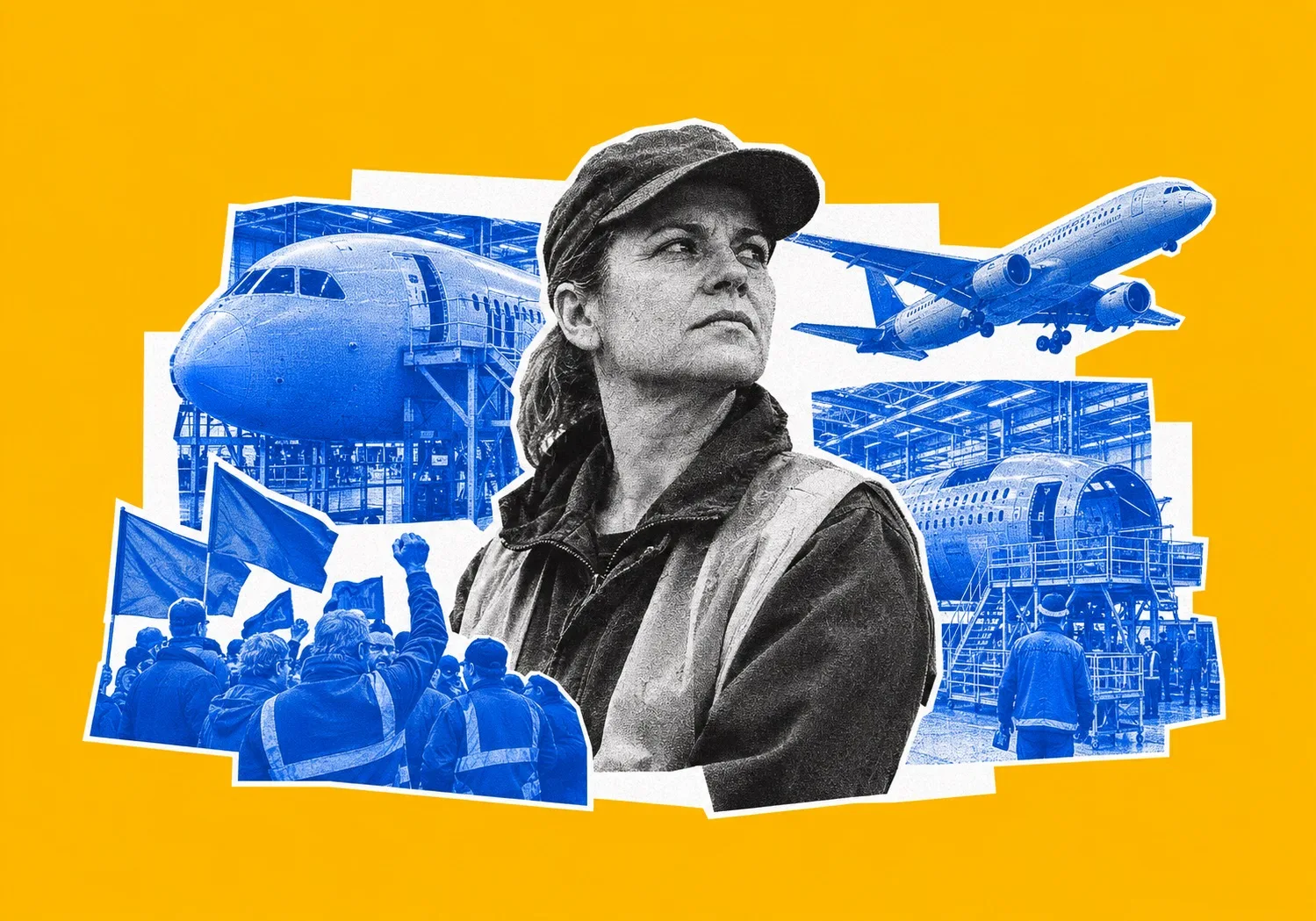
An escalating labour dispute at Airbus’s Spanish facilities has moved from factory-floor strikes to a high-stakes legal battle in Spain’s National Court, threatening supply chains that feed final assembly lines in Toulouse and Hamburg. While management and major unions reached a preliminary deal, minority unions have frozen the referendum, highlighting a structural shift in how European aerospace balances record profits against inflation-linked pay.
Components produced in Seville, Cádiz, Getafe, Albacete and Illescas are tied into Airbus production in France and Germany, making a dispute over Spanish wages a potential constraint on aircraft assembly in Toulouse and Hamburg.
That is the vulnerability of just-in-time manufacturing: efficiency depends on every part of the network remaining predictable.
A wage dispute inside a highly profitable company
The timing is central to understanding the anger among Airbus employees.
The company reported net profit of €5.221bn in 2025, up 23 per cent year on year, on revenue of €73.4bn. Net profit increased by another 47 per cent in the first half of 2026. Airbus is targeting operating profit of €12bn – €13bn by 2029 and has announced share buyback programmes worth up to €5bn.
For workers, those figures sit alongside a very different economic reality. Inflation has eroded purchasing power, including among highly skilled engineering staff. In Madrid, residential rents rose 7.6 per cent year on year in the second quarter of 2026.
The dispute therefore goes beyond a conventional argument over the size of an annual pay rise. Workers are challenging a bargaining model in which nominal wages can rise while real purchasing power remains under pressure.
That helps explain why the conflict has brought together employees who are often treated as separate constituencies: shop-floor workers and engineers. Their common concern is increasingly the gap between corporate performance and household purchasing power.

The disagreement over inflation indexation has become the most consequential part of the negotiations. The preliminary agreement reached on September 4 by Airbus and the four major unions - CCOO, ATP, SIPA and UGT - provides for actual CPI indexation plus a 7.95 per cent purchasing-power increase over four years, alongside a €2,000 one-off payment.
The alternative proposed by CGT, ÚTIL and the strike committee is considerably different: CPI plus 4 per cent annually in 2026 and 2027, without caps, a €4,000 lump sum and full retroactive application from January 1.
The difference is not simply financial. It is about who carries the risk when inflation changes faster than collective agreements anticipate.
Spain’s dispute is already a European industrial problem
Airbus is particularly exposed to this kind of confrontation because its manufacturing model is European in a very literal sense.
The Spanish facilities are not isolated production sites. Seville handles final assembly of military aircraft including the A400M and C295 and supplies sub-assemblies to commercial programmes. Cádiz produces composite structures for the A320, A330 and A350 families. Getafe combines engineering, structural assembly and work on military derivatives such as the A330 MRTT, while Albacete and Illescas contribute helicopter and advanced carbon-fibre production.
The commercial aircraft system depends on these links operating with little slack.
A stoppage in Spain can therefore become a problem for final assembly lines in Toulouse and Hamburg, where Airbus relies on tightly timed deliveries of components. A national labour dispute can cross a border without requiring the dispute itself to become international.
That distinction matters. Capital, engineering and production have been integrated across Europe for years, while wage negotiations, labour protections and collective bargaining remain predominantly national.
The Spanish strike exposes the mismatch.
A company can organise production as one European industrial network, but it cannot negotiate with its workforce as if Europe had one labour market. A wage settlement in Spain does not automatically establish terms in France or Germany. Yet the economic consequences of that settlement can reach factories in both countries.
European aerospace unions are already watching the Spanish negotiations because the outcome provides a reference point for their own demands around inflation protection, remote working and the distribution of corporate profits.
The fight is no longer only between Airbus and its workers
The September agreement also exposed divisions inside organised labour.
After weeks of industrial action, Airbus and the four major unions reached a preliminary understanding under mediation by Industry Minister Jordi Hereu. Management was represented by chief executive Guillaume Faury, chief human resources officer Carmen-Maja Rex and Airbus Spain president Francisco Javier Sánchez Segura.
Hereu presented the agreement as a step towards social dialogue and industrial stability. Minority unions disputed that interpretation, arguing that government involvement was driven by the need to protect production and delivery schedules rather than resolve the underlying compensation dispute.
The divisions became more concrete when strikes were suspended on September 9 and pickets were removed from factory gates, despite an internal worker vote producing a narrow majority of 67 votes for continuing the strike.
Five days later, about 5,000 workers organised by CGT, ÚTIL and dissenting UGT sections demonstrated in Madrid. Their message was that the conflict had not been settled and that negotiations should continue directly with the workforce's competing union representation.
This has turned the dispute into a question of legitimacy as well as pay.
The majority unions negotiated an agreement representing more than 80 per cent of the relevant workforce representation. Minority organisations, however, have challenged both its substance and the process through which it is to be ratified.
That challenge reached Spain's National Court.
The courtroom now sits between Airbus and a settlement
On September 18, the Audiencia Nacional temporarily suspended a binding workforce referendum that had been scheduled for September 24–25.
The injunction followed a collective labour conflict lawsuit brought by CGT, which alleged negotiating bad faith and violations of workers' rights.
The immediate consequence is procedural uncertainty. The proposed agreement cannot simply move from negotiation to a workforce-wide vote on the original timetable while the court considers the challenge.
That is significant because Spanish collective bargaining relies heavily on established rules of representation and ratification. Judicial intervention introduces another layer into an already fragmented dispute: management, majority unions, minority unions, workers and now the courts are all affecting the route towards a final settlement.
The conflict over the Bradford Index adds another dimension.
The absenteeism-monitoring system, which calculates absence using a formula based on the frequency and duration of absences, has already faced legal resistance. Spanish labour courts struck down specific corporate applications of the index in December 2025 because of the penalties imposed on short-term sick leave.
Airbus has offered to suspend the index as part of the wider settlement, alongside preserving 40 per cent remote-working allowances and making concessions on shifts, transport and canteen services.

These issues might appear secondary beside the headline wage figures. They are not. They point to a broader renegotiation of the workplace itself, in which workers are challenging both how they are paid and how productivity and absence are measured.
The European question is what happens when inflation returns to bargaining
For decades, wage moderation was a familiar feature of industrial policy across southern Europe. The Airbus dispute points towards a different bargaining environment.
Workers are seeking mechanisms that automatically preserve purchasing power rather than relying on periodic negotiations to catch up with inflation. Employers, meanwhile, must absorb higher labour costs while maintaining competitiveness and production targets.
In a highly integrated industrial company, the consequences do not remain within one national wage agreement.
If Spanish workers establish stronger CPI-linked protections, French and German aerospace unions have a benchmark for their own negotiations. If Airbus accepts substantially higher automatic wage growth in one major manufacturing base, that settlement becomes part of the economic context elsewhere in its network.
That is why the dispute matters beyond Spain.
Airbus can move production and investment across a European industrial system, but it cannot move the underlying social expectations surrounding wages with the same ease. The company may have a single balance sheet and a cross-border supply chain; its workforce still bargains through national institutions with different legal rules and union structures.
The Spanish strike has made that contradiction operational.
For Airbus, the immediate challenge is to restore an agreement without weakening the production system on which its financial targets depend. For the unions, the question is whether inflation-linked compensation can become a durable feature of aerospace bargaining rather than a concession made under exceptional cost-of-living pressure.
And for Europe's industrial model, the more difficult issue is now visible: when one country's workers can interrupt a production chain spanning several others, national labour disputes are no longer quite national.
Sources: Europea Contre-courant, EFE, Reuters, Wordpress