
Spain Wanted to Retire Its F-18s. Europe’s Fighter Shortage Had Other Plans

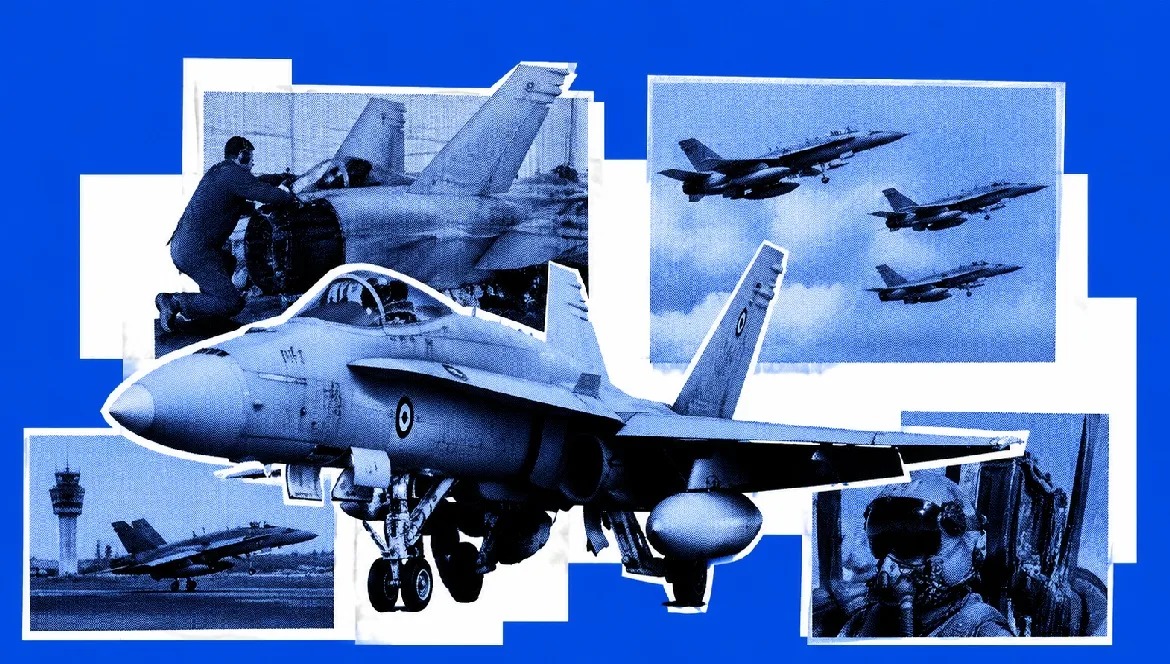
Spain’s decision to keep parts of its F-18 fleet in service until 2040 exposes a wider European problem: defence budgets are rising faster than the continent can produce the aircraft needed to replace its ageing fleets. As new Eurofighters arrive gradually and the FCAS sixth-generation programme collapses into uncertainty, Europe is discovering that rearmament is not only a question of money. It is a question of industrial capacity, production timelines and how long old systems can survive while the future is being built.
Spain is preparing to keep some of its F-18 fighter jets in service until 2040. The decision is more than a Spanish procurement problem. It is a sign of a wider European dilemma: governments are moving faster to increase defence spending than the continent’s defence industry can move to deliver the equipment that spending is supposed to buy.
The Spanish Air and Space Force had originally planned to retire its F-18 fleet around 2030. That deadline was later pushed back to 2035. Now Madrid is preparing to extend the operational life of some of the aircraft even further, potentially until 2040. By then, several of the aircraft will have been flying for more than five decades.
The decision comes as Spain tries to replace its ageing Hornets with newer Eurofighters while simultaneously dealing with the uncertainty surrounding the Future Combat Air System, or FCAS. The sixth-generation programme was supposed to provide the long-term successor to much of Europe’s existing fighter fleet. Instead, disagreements between France and Germany over leadership, industrial control and the design of the aircraft have left the project in crisis. Spain is now caught between an aircraft it wants to retire and a future aircraft that does not yet exist.
The gap between replacement and retirement is getting longer
The immediate problem is not that Spain has no new fighter aircraft. Madrid has ordered 45 new Eurofighters under the Halcón programmes, and the first aircraft of the latest batch was rolled out at Airbus’s Getafe facility in June, with deliveries beginning this year. The new aircraft will gradually strengthen the Spanish fleet and replace some of its older aircraft. But they will not arrive overnight.
The 45 aircraft will be delivered progressively over the next decade. In the meantime, Spain still has to maintain the number of combat-ready aircraft required for national air defence, NATO commitments and operations across its territory. That is where the F-18 becomes difficult to remove. The aircraft is old, but it remains operationally useful. Spanish F-18s continue to perform air-defence and interception missions, including Quick Reaction Alert duties. In February, six Spanish F-18s participated in the Eagle Eye activation in the Gulf of Cádiz and conducted more than 30 air-defence missions.

The problem is therefore not simply that the aircraft are obsolete. It is that the aircraft that should replace them are arriving gradually, while the strategic need for combat aircraft exists now. The result is a familiar pattern across Europe: retirement schedules are being pushed back because the replacement platform is delayed, insufficient in number or still trapped inside a development programme.
The aircraft Europe needs are often still on paper
For Spain, the most important missing piece was supposed to be FCAS. The programme was designed as one of Europe’s most ambitious defence projects: a sixth-generation fighter connected to drones, sensors and a broader combat cloud. Spain joined the project with significant industrial ambitions, particularly through companies such as Indra. The programme was also supposed to solve a long-term problem. Europe’s current generation of combat aircraft will eventually reach the end of their useful lives, and replacing them requires decades of development, testing, industrial investment and production.

FCAS was intended to provide that answer. Instead, the programme became another example of how difficult it is for European countries to build major defence systems together when their strategic and industrial priorities diverge. France wanted an aircraft compatible with its nuclear deterrent and aircraft carriers, while Germany had different requirements. Dassault Aviation and Airbus Defence and Space disagreed over leadership and the division of industrial responsibilities. The political dispute eventually became an industrial one.
For Spain, the consequences are particularly uncomfortable. It invested in the programme, built industrial capabilities around it and expected the project to provide a future replacement for older aircraft. Now the country has to preserve its existing fleet while searching for a new long-term option. That is why keeping F-18s in the air until 2040 is not necessarily a vote of confidence in the aircraft. It is a vote of no confidence in the speed of the transition.
Europe is discovering that money cannot instantly create a fighter fleet
Since Russia’s full-scale invasion of Ukraine, European governments have been under pressure to rebuild military capabilities that were reduced after the end of the Cold War. Defence budgets are rising, procurement programmes are expanding and governments are ordering more ammunition, air-defence systems, armoured vehicles and aircraft. But a defence budget is not the same thing as an operational capability.
A country can announce a large procurement programme today and still wait years before the first aircraft enters service. In the case of advanced combat aircraft, the timeline is even longer. Production lines have limited capacity, components come from complex international supply chains and new systems require extensive training and maintenance infrastructure. The aircraft themselves are only one part of the problem. Pilots must be trained, technicians must learn to maintain the new platform, bases must be upgraded, weapons and spare parts must be purchased, and simulators and logistics systems must be established.
This creates a structural problem for European militaries. The old equipment is becoming increasingly expensive to operate, but the new equipment cannot be delivered fast enough to replace it. The transition period is therefore becoming a permanent feature of European defence planning. The continent is trying to rearm in an environment where the industrial capacity required for rapid rearmament was weakened during the very decades when European governments believed they would not need it.
Spain is not the only country trying to keep old aircraft alive
The Spanish case is particularly visible because of the age of the F-18 fleet and the uncertainty surrounding FCAS. But the underlying problem is broader. Across Europe, governments are trying to extend the lives of aircraft that were designed for a different strategic era while waiting for newer systems to arrive.
This is not necessarily irrational. Keeping an aircraft in service can be cheaper and less disruptive than creating a sudden capability gap. A fighter that is old but maintained may still be more useful than a replacement that exists only as a future delivery schedule. The danger is that prolonging the life of old platforms becomes a substitute for making difficult decisions about the future.
Spain is now moving in several directions at once. It is buying Eurofighters, has postponed a decision on the F-35 and is dealing with the uncertainty surrounding FCAS, while extending the service life of aircraft that were expected to disappear from the fleet years ago. Each individual decision can be explained. Together, they show how difficult it has become to build a coherent European fighter strategy.
The industrial bottleneck is becoming a strategic problem
For decades, European defence planning was built around the assumption that major wars were unlikely and that military capabilities could be reduced without immediate consequences. The new security environment has reversed that logic. The problem is that industrial capacity cannot be rebuilt at the same speed as political priorities change.
A new fighter production line cannot be created in a few months. Nor can a complex supply chain be expanded instantly after years of lower demand. Europe can decide to spend more on defence much faster than it can build the factories, engineering teams and production capacity required to turn that money into combat power.
This is particularly important for advanced aircraft. The fighter that replaces an F-18 is not simply a newer version of the same machine. It requires more complex sensors, software, electronic warfare systems, weapons integration and maintenance infrastructure. Each aircraft is therefore more capable, but also more difficult and time-consuming to produce.
That creates a paradox. Europe wants to move rapidly towards more advanced military technology, but the more advanced the technology becomes, the longer the process of delivering it can take. The result is that older aircraft remain in service longer than planned, even as governments announce ambitious plans to modernise their armed forces.
The F-18 is becoming a symbol of the transition Europe cannot avoid
Spain’s decision is ultimately about time. The country does not want to operate F-18s for another generation, but it also cannot simply remove dozens of combat aircraft from its inventory while waiting for a future system to arrive. The Eurofighter can cover part of the gap, but it is not the same as having a complete replacement strategy. FCAS was supposed to provide the next major step. Its future is now uncertain.

This leaves Spain with an increasingly common European choice: spend more money to keep older systems operational, or accept a temporary reduction in capability while waiting for new platforms. Neither option is attractive. The longer-term lesson is that Europe’s rearmament problem is not only financial. It is industrial and organisational.
European governments have now recognised that they need more military equipment. The harder question is whether European industry can produce that equipment quickly enough. Spain’s F-18s are therefore unlikely to be the last European aircraft to receive an unexpected extension. As governments accelerate their defence plans, the continent may increasingly find itself relying on old platforms to bridge the gap between the military it has and the military it has decided it needs.
The uncomfortable reality is that Europe can announce a new defence era in a single budget. It cannot manufacture one at the same speed.
As governments accelerate their defence plans, the continent may increasingly find itself relying on old platforms to bridge the gap between the military it has and the military it has decided it needs.
The uncomfortable reality is that Europe can announce a new defence era in a single budget.
It cannot manufacture one at the same speed.
Sources: Euractiv, Spanish Air and Space Force, Infodefensa, AeroTime, El País