Top news

Oct 13, 2026, 02:00 AM UTC

← Latest news

01
ContinuingAI-generated
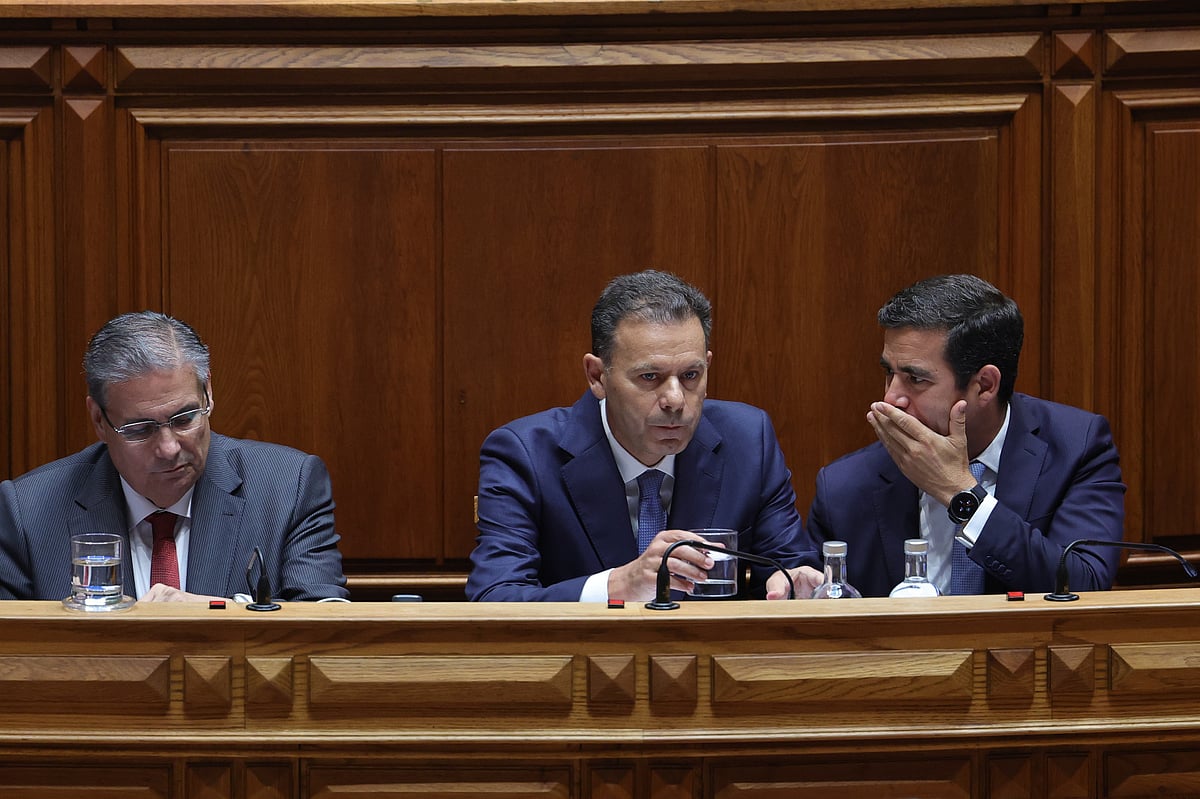
Portuguese government targets Chega and Socialists after censure motion fails

Portuguese government targets Chega and Socialists after censure motion fails

Portugal's minority government criticized Chega and the Socialist Party after a censure motion failed in parliament following a Socialist abstention.

Portugal's minority coalition government has strongly criticized both the far-right Chega party and the opposition Socialist Party (PS) following the defeat of a parliamentary motion of censure. The motion, introduced by Chega over controversies involving the internal administration ministry, failed after Socialist lawmakers abstained from voting.

During the three-hour parliamentary debate, Minister of the Presidency António Leitão Amaro stated that the public would make a "political judgment" on Chega’s decision to advance a motion bound to fail. Despite heated arguments between political figures, cabinet officials reaffirmed that the executive has no "preferred partner" in parliament and will continue negotiating legislation on a case-by-case basis.

Sources: Diário de Notícias (DN), Expresso, RTP (Rádio e Televisão de Portugal)

Read more
02
ContinuingAI-generated
Russian ground offensive stalls as aerial strikes target Ukrainian energy grid

Russian ground offensive stalls as aerial strikes target Ukrainian energy grid

Russian ground forces have stalled along the front line, prompting Moscow to intensify long-range aerial attacks against Ukraine's energy grid ahead of winter.

Russian ground operations across Ukraine have effectively stalled through late September, contradicting claims of military progress from Moscow. Comparative mapping analysis shows virtually zero net territorial change over four weeks, as limited Russian gains were offset by localized Ukrainian counterattacks.

With frontline momentum constrained, Russian forces have escalated long-range aerial bombardment targeting Ukrainian heating and power infrastructure ahead of winter. Prime Minister Serhij Koreckyj confirmed that recent strikes marked the largest assault on energy assets since last winter, with Kyiv remaining a focal point. Concurrently, Ukrainian air defense efficiency against incoming Russian drones declined to 83 percent in September, down from 92 percent recorded in May.

Sources: Deník N, Ekonomický deník, Respect, Seznam Zprávy.

Read more
03
ContinuingAI-generated
Dagens Nyheter details primary aerial weapons used in Russia-Ukraine war

Dagens Nyheter details primary aerial weapons used in Russia-Ukraine war

Swedish newspaper Dagens Nyheter published an analysis detailing the mechanics and defense challenges of ballistic missiles, cruise missiles, and attack drones in Ukraine.

Swedish daily newspaper Dagens Nyheter has published a technical analysis detailing the primary aerial weapons utilized in the war between Russia and Ukraine. The report outlines key operational differences between ballistic missiles, cruise missiles, and long-range attack drones, explaining the strategic challenges each presents to air defense systems.

Ballistic missiles follow high-altitude trajectories at extreme speeds, giving air defense crews minimal reaction time. Conversely, cruise missiles travel at lower altitudes and maneuver along terrain to evade radar detection. Meanwhile, long-range drones are frequently deployed in large swarms to saturate air defense radars and exhaust costly interceptor missile stockpiles. Defense experts stress that protecting infrastructure against these combined threats requires an integrated, multi-tiered defensive strategy capable of addressing high-velocity, low-altitude, and high-volume attacks.

Sources: Dagens Nyheter

Read more
04
ContinuingAI-generated
Croatia targets economic expansion as analysts warn of lagging productivity

Croatia targets economic expansion as analysts warn of lagging productivity

Croatia aims for €100 billion GDP by 2026 and wage increases, but business leaders and economists warn that rising labor costs and cooling demand pose structural risks.

Croatian Prime Minister Andrej Plenković has projected that national gross domestic product will surpass €100 billion by 2026, driven by an estimated annual growth rate of 2.4 percent. The government also pledged to raise average net monthly wages to €1,600 by 2028 and establish new minimum wage targets following consultations with trade unions and employers.

To sustain momentum beyond state spending and EU funds, Zagreb unveiled a €3 billion national industrial strategy running through 2034. However, economic stakeholders raised concerns over structural challenges. Mislav Balković, president of the Croatian Employers' Association, emphasized that rising labor costs are outpacing productivity gains, insisting that the private sector must lead future expansion. Meanwhile, former economy minister Ljubo Jurčić warned that domestic consumption is cooling, characterising the economy as drifting "without an engine and without a rudder."

Sources: HRT Vijesti, Index, Klix, Poslovni dnevnik, Vijesti.

Read more
Share