Top news

Sep 27, 2026, 10:30 AM UTC

← Latest news

01
ContinuingAI-generated
Finnish president downplays timeline for potential Russian attack on NATO

Finnish president downplays timeline for potential Russian attack on NATO

Finnish President Alexander Stubb dismissed German estimates of a potential Russian attack on NATO by 2029, even as frontline European nations bolster defenses against hybrid threats.

Finnish President Alexander Stubb has rejected predictions from German officials that Russia could be capable of attacking NATO territory by 2029. In an interview with German daily Bild, Stubb stated there are "neither evidence nor facts" to back claims of a planned conventional assault against the alliance. He added that he could not imagine Moscow attempting to target "the most powerful military alliance in the world."

Despite his skepticism regarding a direct conflict, Stubb urged NATO members to prepare for worst-case scenarios to maintain effective deterrence. Meanwhile, intelligence agencies across Poland, the Baltic states, and Northern Europe report a surge in Russian hybrid warfare, espionage, and sabotage activities. In response, regional allies are expanding joint defense initiatives, including military support agreements between Sweden and Finland.

Sources: Defence24, Portal obronny, Rzeczpospolita, TVP info.
Read more
02
ContinuingAI-generated
Ukraine targets defense self-reliance amid air defense shortages

Ukraine targets defense self-reliance amid air defense shortages

Ukraine expands domestic defense manufacturing, developing indigenous ballistic missiles and glide bombs to offset critical air defense shortages.

Ukraine is expanding domestic weapons development to counter intensified Russian ballistic missile strikes as Western air defense supplies falter. President Volodymyr Zelenskyy confirmed that establishing local production of Patriot systems under U.S. licenses will require between 12 months and several years due to regulatory and technical delays.

To address immediate vulnerabilities and reduce reliance on foreign military aid, two Ukrainian companies are currently engineering indigenous ballistic missiles, though technical challenges hamper rapid mass production. Concurrently, the Ukrainian armed forces are procuring the domestically produced "Equalizer" glide bomb kit. Developed by DG Industry with the Brave1 defense cluster, the system converts conventional aerial bombs into long-range precision munitions compatible with Soviet-era and Western-supplied fighter aircraft.

Sources: NEXTA, NV, Point, The Insider, Українська правда

Read more
03
ContinuingAI-generated
Heavy combat continues in eastern Ukraine as drone strikes hit civilian areas

Heavy combat continues in eastern Ukraine as drone strikes hit civilian areas

Ukrainian forces repelled over 250 assaults across eastern sectors, while overnight Russian drone strikes caused civilian fatalities in the Kyiv and Kherson regions.

Ukrainian forces faced over 250 combat clashes across the front line over a 24-hour period, with particularly intense fighting reported in the Lyman, Kostiantynivka, and Pokrovsk sectors. According to the Ukrainian General Staff, defensive units repulsed dozens of Russian assault attempts around several key settlements.

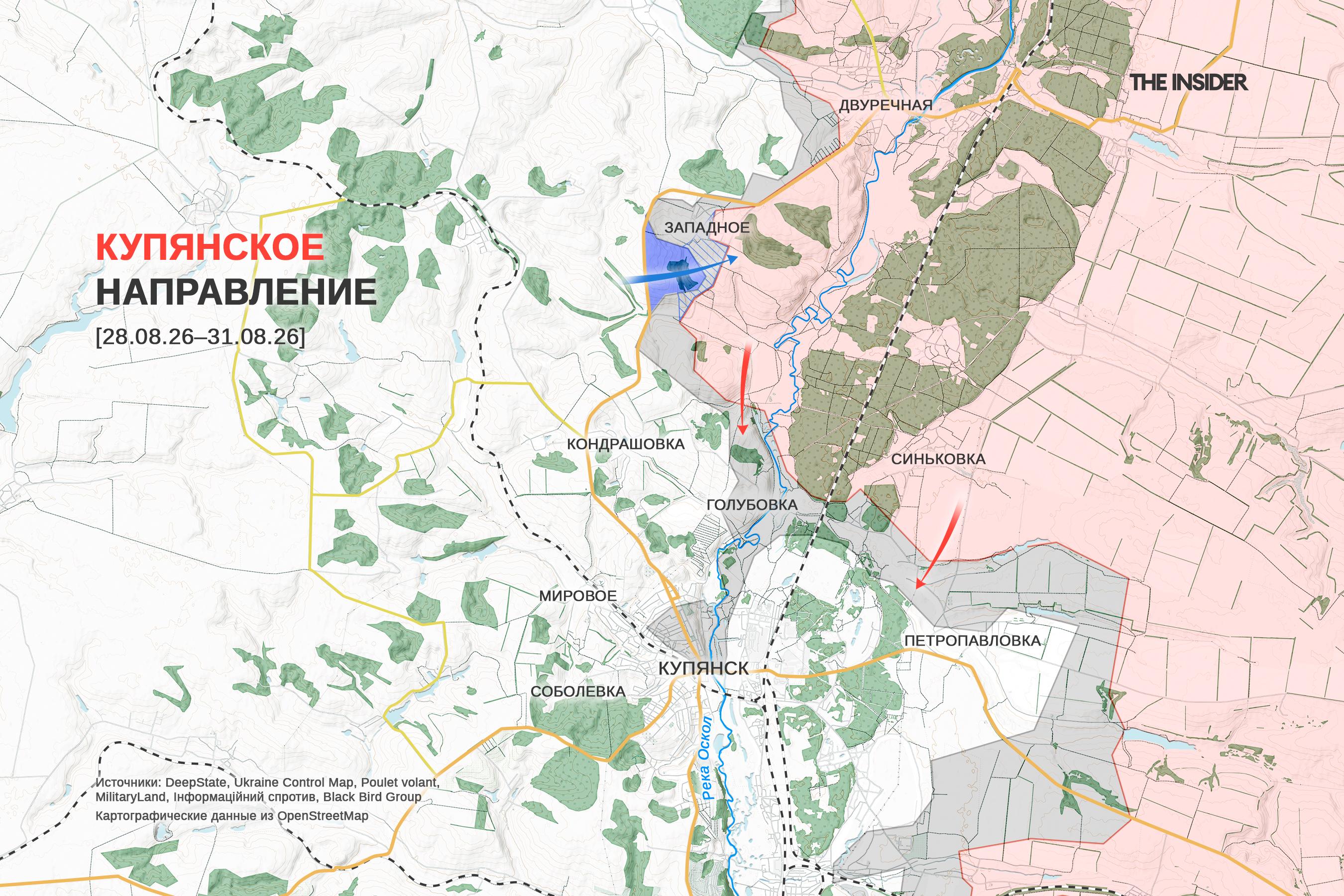
North of Kupiansk, Ukrainian infantry conducted clearing operations along the Oskil River following targeted efforts to suppress Russian drone operations. Meanwhile, Russia's Ministry of Defense claimed to have captured several settlements near Sumy, and Russian Chief of General Staff Valery Gerasimov denied reports of Ukrainian advances in Zaporizhzhia.

Aerial attacks also escalated as Russian forces deployed 138 drones overnight. Local officials confirmed civilian deaths in Kyiv Oblast, where a mother and two children were killed, and in Kherson Oblast, where a priest died in a drone attack on a monastery.

Sources: NV, Point, Радіо Свобода, The Insider, Українська правда.

Read more
04
ContinuingAI-generated
US rejects Iranian proposal to reopen Strait of Hormuz amid military escalation

US rejects Iranian proposal to reopen Strait of Hormuz amid military escalation

US President Donald Trump rejected a seven-day Iranian proposal to reopen the Strait of Hormuz, as military clashes and naval tactics intensify in the region.

Tensions in the Strait of Hormuz continue to mount as diplomatic efforts stall alongside escalating military operations. United States President Donald Trump rejected a seven-day proposal from Tehran that offered to temporarily reopen the strategic waterway in exchange for lifting the US blockade, suspending sanctions, unfreezing assets, and halting military operations. Iranian officials reiterated that the corridor "will not be opened" until Washington fulfills all of Tehran's terms.

Concurrently, military friction has heightened following a US attack on Iran's Larak Island. American forces have begun escorting commercial oil tankers through the strait during night hours, while Iranian troops responded by deploying rocket-launched sea mines into the transit corridor. Both sides appear focused on maximizing leverage amid warnings of a dangerous escalation cycle.

Sources: Expresso, Expresso das Ilhas, Jornal Económico, RTP (Rádio e Televisão de Portugal)

Read more
05
ContinuingAI-generated
German authorities trace foiled Leipzig airport drone attack to Russian intelligence

German authorities trace foiled Leipzig airport drone attack to Russian intelligence

German investigators have linked a failed drone strike at Leipzig/Halle Airport to a Russian GRU operative amid warnings over more than 100 state-sponsored hybrid operations.

German law enforcement agencies are currently investigating more than 100 suspected state-sponsored hybrid incidents nationwide, ranging from unauthorized drone flights near military sites to infrastructure tampering.

Primary focus remains on a foiled August drone attack targeting Ukrainian cargo aircraft at Leipzig/Halle Airport. According to investigative details revealed from secret intelligence documents, authorities have identified a suspected operative from Russia's military intelligence agency, the GRU, as the logistical coordinator behind the attempted bombing.

Alongside the airport probe, domestic intelligence agencies warned that foreign operatives may have planted hidden weapon stashes across Germany to support future sabotage efforts. Security reporting notes that these multi-faceted operations—encompassing physical sabotage, deep-sea cable damage, and coordinated online disinformation—are increasingly deployed to erode public trust and destabilize democratic institutions.

Sources: Correctiv, Der Standard, FAZ, ORF, Tagesschau

Read more
Share