Top news

Sep 21, 2026, 10:30 AM UTC

← Latest news

01
ContinuingAI-generated
Ukrainian forces advance near Kupiansk as heavy frontline fighting continues

Ukrainian forces advance near Kupiansk as heavy frontline fighting continues

Ukrainian forces reported over 250 combat engagements along eastern frontlines as Russian drone strikes killed civilians in Kyiv and Kherson regions.

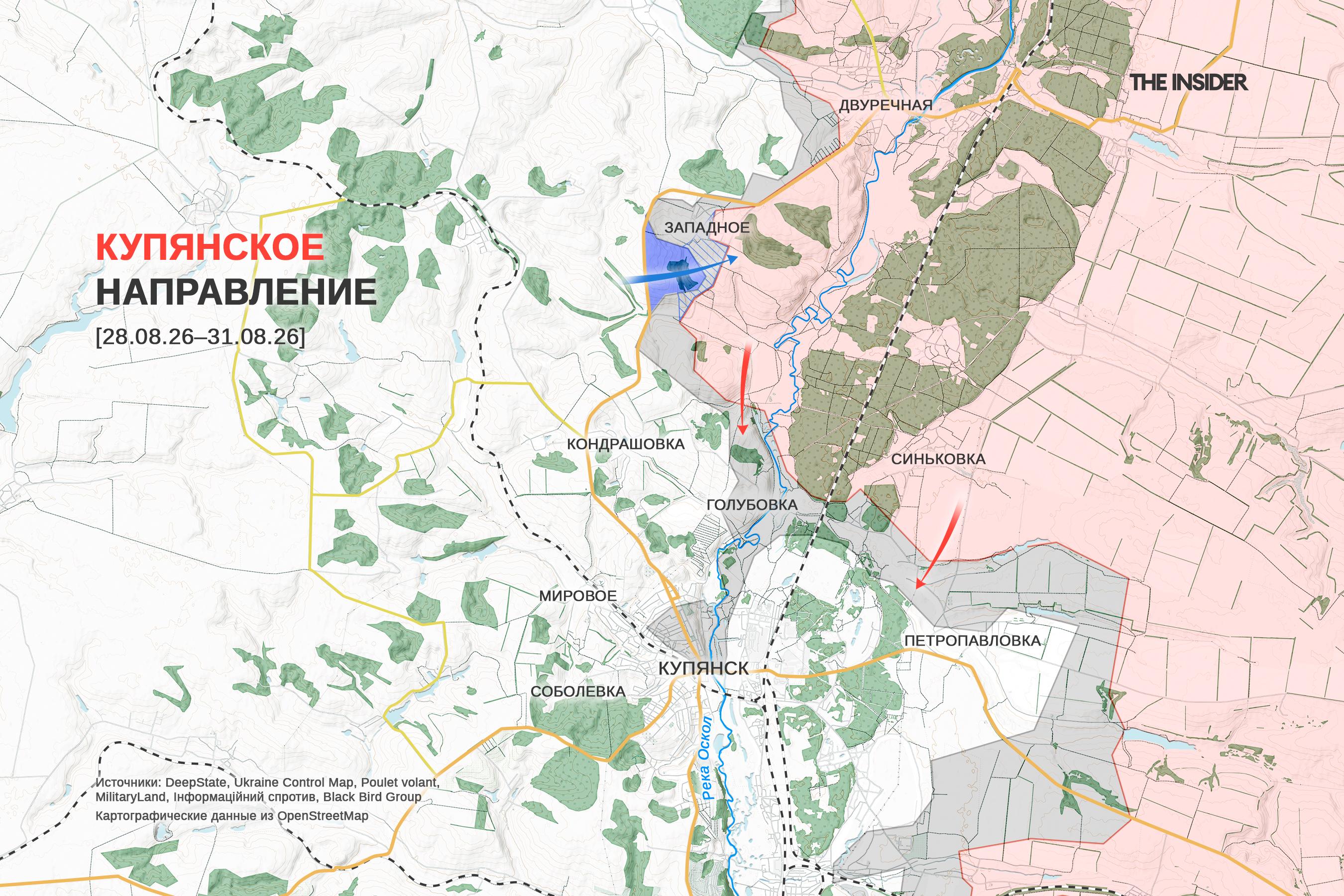
Ukrainian forces engaged in over 250 combat operations along eastern frontlines, with heavy fighting reported across the Lyman, Pokrovsk, and Kostiantynivka directions. Near Kupiansk, Ukrainian troops executed tactical infantry clearing operations along the Oskil River after suppressing Russian drone capabilities with electronic warfare.

Territorial claims along several sectors remain contested. Russia's Defense Ministry reported capturing settlements near Sumy, while Russian Chief of the General Staff Valery Gerasimov denied reported Ukrainian gains in Zaporizhzhia. Conversely, reports indicate potential Ukrainian advances north of Kupiansk and near Lyman.

Concurrently, Russian overnight strikes involving over 130 drones targeted multiple Ukrainian regions. Attacks in Kyiv Oblast resulted in three civilian fatalities, including two children, while a separate strike in Kherson Oblast killed a priest at a local monastery.

Sources: NV, Point, Radio Svoboda, The Insider, Ukrainska Pravda.
Read more
02
ContinuingAI-generated
Ukraine pursues domestic weaponry amid air defense supply delays

Ukraine pursues domestic weaponry amid air defense supply delays

Ukraine is expanding domestic defense efforts, developing ballistic missiles and glide bomb kits while facing delays in producing Patriot systems locally.

Ukraine is accelerating efforts to manufacture domestic weaponry and secure long-term air defense solutions following heavy Russian ballistic missile strikes. President Volodymyr Zelenskyy confirmed that two Ukrainian companies are working on indigenous ballistic missiles, though technical hurdles remain before mass production can begin.

Concurrently, Ukrainian forces are procuring the locally produced "Equalizer" glide bomb kit. Developed by DG Industry through the Brave1 initiative, the module transforms unguided aerial bombs into precision-guided munitions compatible with Soviet-era jets and Western fighters.

However, officials and defense analysts warn that immediate air defense coverage remains constrained. Licensed domestic production of U.S. Patriot missile systems could take up to several years due to licensing requirements and regulatory delays, leaving critical infrastructure reliant on limited Western interceptor deliveries.

Sources: NEXTA, NV, Point, The Insider, Українська правда.

Read more
03
ContinuingAI-generated
Finnish president downplays direct Russian NATO threat amid rising hybrid risks

Finnish president downplays direct Russian NATO threat amid rising hybrid risks

Finnish President Alexander Stubb sees no evidence of an imminent Russian attack on NATO, even as Eastern Flank nations brace for heightened hybrid risks and Baltic Sea provocations.

Finnish President Alexander Stubb has dismissed assessments suggesting Russia could target NATO by 2029, stating there is no evidence indicating Moscow would challenge the alliance directly. Speaking to German media, Stubb emphasized that while a direct assault remains unlikely, member states must maintain robust deterrence and prepare for worst-case scenarios.

Despite Stubb's skepticism regarding open war, regional defense analysts and officials from Baltic Sea states warn of intensifying asymmetrical threats. Polish military expert Col. Maciej Korowaj stated that Russian forces are actively probing NATO security responses to refine plans for potential provocations, with increased risks anticipated from September. Meanwhile, Poland, Finland, and the Baltic states are expanding defense cooperation—including Swedish military support for Helsinki—to counter escalating hybrid, intelligence, and sabotage operations along NATO's eastern flank.

Sources: Defence24, Portal obronny, Rzeczpospolita, TVP info

Read more
04
ContinuingAI-generated
US operation in Strait of Hormuz triggers Iranian response as passage remains closed

US operation in Strait of Hormuz triggers Iranian response as passage remains closed

The Strait of Hormuz remains closed following a major US crude oil transport operation, Iranian rocket-mine deployments, and US strikes on Larak Island.

US military forces conducted a major overnight operation utilizing air, sea, and space assets to transport millions of barrels of crude oil through the disputed Strait of Hormuz. In response, Iranian forces deployed rocket-launched sea mines in the strategic waterway, prompting retaliatory US strikes against Iran's Larak Island.

Tehran subsequently confirmed that the strait "will not be opened" until Washington complies with conditions set in a memorandum of understanding. The demands require an end to military threats, the lifting of port blockades, suspension of energy sanctions, and the unfreezing of Iranian assets. The passage previously handled roughly 20 million barrels of crude oil daily before hostilities began. Analysts warn that both nations face a shrinking window to exert pressure, significantly heightening the risk of further military escalation across the region.

Sources: Expresso, Expresso das Ilhas, RTP (Rádio e Televisão de Portugal)

Read more
05
ContinuingAI-generated
US midterm election pressures shape White House policy on Iran and Ukraine

US midterm election pressures shape White House policy on Iran and Ukraine

Rising political tensions ahead of the U.S. midterms are shaping foreign policy, affecting decisions on Iran and legislative support for Ukraine.

Internal political considerations ahead of the upcoming United States midterm elections are increasingly influencing Washington's foreign policy decisions. Senior advisers to President Donald Trump are reportedly urging restraint regarding military tensions with Iran to avoid undermining Republican electoral prospects in November.

At the same time, foreign policy analysts and former diplomats caution that significant Republican losses in Congress could cause American political attention to turn inward, potentially reducing focus on Ukraine. During a visit to Kyiv, a bipartisan delegation of U.S. lawmakers reiterated continued support for strengthening Ukraine's position ahead of potential future negotiations. However, the representatives acknowledged that escalating partisan disputes in Capitol Hill continue to impede legislative progress, including proposed sanctions against Russia.

Sources: NV, Liga net, Українська правда, Радіо Свобода.

Read more
Share