Top news

Sep 19, 2026, 04:00 PM UTC

← Latest news

01
ContinuingAI-generated
Finnish president rejects warnings of potential Russian attack on NATO

Finnish president rejects warnings of potential Russian attack on NATO

Finnish President Alexander Stubb dismissed forecasts of a Russian attack on NATO by 2029, while experts warn of escalating hybrid threats in the Baltic region.

Finnish President Alexander Stubb has dismissed German predictions that Russia could attack NATO territory by 2029, stating there are "neither evidence nor facts" to support the claims. Stubb noted he cannot imagine Moscow targeting the alliance, though he stressed that member states must remain prepared for worst-case scenarios to maintain deterrence.

While Stubb downplayed the likelihood of a direct military assault, security analysts highlight escalating non-conventional risks. Polish military expert Col. Maciej Korowaj warned that Russian intelligence is actively testing NATO response protocols across the Baltic Sea to refine plans for potential provocations, with operational risks expected to surge starting in September.

Sources: Defence24, Portal obronny, Rzeczpospolita, TVP info
Read more
02
ContinuingAI-generated
Ukraine expands domestic arms production amid air defense shortages

Ukraine expands domestic arms production amid air defense shortages

Kyiv is accelerating local production of ballistic missiles and glide bomb modules as bureaucratic hurdles delay domestic Patriot manufacturing.

Ukraine is accelerating efforts to develop indigenous weaponry to mitigate shortages of Western air defense interceptors and long-range systems. Amid intensified Russian ballistic strikes, Ukrainian President Volodymyr Zelenskyy cautioned that establishing domestic production of U.S.-designed Patriot systems under license could take up to several years due to regulatory delays.

To address immediate vulnerabilities, domestic manufacturers are pursuing technological alternatives. Two local enterprises are currently working on indigenous ballistic missiles capable of striking deep target areas, although engineering challenges remain before mass output begins. Concurrently, the Ukrainian military is acquiring the locally developed "Equalizer" precision glide bomb module, designed to convert unguided ordnance for deployment from both Soviet-era and Western fighter jets. The initiative aims to enhance Kyiv's operational autonomy while securing vital infrastructure against ongoing aerial bombardments.

Sources: NEXTA, NV, Point, The Insider, Українська правда

Read more
03
ContinuingAI-generated
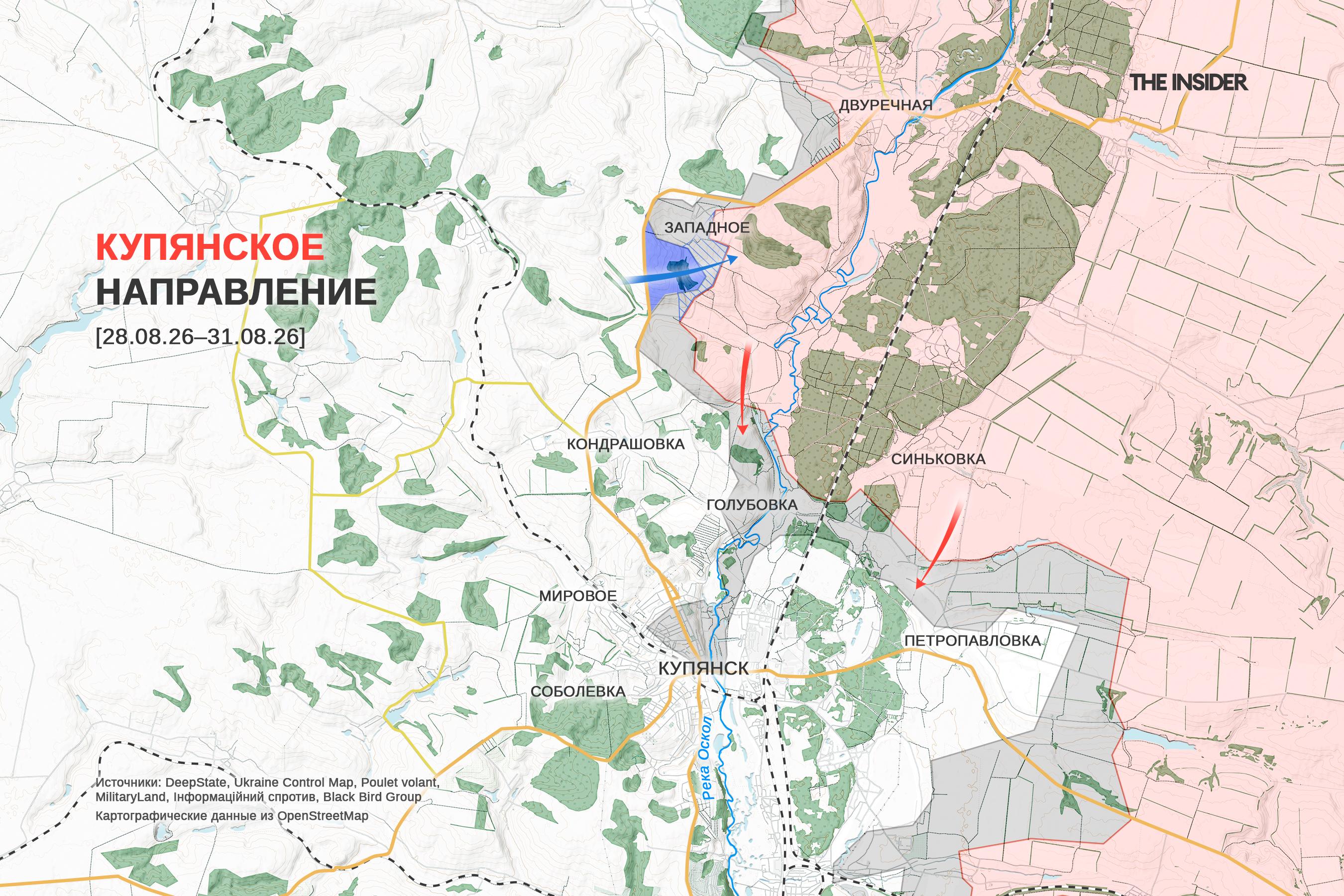
Clashes persist across eastern Ukraine as Ukrainian forces report gains near Kupiansk

Clashes persist across eastern Ukraine as Ukrainian forces report gains near Kupiansk

Heavy fighting continues across eastern sectors as Ukrainian forces report tactical gains near Kupiansk, while Russia claims localized progress near Sumy.

Ukrainian forces continue to engage Russian troops across eastern and northern sectors, with Ukraine's General Staff reporting more than 200 daily combat engagements.

Heavy fighting remains concentrated around Pokrovsk, Lyman, and Kostiantynivka, where Ukrainian defenders reportedly repelled dozens of Russian attempts to break through defensive lines. In the Kupiansk sector, Ukrainian infantry advanced along the right bank of the Oskil River following electronic warfare operations that disrupted Russian drone capabilities. Additional reporting indicates Ukrainian progress near Lyman, though frontline claims remain dynamic.

Contrasting accounts persist in other regions. Russian defense authorities claimed to have captured several border settlements near Sumy, while Russian military commanders denied reports of Ukrainian advances in the Zaporizhzhia region.

Sources: NV, Radio Svoboda, The Insider, Ukrainska Pravda.

Read more
04
ContinuingAI-generated
Tensions rise in Strait of Hormuz as US completes major crude transit

Tensions rise in Strait of Hormuz as US completes major crude transit

U.S. forces escorted a major crude oil transit through the Strait of Hormuz while Tehran maintained the choke point will remain closed until Washington lifts sanctions.

Military actions in the Strait of Hormuz have intensified following a large-scale U.S. operation escorting oil tankers through the maritime choke point under cover of night. Iranian forces responded by deploying rocket-launched sea mines along key transit channels, prompting American strikes on military targets on Larak Island to protect merchant shipping.

Tehran reiterated that the strategic waterway will remain closed until Washington meets its conditions. Iran's demands include ending the U.S. naval blockade on Iranian ports, lifting petroleum sanctions, unfreezing national assets, and halting military operations across all fronts. Prior to the war, roughly 20 million barrels of crude oil navigated the strait every day.

Sources: Expresso, Expresso das Ilhas, RTP

Read more
05
ContinuingAI-generated
Russian attacks kill five and injure 16 in Ukraine's Dnipropetrovsk region

Russian attacks kill five and injure 16 in Ukraine's Dnipropetrovsk region

Russian strikes across five districts in Ukraine's Dnipropetrovsk region killed five people and injured 16 others over a 24-hour period.

Russian forces targeted five districts in Ukraine's Dnipropetrovsk region with nearly 60 strikes over a 24-hour period, according to local emergency officials. The artillery and drone attacks resulted in at least five civilian deaths and left 16 other residents injured.

The heaviest casualties occurred in the Kamianske district, where three people died and five were hurt. In Pavlohrad, two individuals were killed and seven sustained injuries. Additional casualties and property destruction were recorded in the Nikopol district as firefighters worked to contain blazes and clear debris from damaged civilian sites.

Sources: Ziarul de Gardă

Read more
Share