
Yandex Cloud Data Center and Defense Plant Hit in Unprecedented Drone Strike on Russia’s Sasovo

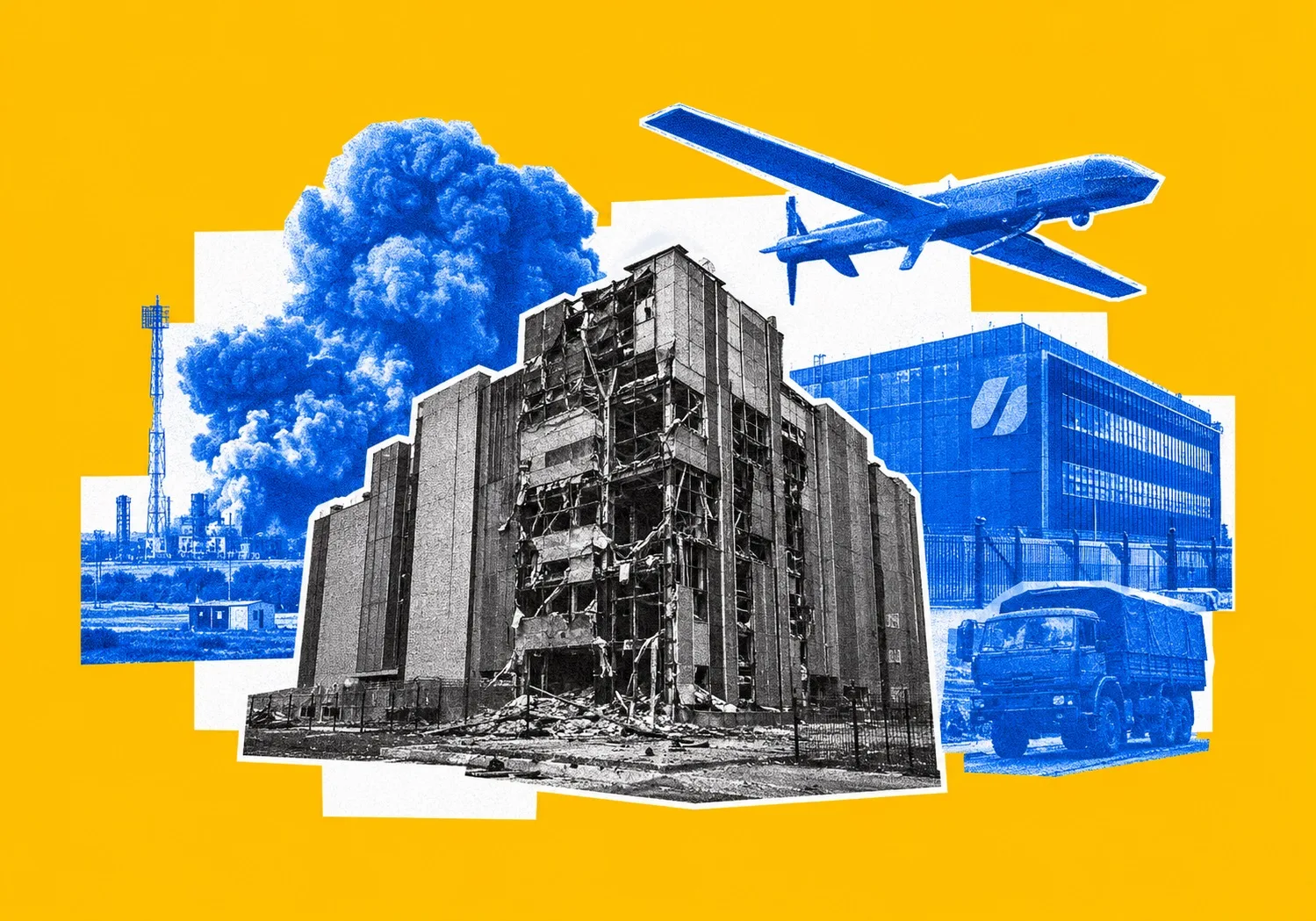
An overnight drone strike on a dual-use industrial site in Sasovo, Ryazan region, has disabled a major Yandex Cloud data center and damaged the Sasta machine-tool plant supplying Russia’s defense sector. The incident exposes a critical structural flaw in Russia’s infrastructure: the physical co-location of commercial cloud computing and sanctioned military-industrial facilities within reach of long-range drones.
The exact target remains unclear.
Yandex acknowledged an incident, power failures, and damage to its infrastructure, but did not initially attribute the fire to a drone strike. Russian regional and federal authorities reported the fire and emergency response without specifying the precise target. Ukrainian officials have not claimed responsibility.
Witness footage, OSINT reporting, and Russian media coverage, including RBC and ASTRA, support the link to a drone attack. Reuters, BBC and CNBC have also reported the incident while noting that it remains uncertain whether the Sasta plant, the Yandex facility, or both were the intended target.
That ambiguity is important because the two facilities represent very different parts of Russia’s strategic economy.
Sasta is not simply another industrial plant. It produces CNC machine tools, including five-axis machining centres and heavy lathes. Such equipment is fundamental to manufacturing components requiring tight tolerances, from engine and turbine parts to missile and aviation components. With Western sanctions restricting Russia’s access to imported precision machinery, domestic producers have become more important.
Sasta itself has been sanctioned by the UK, EU, Canada, Switzerland, Australia, New Zealand and Japan because of its role in Russia’s defence-industrial complex. It has also supplied equipment to entities connected with Roscosmos.
 Yandex DC Sasovo represents the other side of the same vulnerability. Opened in 2014, the facility has a 12 MW electrical capacity and space for tens of thousands of servers. It is a major physical node in Yandex Cloud, supporting enterprise and public-sector customers through the
 ru-central1-b zone.
The unusual feature is not that either facility could matter independently. It is that they were physically co-located.
That creates a wartime problem that neither cybersecurity nor conventional cloud redundancy can solve on its own.
The cloud is still made of concrete
Cloud computing is designed around redundancy. Data can be distributed between availability zones; workloads can be migrated; physical failures at individual servers are supposed to remain invisible to customers.
But redundancy has a physical limit.
Yandex advised customers to move workloads from ru-central1-b after the Sasovo facility was completely shut down. Users experienced difficulties creating new virtual machines, Kubernetes clusters, and databases, alongside problems accessing cloud servers. Yandex’s wider consumer ecosystem did not suffer a total outage, but the incident demonstrated the difference between digital resilience and physical resilience.
A cloud architecture can tolerate the failure of a server rack. It is harder to tolerate the destruction of an entire data centre.
The immediate market reaction was modest but telling. When trading opened on the Moscow Exchange, Yandex shares fell by more than 3.2–3.4 per cent after confirmation of the incident. Investors were not responding merely to a temporary IT problem. The question is whether a facility that has become strategically important can continue to be operated economically when its physical location is exposed to aerial attack.
That changes the economics of Russian cloud computing.
Data centres traditionally concentrate expensive servers, power systems, cooling equipment and network infrastructure because scale makes them efficient. War introduces a different calculation. A large, efficient facility can also become a single, concentrated physical point of failure.
The problem becomes even sharper when that facility shares a site with an industrial operation that may itself be considered strategically significant.
Russia is now paying for physical cloud security
The Sasovo incident comes at a particularly awkward moment for Russian infrastructure operators.
In August, Vladimir Putin signed a decree allowing temporary state administration over critical infrastructure facilities that fail to provide adequate protection against aerial threats. Following that policy shift, Russian data-centre operators have been required to introduce physical measures such as anti-drone defences, reinforced roofing and protection for backup generators and cooling systems.
Those measures were not part of the conventional economics of data-centre construction.
They now become another cost of operating digital infrastructure in Russia.
 For cloud providers, the implications extend beyond putting physical barriers around a building. Facilities may have to be distributed more widely, separated from industrial sites, protected against attacks on electricity supplies and equipped with additional backup capacity. Each layer improves resilience, but each also makes the underlying service more expensive.
The burden will ultimately reach the companies and institutions that rely on those systems, including banks, telecom operators and state organisations.
There is a strategic irony here. Russia’s effort to build domestic digital infrastructure partly reflects the restrictions imposed on its economy by sanctions and the wider technological separation from Western suppliers. Yet protecting that infrastructure from the consequences of the war creates another layer of dependence on costly domestic investment.
The digital economy is discovering that physical geography still matters.
The machine-tool problem may be harder to replace
For Sasta, the consequences are potentially more structural.
Russia’s machine-tool sector was already under pressure because sanctions have constrained access to foreign CNC equipment. Precision machinery is not an easily interchangeable commodity. Replacing a damaged industrial machine, restoring production capacity and maintaining the expertise required to manufacture specialised equipment can take considerably longer than restoring an ordinary warehouse or commercial building.
A prolonged disruption at Sasta would therefore affect more than the company itself.
Its machinery supports sectors in which delays can propagate through supply chains. Defence manufacturers need precision components. Aerospace production needs specialised tooling. Heavy industry requires equipment capable of machining large and complex parts.
That makes a strike on a machine-tool producer different from the attacks that have dominated much of Russia’s long-range infrastructure conflict, where oil refineries, fuel storage and energy facilities have often been central targets.
The vulnerability is no longer confined to what Russia burns or stores. It extends to what Russia uses to manufacture the next generation of industrial and military equipment.
The cost of separation
The most consequential question raised by Sasovo may therefore concern geography rather than recovery.
If Russian cloud providers continue to place major computing facilities alongside industrial sites with defence connections, they create a problem that cannot be solved by software. The alternatives are expensive: physically separate facilities, redistribute servers across safer regions and build additional redundancy so that the loss of one major node does not become a serious operational event.
That could benefit competing Russian cloud providers and regional data centres that are perceived as safer or more geographically isolated. Customers have an obvious incentive to diversify if a single facility can simultaneously threaten their computing capacity and expose them to prolonged disruption.
For Yandex, the challenge is particularly uncomfortable. The company must restore capacity while convincing enterprise customers that its infrastructure can remain dependable under conditions in which the physical sites underpinning that infrastructure are themselves potential targets.
The August security decree has already shifted some of those costs from hypothetical risk into mandatory expenditure.
Sasovo makes the risk tangible.
A data centre can be redundant on paper while remaining concentrated in the real world. A defence supplier can be protected by sanctions while its physical plant remains exposed. And an industrial zone can contain assets serving entirely different markets without those assets having entirely different security problems.
The attack brought those contradictions into one location.
For Russia’s infrastructure planners, separating the digital economy from the military-industrial geography may now become less a question of efficiency than of survival. The difficulty is that moving servers is possible; rebuilding the physical and industrial networks around them is considerably more expensive.