
Ukraine Resumes Russian Oil Refinery Strikes as Zelensky Confirms End to Truce Following Ryazan Attack

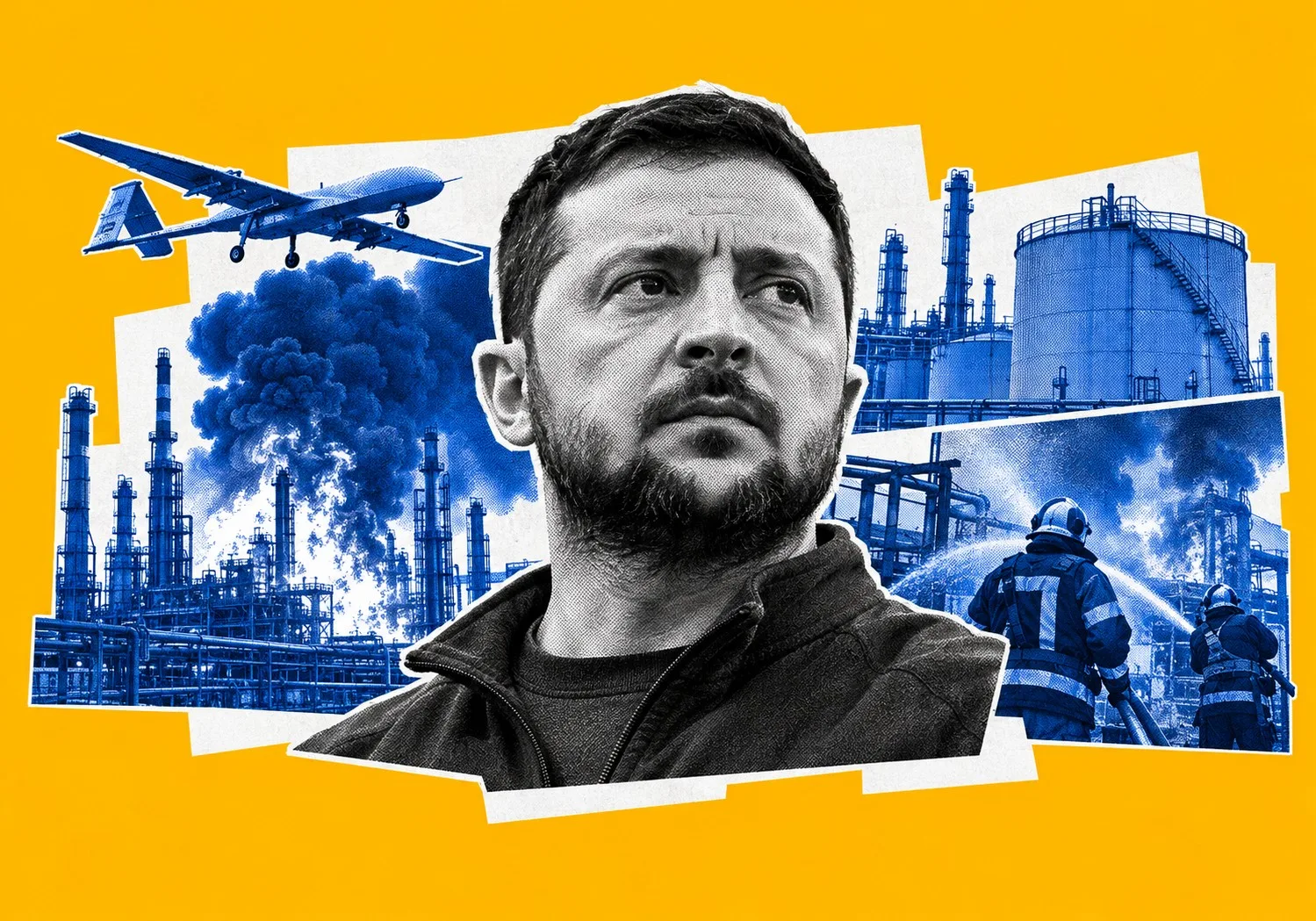
Ukraine has officially resumed drone strikes on Russian energy infrastructure, hitting Rosneft’s oil refinery in Ryazan on Thursday after President Volodymyr Zelenskyy confirmed to the Financial Times that Kyiv has lifted its temporary ban on such attacks. Speaking to the newspaper, Zelensky declared that Ukraine’s three-day pause had ended, stating: "The block is out. We’re done." The attack was confirmed by Ryazan Regional Governor Pavel Malkov, who reported on Telegram that emergency services were at the scene fighting a fire caused by a mass drone raid at the facility.
The Ryazan Oil Refinery, owned by state oil major Rosneft, ranks among the top five largest oil refining facilities in the Russian Federation.
With an annual processing capacity of up to 18 million tonnes of crude oil, the plant accounts for roughly 5 per cent of Russia's total refining throughput and serves as a vital fuel supplier to the Moscow region. In the previous year, the refinery produced 2.2 million tonnes of gasoline, 3.4 million tonnes of diesel fuel, and 4.3 million tonnes of fuel oil (mazut).

Prior to Thursday's assault, Ukraine's Defense Forces last reported a confirmed strike on the Ryazan facility in September 2026.
Governor Malkov reported that material damage was being assessed while emergency services worked at the scene.
He added that a warehouse elsewhere in the region was also damaged during the mass drone attacks, and that classes in schools and kindergartens across two districts of the Ryazan region were canceled.
The strike represents the first Ukrainian attack on a Russian energy facility since US President Donald Trump announced on Sunday that Russia and Ukraine had agreed to an energy ceasefire—a truce that had not been officially confirmed or signed by either side.
The Coercion Engine
According to statements by Ukrainian officials and President Zelensky, the resumption of refinery strikes follows a public split between Kyiv and Washington over the unilateral energy truce announced by President Trump.
President Trump announced the truce alongside a deal allowing the US Treasury Department to open markets to over 300,000 tonnes of Russian diesel fuel.
The measure was designed to curb global fuel price spikes that followed the start of the US-Israeli war with Iran in February.
Following Trump's announcement, Kyiv refrained from attacking Russian refineries for three days to comply with requests from Washington.
However, during this three-day period, Ukrainian officials reported that Washington implemented technical and intelligence restrictions against Ukrainian military forces:
Military counterparts explicitly warned Ukrainian officials that the US would block intelligence sharing and early-warning alerts for incoming Russian ballistic missiles unless strikes on Russian energy infrastructure were halted.
Ukrainian officials subsequently confirmed that early-warning alerts for incoming ballistic missiles were cut in recent days.
At the same time, access to Starshield—the military version of Elon Musk’s Starlink satellite internet network owned and controlled by the US government—was throttled across Ukraine.
On the night of October 14, Starshield terminals mounted on Ukrainian attack drones began maintaining connectivity only up to speeds of 160 km/h, disrupting frontline operations and medium-range strikes against Russian military sites.
US officials informed their Ukrainian counterparts that the disruptions to satellite communications and intelligence alerts were caused by technical glitches.
President Zelensky explicitly rejected that explanation in his interview with the Financial Times, stating: "It was not a technical problem, it was the will."
Elon Musk publicly posted on X that Starshield is owned and controlled by the US government, which decides on any operational speed limits.
Ukrainian president noted that while Ukraine paused its strikes for three days to comply with Washington's wishes, Russia continued attacking Ukrainian energy infrastructure, leaving 600,000 people without power as of Wednesday and killing more than 100 civilians over the preceding week.
The Fifth Winter Offensive
The attack on the Ryazan refinery comes amid an intensified Russian campaign targeting Ukrainian power generation and transmission networks ahead of the winter season, marking Moscow's fifth winter offensive since the full-scale invasion began in 2022.
Volleys of explosions were recorded across Kyiv in the early hours of October 14 as Russian missiles and drones targeted multiple energy facilities supplying the capital.
The barrage followed low-intensity background strikes sustained throughout the summer against businesses and critical utility infrastructure.
According to social media statements by President Zelensky, Russian forces targeted 26 distinct power facilities across Ukraine during the single wave of attacks on October 14.
The massive assault during the proposed truce as an unprecedented show of disrespect by Moscow toward the United States., Zelensky wrote.
Data provided by the press department of Ukraine’s Energy Ministry confirmed that during the week of October 5 to 11 alone, national infrastructure sustained approximately 200 hits on power sector installations and 17 on oil and gas assets.
Energy specialists told reporters that Ukraine suffers from a critical deficit in air defense interceptors required to counter Moscow’s expanding missile and drone arsenal.
Furthermore, an energy official with direct knowledge of the matter confirmed under condition of anonymity that Ukrainian authorities have recorded a recent uptick in Russian reconnaissance drones and missiles flying near nuclear power plants.
The official stated that the drones appear to be monitoring nuclear plants and their surrounding infrastructure, warning that Russian forces may be preparing to strike nodes connected to nuclear generation—an area Moscow had largely refrained from targeting during earlier phases of the invasion.
Market Stability versus Survival
The disagreement over refinery strikes highlights differing priorities between Washington, Kyiv, and Moscow regarding global oil markets and military defense strategies.
Following the outbreak of the US-Israeli war with Iran in February, global diesel prices surged due to disruptions in Middle Eastern energy exports. President Trump publicly blamed Ukrainian attacks on Russian oil infrastructure for driving up diesel prices on global markets and defended the US Treasury Department's decision to open markets to Russian diesel fuel. On Saturday, President Trump called for Ukraine to replace Volodymyr Zelensky and criticized Kyiv's continued targeting of Russian oil assets.
Data from the International Energy Agency (IEA) illustrates the extent of Ukraine's refinery campaign prior to the truce.
According to the IEA, only five of Russia's 32 major oil refineries had escaped Ukrainian drone attacks by late August, with certain facilities struck as many as 15 times since February 2022.
Ukraine’s Ministry of Defence reported that Ukrainian forces significantly intensified their campaign in September alone, striking 12 major refineries across Russia.
Regarding the status of the proposed energy truce, Kremlin spokesperson Dmitry Peskov expressed skepticism on Wednesday during a press briefing, questioning whether any formal parameters had ever been established: "What was announced? What are the boundaries of the energy ceasefire? What does it mean? Was any of this specified? That is why work in this direction is continuing."
When asked whether Ukraine would be open to halting energy strikes to repair diplomatic relations with the White House, President Zelensky told the Financial Times that he could only agree if Washington provided additional US-made MIM-104 Patriot air defense interceptors in return, calling those systems the "minimum" that would be acceptable to protect Ukrainian infrastructure.
A Division Across the Atlantic
The public dispute between Kyiv and Washington has drawn distinct reactions from European Union officials and international foreign policy leaders.
Speaking to Euronews in an interview ahead of the EU summit in Brussels, the High Representative of the European Union for Foreign Affairs and Security Policy, Kaja Kallas, explicitly defended Ukraine’s strikes on Russian oil refineries as legitimate under international law.
"If we look at international law, it is clear that \[hitting refineries\] is in defence of Ukraine because that is where the funding comes from for this war to kill Ukrainian people every day," Kallas stated.
Addressing the US agreement to allow 300,000 tonnes of Russian diesel onto global markets and the subsequent ceasefire announcement, Kallas noted: "If we look at the big picture, the majority of the financing for this war comes from oil. And that is why Ukraine is also targeting them \[the refineries\], while Russia is targeting the energy infrastructure inside Ukraine, to cause as much suffering for the Ukrainian people in the upcoming winter."
Kallas stressed that the war has a clear aggressor and victim, stating that the US should join European nations in pressuring Russia rather than Ukraine, and confirming that the European Union will continue its financial and military support for Kyiv.
According to reporting by the Financial Times, the current diplomatic friction between Kyiv and Washington represents the most serious crisis in bilateral relations since February 2025, when President Trump and his team publicly reprimanded Ukrainian president in the Oval Office.
Following the drone attack on Thursday morning, emergency services in the Ryazan region remain on-site assessing the extent of the damage to Rosneft's refining units.
Neither the US State Department nor the White House has issued an official response to the strike on Ryazan or President Zelensky's statements in the Financial Times.
*Read also: SpaceX has imposed an unannounced 160 km/h speed limit on Starshield and Starlink satellite terminals in Ukraine, disrupting frontline military drone missions as CEO Elon Musk claims the restrictions were decided directly by the US military and President Donald Trump. The speed restrictions were disclosed following a public exchange on X with Ukraine's former defence minister Mykhailo Fedorov. Fedorov noted that "Starlink connectivity at speeds of up to 160 km/h is being restored," while adding that "removing Starshield's speed limit entirely is now critical for Ukraine's defence." Musk’s reply was blunt: "Starshield systems are owned and controlled by the US government. Any limits on speed or usage are decided by the US military and ultimately POTUS."***
Sources: The Financial Time, Reuters, Euronews, RBC-Ukraine