
UK War Book and European Civil Defence: How Society Is Preparing for War Beyond the Military

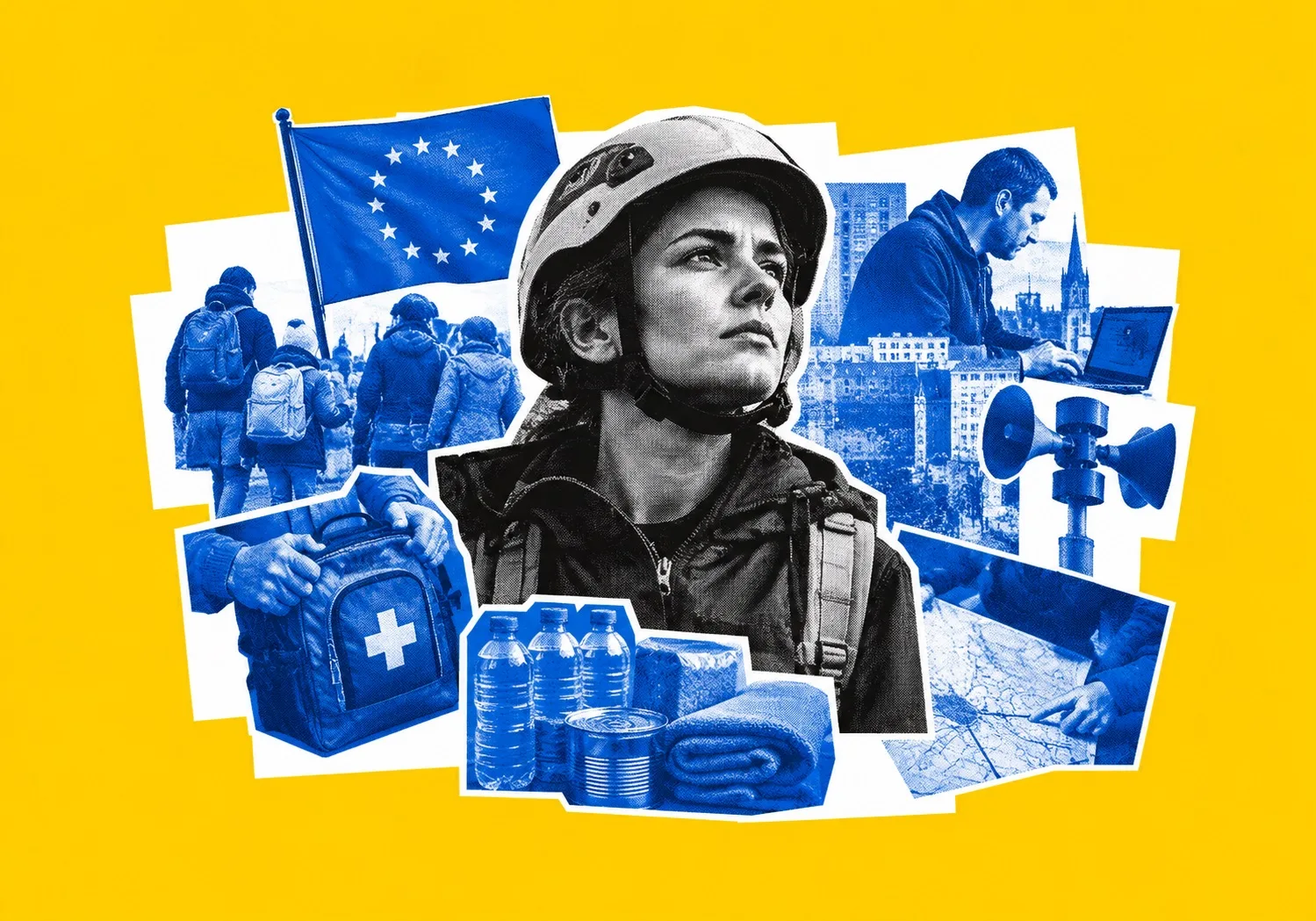
As Britain updates its Cold War-era "War Book" and European governments urge households to stockpile emergency supplies, defence planning is undergoing a radical shift. From Germany’s hospital emergency plans to Nordic Total Defence models, European nations are preparing critical civilian infrastructure and everyday society for potential wartime disruption.
Britain’s renewed War Book is a revealing example. The government has spent decades without treating a major attack on the mainland as a central planning assumption. That is now changing. The updated framework is intended to align military and civilian responses to a crisis affecting the UK, a move that the House of Commons Library describes as part of a broader “whole-of-society” approach to defence.
The message to households is changing too. Citizens are being encouraged to maintain basic emergency supplies, including drinking water, canned food, first-aid equipment, torches, radios, batteries, warm clothing, cash and important documents.
It is an unusually tangible expression of a strategic shift.
The military problem is no longer only military
For much of the post-Cold War period, Western European defence policy was built around relatively small professional forces capable of deploying abroad. The assumption was that conflicts would be limited, geographically contained and dependent on technological superiority rather than mass mobilisation.
That model is under increasing pressure.
Britain illustrates the problem particularly clearly. Its population is about 66mn, while its active professional army is roughly 70,000. Finland, with a population of only 5.5mn, maintains a trained reserve approaching 1mn people and can mobilise about 280,000 troops at short notice.
The contrast is not simply about troop numbers. It is about what constitutes the defence system.
Finland's model treats military preparedness as a function of the wider state. Sweden has moved in a similar direction, integrating civilian specialists and institutions into national defence planning while adapting its structures to NATO membership. The Baltic states have built their own systems around forward-deployed allied forces and a population accustomed to thinking about national security in more immediate terms.
NATO itself is increasingly framing resilience in these terms. Its current doctrine links military defence with the continuity of government, essential civilian services and support from civilian infrastructure.
That matters because a professional army cannot operate independently of the society around it.
A force needs fuel, transport, communications, electricity, medical treatment, food and functioning supply chains. If those systems are disrupted, military capacity can be degraded without a single tank crossing a border.
The battlefield has moved into civilian infrastructure
The most consequential change in European planning is therefore not the prospect of a conventional invasion of western capitals. It is the recognition that an adversary can impose strategic costs without fighting a conventional battle.
Undersea cables can be damaged. Energy systems can be disrupted. Digital networks can be attacked. Logistics hubs can be paralysed. Airspace can be probed. Cyber operations can interfere with services on which both civilians and armed forces depend.
For citizens, this produces a very different form of preparedness from the civil-defence exercises of the Cold War.
A household radio and several days of water may sound modest compared with tanks, aircraft or missile systems. Yet they address a basic vulnerability: the assumption that essential services will always be available.
The military's problem is the same at a much larger scale. If hospitals cannot absorb casualties, if transport networks cannot move reinforcements, or if electricity and communications fail for prolonged periods, military plans can become irrelevant.
Germany's planning for a potential flow of up to 1,000 wounded soldiers a day illustrates the scale of the adjustment. Civilian hospitals would have to become part of a wartime medical architecture, while infrastructure built for an earlier era of confrontation is being reconsidered.
That is not an exercise in nostalgia. It is a recognition that the distinction between civilian and military infrastructure has become increasingly difficult to maintain.
Europe’s “crisis of disbelief”
The deepest problem may therefore be psychological.
Countries on NATO's eastern and northern flank never fully abandoned the idea that national survival might require mass mobilisation. Finland retained conscription and a large reserve after the Cold War. Sweden maintained elements of its civil-defence tradition and has been rebuilding them. Poland and the Baltic states have approached the Russian threat from a geographical position that leaves less room for strategic abstraction.
Much of western Europe took a different path.
After the collapse of the Soviet Union, defence establishments were reduced, civil-defence systems were dismantled or neglected, and national economies became increasingly organised around the assumption that major war on European territory was unlikely. Germany's energy relationship with Russia, including the Nord Stream pipelines, became one expression of that wider confidence in economic interdependence.
The annexation of Crimea in 2014 challenged the assumption. Russia's full-scale invasion of Ukraine in 2022 made it harder to sustain.
Yet institutional change is easier than psychological change.
A population that has lived for decades without preparing for war does not suddenly acquire the habits of a mobilisation society because a government issues a preparedness leaflet. That is the “crisis of disbelief” facing western Europe: the gap between what military planners increasingly consider possible and what ordinary citizens consider plausible.
Britain's military leadership has been unusually direct about this gap. Sir Richard Knighton has described the current period as the most dangerous of his 35-year career and warned that Britain needs to prepare for longer and potentially more intense conflicts rather than the shorter, limited wars for which Western forces had planned.
The political difficulty is obvious. Preparing society for a conflict that most people still hope will never happen requires governments to spend money, change institutions and ask citizens to accept inconvenience for a threat that remains contingent.
The Nordic lesson is about integration
Finland and Sweden are important to the debate not because every element of their systems can simply be imported into Britain, Germany or France. Their geography, history and political cultures are different.
Their more relevant lesson is organisational.
Military forces are not treated as a separate profession that becomes relevant only once a crisis begins. Civilian expertise, reserves, infrastructure, public administration and private-sector capabilities are incorporated into preparedness before a crisis occurs. NATO's own work on Total Defence increasingly emphasises this integration, with Finland, Sweden and Norway presenting their approaches as examples of how conscription, mobilisation, education and civilian society can be connected.
For western European governments, that means reconsidering what counts as defence spending and what counts as defence capacity.
A hospital bed can be a defence asset in a mass-casualty scenario. A resilient power network can be part of deterrence. A communications company can become strategically important. A transport operator may be essential to moving military personnel and equipment.
The boundaries between defence policy and domestic policy are consequently becoming harder to sustain.
The price of resilience
That creates a political problem that military planning cannot solve.
European governments are already under pressure to increase defence spending. Redirecting resources towards military medicine, protected infrastructure, emergency communications, reserves and civil preparedness inevitably competes with other public priorities.
The same tension applies to citizens. Emergency supplies are inexpensive compared with a fighter aircraft, but national resilience ultimately requires much more than nine items in a cupboard. It requires investment in infrastructure, hospitals, energy security, stockpiles, communications and trained personnel.
The post-Cold War settlement allowed European governments to treat many of these capacities as insurance they were unlikely to need. The emerging model treats them as part of deterrence itself.
That is the more consequential change now taking place. Europe is not simply rebuilding armies. It is beginning to rebuild the relationship between armies and the societies that sustain them.
And that raises a difficult question for governments that spent three decades separating civilian life from military preparedness: how much of everyday life can be reorganised around a war that policymakers are trying to prevent without making that war the organising principle of society?
Sources: BBC, The Guardian, Exspress