
UK Transfer of 'Stone Cloak' EW Tech to Ukraine Signals Strategic Shift to Local Production

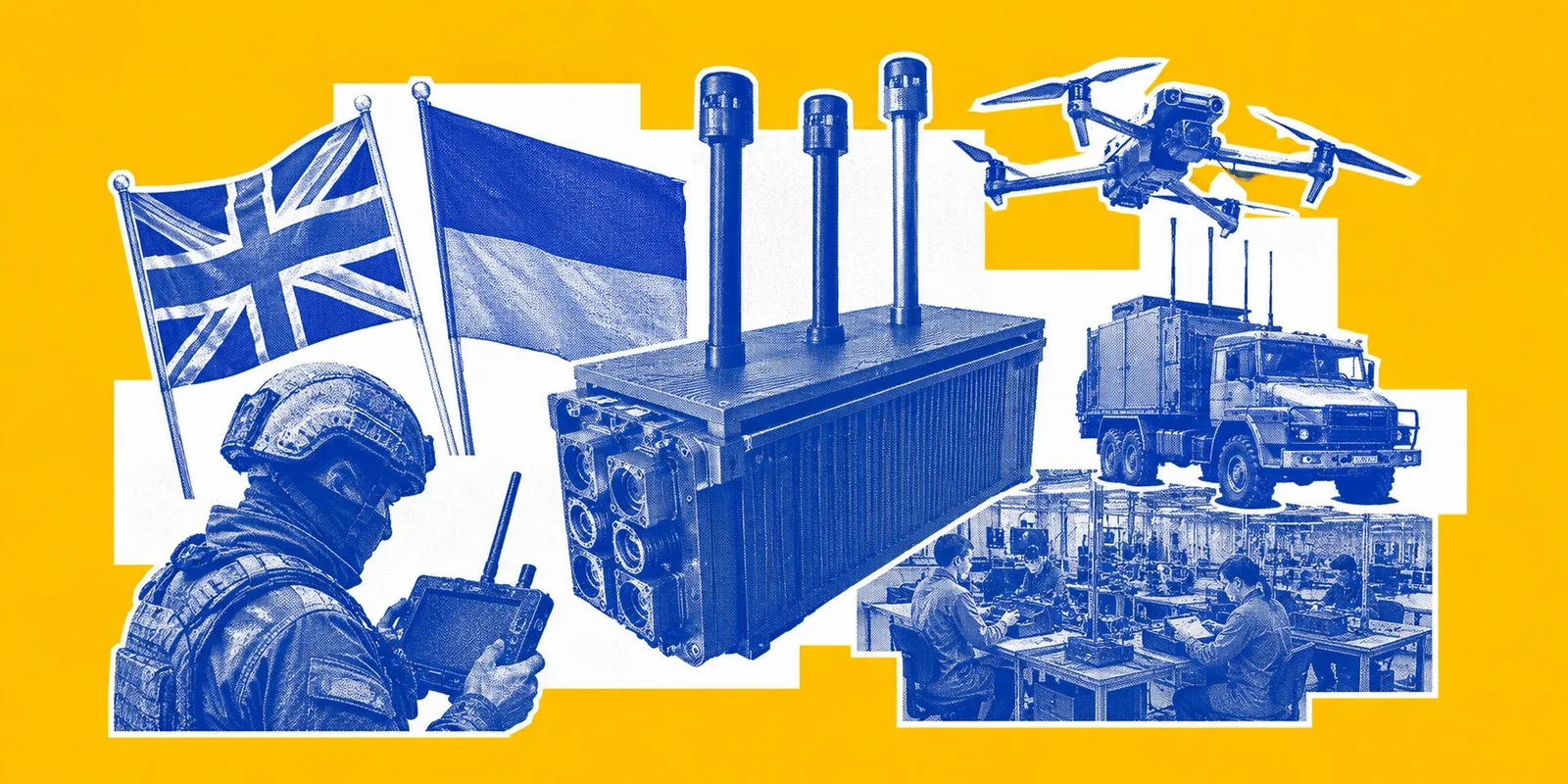
British Prime Minister Andy Burnham will meet Ukrainian President Volodymyr Zelensky on Monday to announce the transfer of intellectual property for the "Stone Cloak" electronic warfare system. The deal enables Ukraine to mass-produce the drone-jamming technology domestically, marking a pivotal transition from direct Western arms deliveries to localized defence industrial integration.
Britain has already supplied Ukrainian forces with thousands of Stone Cloak units. The new agreement would allow Kyiv to manufacture the tablet-sized jammers itself and integrate them into Ukrainian strike drones. In return, the British defence sector will receive real-time operational data from the battlefield - a trade that effectively links Ukrainian wartime production to the future development of British weapons.
The relationship is becoming industrial rather than transactional.
From finished equipment to sovereign production
Stone Cloak is designed to interfere with signals used by Russian air-defence systems. Mounted on Ukrainian strike drones, the compact electronic warfare module can make it harder for Russian systems to detect, track and intercept drones operating against targets deep inside Russia.
The difference between receiving thousands of finished units and receiving the technology to produce them is fundamental.
An equipment delivery depends on the donor country's production schedules, inventories and logistics. A technology licence places at least part of the supply chain inside Ukraine. For a country conducting sustained long-range drone operations against Russian industrial, energy and military infrastructure, that distinction can determine how quickly operations can be expanded or maintained.

Electronic warfare equipment is also exposed to the pressures of high-intensity conflict. The more frequently drones are launched, the greater the demand for the systems that help them penetrate hostile air defences. Any interruption in foreign deliveries can therefore become an operational constraint.
Local production does not remove Ukraine's dependence on foreign technology. Stone Cloak itself is British-developed. But it changes where the final manufacturing capacity sits and reduces the vulnerability created when every component must travel through an international supply chain before reaching the battlefield.
That is the strategic value of the agreement.
The British government is not simply sending Ukraine more equipment. It is placing part of the production process inside the country that is using the technology most intensively.
The battlefield becomes part of the British design process
The reciprocal element is even more significant.
Under the arrangement, the UK defence sector will receive battlefield telemetry and operational performance data from Ukrainian use of Stone Cloak. That information is expected to feed into future British drone and missile programmes, including Project Brakestop.
The implications go beyond one electronic warfare system.
Project Brakestop is intended to develop low-cost, mass-produced long-range cruise missiles and strike effectors capable of operating at ranges exceeding 500–600 kilometres, with speeds above 600 km/h and warheads in the 200–300 kg range. The programme is designed to reduce reliance on US-supplied components and GPS navigation.
The British military therefore gains something traditional weapons procurement struggles to obtain quickly: data from a live, technologically sophisticated war.
The information generated by Ukrainian operations can help reveal how systems perform against real air-defence networks, how electronic warfare affects the survivability of strike platforms and which design choices matter under conditions that cannot be fully replicated on a test range.
The result is a feedback loop.

British technology enters Ukrainian production and combat operations. Ukrainian forces generate operational data. That data returns to British defence programmes, where it can influence the next generation of weapons.
For Western defence industries, the attraction is obvious. The development cycle is no longer based solely on laboratory testing, exercises and simulations. A system can be modified according to information emerging from an active conflict.
That does not make the battlefield a simple testing ground. Ukraine is fighting a war with real infrastructure, lives and strategic consequences at stake. But the industrial relationship means that the experience of that war is increasingly being built directly into the design of future Western weapons.
Why low-cost weapons are becoming more important
Project Brakestop points to a broader problem facing European militaries.
Traditional defence systems are often expensive, complex and slow to manufacture. That model becomes increasingly difficult to sustain in a conflict where relatively inexpensive drones can be launched in large numbers and where air-defence systems must constantly decide how to allocate limited and costly interceptors.
A military built around small numbers of highly sophisticated platforms may struggle when the operational environment rewards volume, adaptability and the ability to replace losses quickly.
The Brakestop concept moves in the opposite direction: lower-cost, mass-producible weapons with long range and reduced dependence on American components or satellite navigation.
The importance of this approach is not only financial. It is also political.
European defence autonomy has often been constrained by dependence on foreign technologies, supply chains and components. Reducing reliance on US ITAR-controlled elements could give Britain and its European partners greater freedom to design, manufacture and export weapons according to their own strategic priorities.
Ukraine's war has made the consequences of such dependence harder to ignore. A weapon system may be technically advanced and militarily effective, but its availability can still be limited by production capacity, licensing arrangements or access to critical components.
The Stone Cloak agreement addresses that vulnerability from the Ukrainian side. Project Brakestop addresses it from the British side.
Together, they point towards a defence model built around modular systems, local production and rapid adaptation rather than a one-time transfer of finished platforms.
A political signal wrapped inside an industrial agreement
Burnham's meeting with Zelensky also carries a political message.
The prime minister invited the Ukrainian president to Britain during his first telephone call after taking office, signalling that the change in British leadership would not mean a change in the country's security commitments.
That continuity matters because the agreement comes after a turbulent week in Kyiv, including the dismissal of Defence Minister Mykhailo Fedorov. US and British officials privately urged Zelensky to preserve anti-corruption initiatives and institutional transparency.
The political message is therefore two-sided. Britain is maintaining military support, but the deeper partnership still depends on confidence in the institutions responsible for managing defence resources and production.
The agreement also comes as Ukrainian military personnel continue training in the UK. Burnham and Zelensky are expected to address more than 200 Ukrainian service members completing three weeks of training under Exercise Sea Breeze, focused on Black Sea naval warfare and counter-mine operations.

The military relationship is expanding across several levels at once: training, equipment, industrial production and technology development.
The Black Sea is becoming harder to separate from European security
The wider security environment makes the timing particularly significant.
On Sunday, a Romanian Air Force F-16 operating under NATO command shot down a Russian Shahed-type drone over Romanian territorial waters in the Sulina-Chilia area of the Black Sea. It was the fourth recent drone interception by Romania along NATO's eastern flank.
Such incidents create a difficult boundary for the alliance. Russian drones operating near NATO territory do not necessarily represent a direct attack on a member state, yet repeated violations force national and NATO forces to respond. Every incident increases the possibility of miscalculation, especially in a region where Ukrainian and Russian operations are already taking place in close proximity to alliance airspace.
The result is a security environment in which the distinction between the war in Ukraine and the defence of NATO's eastern border becomes increasingly operational rather than geographical.
That helps explain why European governments are interested in technologies capable of operating at scale and adapting quickly.
The new bargain of wartime defence innovation
The Stone Cloak agreement may become more important for what it establishes than for the number of jammers Ukraine will eventually produce.
The old model was relatively straightforward: Western countries developed weapons, maintained industrial production and sent selected equipment to Ukraine.
The emerging model is more complicated. Western countries provide intellectual property. Ukraine manufactures and deploys the technology in a war where the systems face sophisticated Russian defences. Operational data then returns to Western defence programmes, influencing weapons that may later be produced for European militaries.
That is a different relationship from military aid.
It creates mutual dependence, but not an equal one. Ukraine receives the ability to produce a critical capability without waiting for every unit to arrive from abroad. Britain receives access to an extraordinary volume of real-world operational experience.
The strategic question is whether this arrangement can be expanded without allowing Ukraine's defence industry to become merely an outsourced production arm for Western militaries. Its value lies precisely in the fact that Ukrainian engineers and manufacturers are operating within the war they are trying to survive.
For Russia, the immediate consequence is more persistent pressure on air-defence networks and logistics supporting its war effort. For Western planners, the lesson is broader: the future of defence production may belong less to the country that designs a weapon first than to the network capable of improving and manufacturing it fastest.
The most consequential part of the British-Ukrainian agreement may therefore be the feedback loop it creates - from British intellectual property, through Ukrainian factories and combat operations, and back into the design of the next generation of European weapons.
Read also:
- Britain and Germany have partnered with 10 allied nations to launch the Deep Precision Strike (DPS) programme - a £30 billion effort to build sovereign European long-range missiles capable of striking targets deeper than 2,000 kilometres. Announced at the NATO summit in Ankara, the initiative combines British technological expertise with German capital to create an independent conventional deterrent aimed at Russia, bypassing traditional EU structures and French leadership.
Sources: The Independent, The Telegraph.