
UK Joins EU’s €90bn Ukraine Defense Loan: How Post-Brexit Cooperation Is Being Redrawn

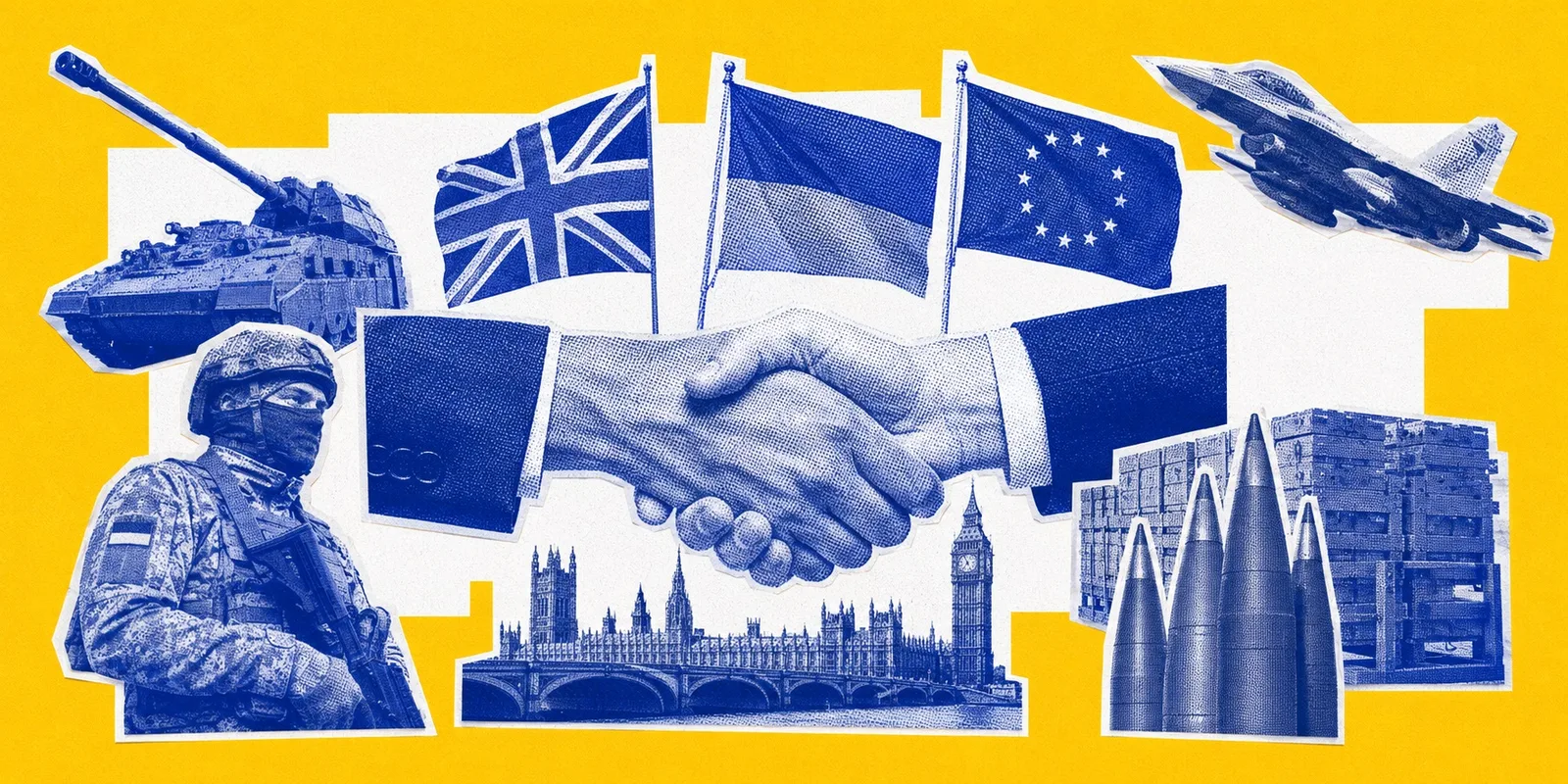
The United Kingdom and the European Union have finalized a landmark agreement granting British defense contractors access to the procurement system of the EU’s €90 billion Ukraine Support Loan for 2026–2027. By opening the program’s €60 billion military envelope to UK industry, the deal bridges post-Brexit barriers to meet Ukraine’s urgent battlefield demand while establishing a new blueprint for European security cooperation.
The Ukraine Support Loan is structured around €90 billion over 2026 and 2027. €60 billion is reserved for military capabilities, defence procurement and support for the European defence industrial base. Another €30 billion is intended for macro-financial and budgetary support.
The unusual feature is the repayment mechanism.
Ukraine is required to repay the principal only if Russia pays war reparations. The EU covers the interest costs through windfall profits and yields generated by immobilized Russian sovereign assets. In practical terms, the financial structure seeks to prevent the cost of sustaining Ukraine during the war from becoming another long-term burden on the Ukrainian state.
That distinction matters. A conventional loan would transfer the immediate cost of the war into Ukraine's future budgets. This arrangement instead tries to connect repayment to the country responsible for the destruction that created the financial need in the first place.
The mechanism does not eliminate the political and legal complications surrounding frozen Russian assets. It does, however, establish a financial principle with much wider implications: Russia's immobilized wealth can be incorporated into a European support structure without requiring Ukraine to assume the full burden of wartime financing.
The first payments have already begun. In June, €7.1 billion was disbursed, including €3.2 billion for budget support and roughly €3.9 billion for defence. Another military disbursement is scheduled for late July.
The significance is not only the scale. It is the predictability.
Ukraine is being given a financing pipeline covering two full years rather than being forced to negotiate each major tranche against the political calendar of individual donor governments.
Why Britain is being let into an EU defence pot
Brexit created a formal institutional separation between Britain and the EU. Defence, however, has never fitted neatly into that separation.
Britain remains one of Europe's major military powers. Its companies possess capabilities in areas where European production is already under pressure, including ammunition, air defence, missile components, maintenance, logistics and complex military engineering.
The war in Ukraine has made industrial capacity a strategic resource. European governments can favour internal procurement, but the battlefield does not wait for factories to expand. Nor can political borders manufacture additional shells, air defence systems or maintenance crews.
That is the tension behind the new arrangement.
The EU retains a general preference for procurement within the bloc. Non-EU purchases remain restricted unless a particular system or capability is unavailable inside the EU. British companies therefore do not receive unrestricted access to a €60 billion market. Their inclusion is conditional, and European procurement rules remain the gatekeeper.
But the gate has been opened.
For the British defence industry, this creates access to a procurement ecosystem that would otherwise have been largely closed by post-Brexit rules. Companies working in ammunition, armoured vehicles, artillery, naval engineering, air defence, missile components, sensors, logistics and equipment maintenance can now compete for contracts financed through the EU-managed military envelope, subject to the applicable conditions.
The most important beneficiaries may not necessarily be those selling the most sophisticated weapons.
Air defence, munitions and maintenance are likely to be especially important because they sit at the intersection of battlefield demand and industrial bottlenecks. A missile system is only as useful as the supply chain supporting it. An armoured vehicle requires repair, spare parts and technical personnel. Ammunition production depends on sustained industrial capacity rather than one-off political announcements.
The agreement therefore connects British industrial capacity to European capital at precisely the point where Europe's defence sector is trying to expand.
That is the deeper story.
A post-Brexit relationship built around necessity
For years, the political language surrounding Britain and the EU was dominated by disputes over trade, regulation and the consequences of separation.
Security has created a different logic.
The United Kingdom did not need to rejoin the EU to become part of a European defence financing mechanism. The EU did not need to abandon its procurement rules to bring British companies into the system. Instead, both sides created a narrower arrangement built around a shared strategic problem.
This is what makes the deal potentially more important than its immediate financial value.
It provides a model for cooperation without institutional reunification.
The framework allows third countries to participate under defined conditions. Such participation can be linked to contributions to borrowing costs and security partnerships with the EU, including arrangements associated with countries such as Norway, Iceland, Liechtenstein, and Switzerland, as well as states with specific EU defence agreements.
Britain's inclusion therefore sits within a broader question: how far can Europe's defence architecture expand beyond the formal borders of the Union?
The answer emerging from the Ukraine war is increasingly pragmatic. EU institutions can remain at the centre of financing and procurement while drawing on capabilities outside the bloc when strategic requirements demand it.
The result is neither a return to the pre-Brexit relationship nor a fully integrated European defence market.
It is something more flexible, and potentially more durable.
The price of unity is variable geometry
The agreement also exposes the limits of European unity.
Hungary, Slovakia and the Czech Republic opted out of the financial guarantee and funding mechanism for the loan. They cannot block the broader structure, but their absence means that the remaining participating EU states and partners must carry the arrangement.
That creates a form of variable geometry in European security policy.
The EU can move forward without complete unanimity among its members. The political consequence is significant. States opposed to, or unwilling to participate in, a particular financial mechanism retain the ability to stand aside. They do not necessarily retain the ability to prevent others from building an alternative coalition around the same strategic objective.
This is an increasingly important distinction in European policymaking.
The Ukraine Support Loan is therefore not only an instrument for financing Kyiv. It is also evidence of how European security cooperation is adapting to internal disagreement. The Union is becoming more capable of constructing coalitions around specific policies, even when all member states do not participate.
For Britain, that may make cooperation easier. London is no longer negotiating with a perfectly unified bloc. It is entering a system capable of accommodating different levels of participation.
The financial architecture is as strategic as the weapons
The most politically visible element of the agreement is British access to EU-funded defence contracts. The less visible element may prove just as consequential: the attempt to move the financial burden of Ukraine's defence away from annual national budgets.
The €90 billion package is a wager on institutional endurance.
A war that continues across multiple years cannot be financed efficiently through a sequence of emergency appeals. Governments need to know what money will be available. Defence companies need to know whether demand will survive beyond one budget cycle. Ukraine needs to plan its military and public finances without facing repeated funding cliffs.
The reparation-linked structure is designed around that problem.
The EU is borrowing now. Interest costs are covered through returns connected to frozen Russian sovereign assets. Ukraine's principal repayment obligation is tied to Russian reparations.
The arrangement turns immobilized Russian wealth into part of a broader financial mechanism for sustaining Ukraine, while seeking to prevent the war's direct financing costs from becoming a permanent Ukrainian liability.
The political message to Moscow is equally clear. The longer the war continues, the more deeply Russia's frozen assets become embedded in the economic architecture supporting Ukraine.
The cyber front moves in parallel
The loan agreement was accompanied by a second development that reveals the breadth of the emerging relationship.
In Paris, Keir Starmer met allies from the Coalition of the Willing as Britain and EU member states announced their first joint cyber sanctions package targeting Russian state actors and criminal networks. They also jointly attributed an attempted cyberattack on Poland's energy grid to Russia's FSB Centre 16, an operation that threatened electricity supplies for up to 500,000 people.
The significance lies in the combination.
Defence procurement, financial sanctions, and cyber attribution are often treated as separate policy areas. In practice, they are increasingly part of the same European security system. The British-EU arrangement links industrial capacity to financial support, while the cyber measures extend cooperation into the digital domain.
Britain is also maintaining its own direct military commitment to Ukraine, with £3.75 billion pledged for 2026 as part of a baseline annual commitment of £3 billion. Since 2022, British aid to Ukraine has reached £25 billion.
The new agreement does not replace national support.
It gives that support another institutional channel.
A new European defence market is being built by war
The central change is not that Britain has been granted an exception.
It is that the boundaries of European defence cooperation are being redrawn around capability.
The EU still wants to strengthen its own defence industry. Its procurement preferences remain. Third-country access is conditional. British firms will have to compete within a system designed primarily to build European capacity.
Yet the war has made absolute separation impractical.
Europe needs more production. Ukraine needs weapons at scale. Britain has industrial capabilities that can contribute. EU institutions have the financial machinery to mobilize capital on a continental scale.
The agreement connects those three realities.
That makes it a precedent. Future European defence arrangements may increasingly be designed not around the old question of who is formally inside or outside the EU, but around which countries can contribute money, industrial capacity and security capabilities under agreed rules.
Brexit created a political boundary. The war has not erased it.
It has made the boundary less decisive.
The most consequential part of this agreement may therefore be the procurement clause: the moment when a British company becomes eligible to compete for contracts financed by an EU-administered military budget. That is where political separation meets industrial necessity.
Europe's defence architecture is being rebuilt, and the first principle of the new system appears to be brutally practical: sovereignty still matters, but in a prolonged war, production capacity matters more.
Read also:
- The European Union has officially agreed on its 21st package of sanctions against Russia, marking a structural shift from broad economic bans to targeting the illicit networks keeping Moscow’s war economy afloat. After weeks of tense negotiations - and a crucial 12-month LNG exemption granted to Greece - the new measures blacklist 32 Russian banks, lock the Russian crude oil price cap at $44 per barrel, and strike directly at shadow fleet tankers, foreign drone suppliers, and crypto-settlement platforms.
- Britain and Germany have partnered with 10 allied nations to launch the Deep Precision Strike (DPS) programme - a £30 billion effort to build sovereign European long-range missiles capable of striking targets deeper than 2,000 kilometres. Announced at the NATO summit in Ankara, the initiative combines British technological expertise with German capital to create an independent conventional deterrent aimed at Russia, bypassing traditional EU structures and French leadership.
- After years of limited production, Raytheon is restarting the manufacture of ADM-160 MALD air-launched decoys in response to growing demand from the United States and NATO allies. The move is more than another defence contract - it signals a fundamental shift in how the Alliance is preparing for future air operations, where penetrating advanced air defence systems will increasingly depend not on the number of aircraft, but on the ability to deceive the enemy.
Sources: GOV.UK, European Commission.