
TikTok Meetup Chaos in Vicenza: Can Italy Hold Influencers Liable for Real-World Riots?

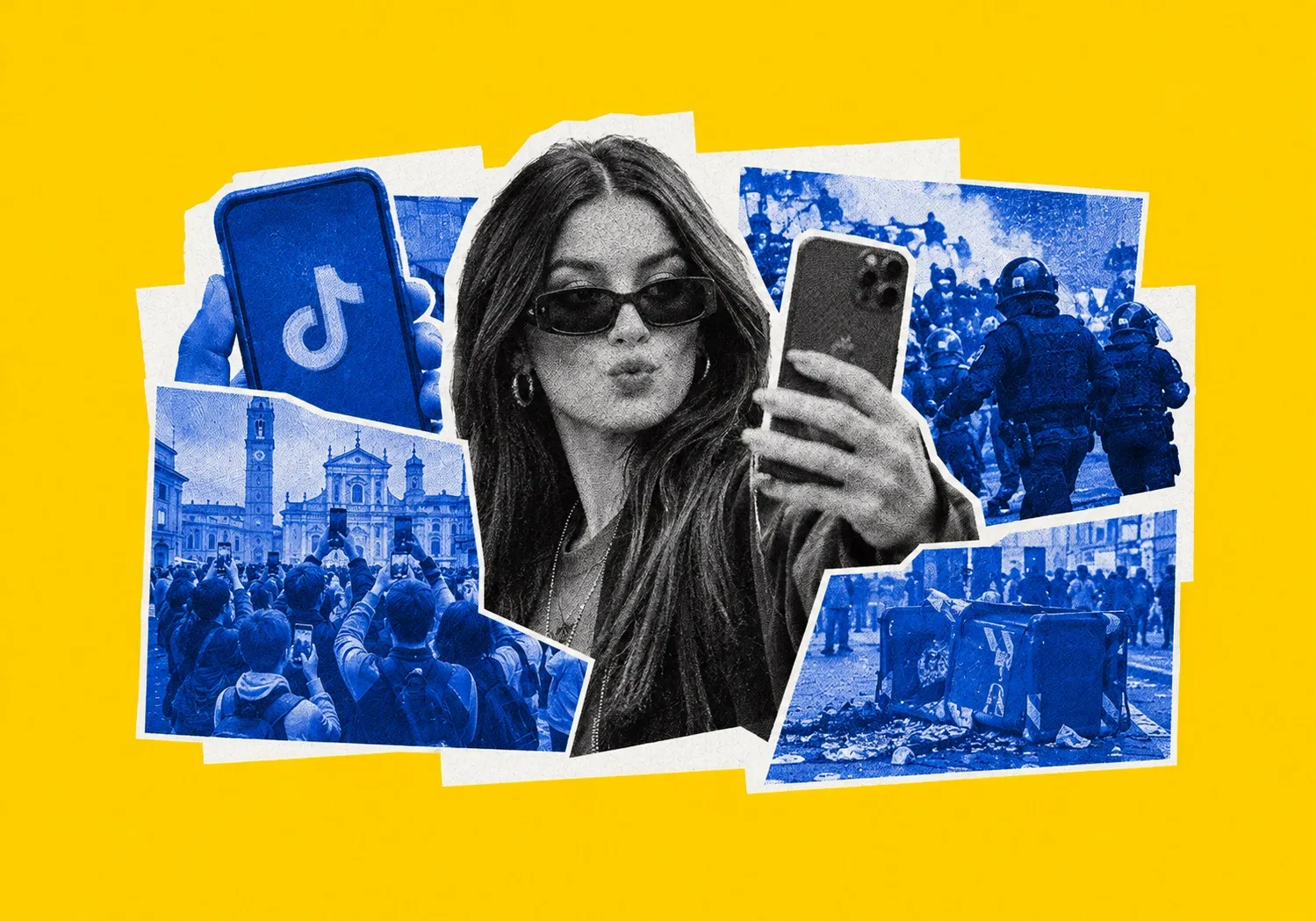
When TikTok creator Hamza Messaf’s "aura battle" flashmob devolved into property damage in Vicenza, it triggered a legal and political battle over influencer liability. As Italian authorities attempt to hold the social media star financially accountable for crowd disorder, the case sets a crucial European precedent on policing algorithmically generated gatherings.
For the city, the incident was more than a case of unruly teenagers. It exposed a problem that local authorities across Europe have yet to resolve: what happens when someone can summon a crowd online but claims no responsibility for managing it offline?
Vicenza wants Messaf to answer for the consequences. Its case could test how far existing public safety rules can reach when a gathering begins with a social media post rather than an organised public event.
An invitation, a crowd and a damaged garage
The gathering was initially planned for Campo Marzo, near Vicenza's central railway station. Young people travelled from different parts of the Veneto region, many of them minors. Reports initially put attendance at around 1,000, although the Prefecture and police later estimated that approximately 300 people had gathered.
The trouble began when Messaf arrived and the crowd moved towards his van, parked at the Park Verdi garage. People pushed and jostled as the situation deteriorated into disorder and vandalism. An exit barrier, an elevator door and automatic sliding doors were damaged. Messaf also reported damage to his vehicle.
The garage operator put the cost of repairs at approximately €10,000 as of 8 October. Mayor Giacomo Possamai said municipal property had not suffered direct structural damage, but argued that the incident had nevertheless harmed the city's operations and reputation.
Messaf rejects responsibility for the disorder. He says he was also a victim, had notified the police before the gathering and did not cause the damage.
That leaves the authorities with two problems. Police must identify the people responsible for individual acts of vandalism. Separately, the municipality wants to establish whether the influencer who promoted the gathering can be held accountable for what followed.
On 5 October, Possamai instructed the city's legal service to begin formal legal action against Messaf. The municipality has also asked the garage operator to file an official claim for compensation. Police are examining surveillance footage, while the city and local authorities consider how to handle similar gatherings in future.
The mayor's position is straightforward: those responsible for the damage must pay. Establishing who those people are, and whether liability extends beyond them, is considerably less straightforward.
When does a meetup become a public event?
Italian public safety law provides a framework for organised gatherings, including advance notification to the Questura where the relevant rules apply. But a meeting assembled through social media does not always fit neatly into the categories used by authorities.
An influencer may advertise a location, encourage followers to attend and offer prizes without hiring a venue or making conventional arrangements for a public event. If hundreds of people respond, however, the practical consequences can be much the same as those of a poorly organised spectacle.
The law must distinguish between promoting a gathering and being responsible for every action taken by the people who attend it. Someone who invites followers to meet cannot automatically be held liable for any damage they cause. Equally, describing an event as informal does not necessarily settle whether the organiser's actions fall within public safety regulations.
Vicenza's case will turn on that distinction. The municipality is pursuing legal action, but the facts available so far do not establish that Messaf has been found legally responsible for the damage.
There is a broader question behind the dispute. Public authorities are accustomed to dealing with events whose organisers, locations and schedules are known in advance. A viral challenge can attract people from several towns with little warning, leaving the police to respond after the crowd has already formed.
The difficulty is not that every online gathering is dangerous. Most will never become a public order problem. It is that authorities may have little time to distinguish an ordinary meetup from one that could overwhelm a confined space or disrupt a busy public area.
Requiring every influencer to obtain permission before meeting followers would be a blunt solution. But leaving organisers entirely outside the rules simply because invitations were issued online would create its own problems. The challenge is to establish when the scale and nature of a gathering make advance safety arrangements necessary.
Politicians see a case for tighter controls
The incident has quickly become part of Italy's political debate over public order and children's use of social media.
Veneto president Alberto Stefani has cited the gathering in support of restricting social media access for children under 14. His proposal shifts the discussion from the conduct of an individual influencer to the platforms through which young people encounter these events.
Other politicians have concentrated on punishment and policing. Infrastructure Minister Matteo Salvini demanded strict penalties for those involved. Lega undersecretary Mara Bizzotto condemned the disorder, while Fratelli d'Italia MP Silvio Giovine announced a parliamentary inquiry to Interior Minister Matteo Piantedosi into the management of public order.
Former general Roberto Vannacci used the incident to argue that Italy was experiencing a wider decline, comparing the disorder with unrest in France.
The political responses may generate pressure for action, but they address different problems. Punishing those who damaged the garage will not necessarily help police anticipate the next gathering. Restricting access for younger users would not, by itself, establish the legal responsibilities of an influencer who invites hundreds of people to a public space.
The presence of minors makes the issue harder to dismiss. It also makes a broad crackdown politically attractive. Yet the central failure in Vicenza was not simply that young people used TikTok. It was that an online event acquired a physical scale and momentum that the city was not prepared to manage.
An effective response would have to address that gap, rather than treating age restrictions as a substitute for public safety planning.
What should TikTok be expected to do?
The platform's role is another unresolved part of the story. Messaf used TikTok to promote the gathering, but that fact alone does not establish that the company was responsible for the disorder. As of the published official notices, his account had not been blocked in Italy.
The EU's Digital Services Act has brought platform responsibility, systemic risks and the protection of minors into a common regulatory debate. Whether a particular platform obligation applies to an incident such as Vicenza's depends on the relevant rules and circumstances. The mere fact that content attracts a crowd does not prove that a platform has breached its obligations.
Still, the episode raises a practical question for regulators: should platforms have a role in identifying content that is likely to bring large numbers of people together in a specific location?
A post announcing a meetup is not necessarily a threat. Nor should platforms be expected to flag every gathering as a potential public safety incident. But where an invitation spreads rapidly, offers a material incentive to attend and attracts a predominantly young audience, authorities may want a way to assess the risk before people arrive.
That would require careful limits. Monitoring public posts is not the same as tracking individuals, and preventing disorder cannot become a blanket justification for surveillance of young people's online lives. Any early-warning system would need clear criteria, safeguards and a defined purpose.
The balance is difficult: police need enough information to respond to a credible risk, while users must remain free to organise lawful gatherings without being treated as potential offenders.
The bill lands on the ground
The most immediate consequences of the Vicenza incident fall on people who had little control over the online invitation. The Park Verdi operator now faces repair costs and the prospect of pursuing compensation. The municipality has had to devote resources to the aftermath, even though its own property was not directly damaged.
Recovering the money may prove more complicated than estimating the losses. Police still need to identify those responsible for the vandalism, and any attempt to hold Messaf liable would have to establish a legal basis for doing so.
For property owners, the uncertainty is significant. A commercial building or parking facility can become an unintended gathering point when a crowd follows an influencer from one location to another. The owner may have neither warning nor a clear route to compensation.
Cities cannot prevent every spontaneous gathering, and not every large crowd requires police intervention. But the old distinction between online activity and physical public order is becoming harder to maintain when a creator can bring followers together across regional boundaries in a matter of hours.
Vicenza is trying to use existing legal mechanisms to establish responsibility after the event. Whether those mechanisms are sufficient remains an open question. The next test will be whether authorities can act before a crowd reaches the point at which damaged doors and barriers are the first clear evidence that something has gone wrong.
Sources: Città di Vicenza, U.S. ARMY, Ground, TGR