
Italy Wine Theft: 30,000 Bottles Worth €5m Stolen from Antinori Estate in Tuscany

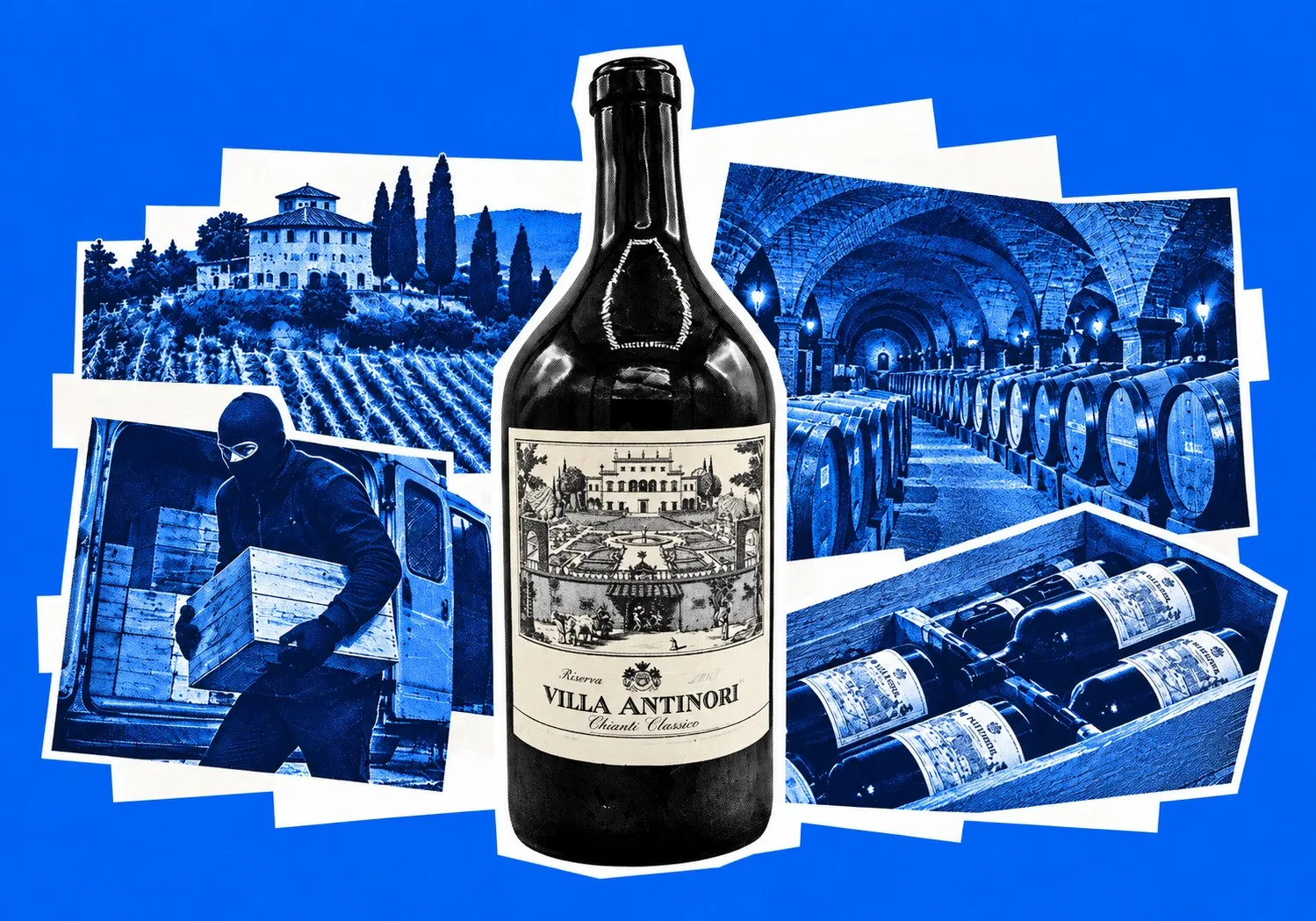
Thirty thousand bottles of Super Tuscan wine worth €5 million—including Tignanello, Solaia, and Guado al Tasso—have been stolen from Marchesi Antinori’s storage facility near Cortona. The theft, executed overnight by a masked crew of at least seven individuals using internal forklifts and company delivery trucks, coincides with recent reported break-ins at Conterno Fantino and Banfi wineries in Piedmont.
Renzo Cotarella, chief executive of the Florentine producer, confirmed that Italian winemaking had not previously recorded a theft of this economic value. The Cortona break-in represents the largest single wine heist documented in Italy, taking place precisely as the estate prepared to ship an international export consignment to foreign customers.
The perpetrators bypassed perimeter defenses, deactivated alarm systems, disabled surveillance cameras, and operated onsite machinery inside the facility. Moving methodically through the warehouse, the crew loaded pallets of high-value Tuscan reds directly into two of the company’s delivery vehicles. Among the stolen inventory were an estimated 8,000 to 10,000 bottles of Solaia—widely ranked among Italy's most sought-after red wines—alongside allocations of Tignanello and Guado al Tasso. Individual bottles within the stolen consignment retail on official commercial markets between €150 and €500.

The discovery was made on Monday morning when estate staff arrived at the facility.
Local law enforcement authorities in Tuscany have launched investigations involving physical scene analysis and transit tracking along regional road networks via highway surveillance cameras.
No arrests have been made, and neither the stolen inventory nor the vehicles have been recovered.
"Two trucks full of merchandise can't just disappear into thin air. The Tuscan roads are full of cameras; perhaps with a bit of luck we'll be able to recover at least some of the bottles stolen from us," Renzo Cotarella, the chief executive, told Corriere della Sera.
He told the Financial Times: "These wines have a great value and I don't know how they can sell all this wine around the world without being seen."

The Tuscan heist follows consecutive break-ins executed across prestigious winemaking zones in Piedmont. In mid-September, four masked individuals accessed the Conterno Fantino estate in Monforte d’Alba, located within the Cuneo province of the Langhe winemaking region. The crew crossed adjacent vineyard parcels on foot under cover of darkness to reach the main cellars.
Security media recorded the intruders spending approximately three hours inside the property. Demonstrating detailed knowledge of the cellar floor plan, the group bypassed standard inventory to select specific allocations of Barolo. The perpetrators operated an internal forklift to move heavy pallets, loaded the stock into two of the winery’s commercial utility vans, and departed the property. Total damage at Conterno Fantino is estimated in the hundreds of thousands of euros.
Earlier in the summer, on the night of 28–29 June, an intruder crew targeted the Banfi winery’s Strevi cellars in Alessandria province. The perpetrators removed over 3,000 bottles of Alta Langa DOCG traditional-method sparkling wine, specifically targeting pallets containing Cuvée Aurora, Cuvée Aurora Rosé, and Riserva 100 Mesi vintages. The operation bypassed general warehouse stock to extract full pallets of sparkling wine, resulting in losses assessed in the hundreds of thousands of euros.
These recurring incidents demonstrate a distinct structural gap in agricultural site defense. High-value wine inventories are stored in rural production hubs engineered for agricultural transport and harvesting access rather than industrial storage defense.
Market Valuation and Commodity Characteristics
The operational mechanics recorded across Tuscany and Piedmont align with shifting economic dynamics in the international wine trade. Broad European market trends indicate a long-term structural decline in generic table wine consumption. Conversely, premier appellations, high-end DOCG labels, and prestigious Super Tuscan reds retain high unit valuations and commercial liquidity.
The market profile of Alta Langa DOCG illustrates this specific divergence. Originating from experimental production initiated in the mid-19th century by Carlo Gancia, the designation received formal DOC status in 2002 and upgraded DOCG recognition in 2011. From seven founding producers at its first vintage in 1996, the appellation expanded to approximately 100 producers by 2024, with 90 belonging to the official protection consortium across 490 hectares of vineyards.
Annual production of Alta Langa DOCG crossed two million bottles in 2024, sustaining a ten per cent annual growth rate over the preceding decade despite broader industry contractions. This sustained commercial growth positions top-tier sparkling wines and DOCG reds as high-value, liquid physical assets.
Individual bottles stolen during the Antinori break-in retail between €150 and €500 on official primary markets. At these price points, a standard commercial cargo container or delivery truck represents a concentrated store of physical value.
Unlike standard consumer luxury items, fine wine moves through international dining networks, private buyer channels, and secondary resale markets across 170 export destinations. In each reported incident, perpetrator groups bypassed standard inventory to select specific high-margin labels, lot allocations, and export consignments, transporting palletized cargo through company fleet vehicles onto regional road corridors.
Site Vulnerabilities and Onsite Equipment
The operational methods recorded in Tuscany and Piedmont reflect physical security frameworks common across European agricultural estates. Producers like Marchesi Antinori—a family institution established in 1385, reporting annual revenues of €263 million (£223 million) across 170 international markets—maintain extensive production and storage facilities dispersed across rural landscapes.
While urban distribution centers holding comparable asset values implement biometric access controls, perimeter monitoring, and vehicle tracking systems, rural agricultural facilities often rely on standard physical property security scaled for agricultural storage.
Across the Antinori, Conterno Fantino, and Banfi break-ins, perpetrator crews co-opted the victims' internal logistics machinery and transport fleets. Operating onsite forklifts allowed the crews to handle heavy palletized glass cargo without bringing noisy external extraction machinery into quiet rural areas.
Using company trucks and vans enabled the perpetrators to load cargo inside enclosed facility bays and enter regional road networks without attracting immediate attention. Regional law enforcement agencies in Tuscany and Piedmont are reviewing surveillance media, analyzing physical evidence left on scene, and tracing vehicle routes across regional transit arteries via highway camera networks.
Supply Chain Operations and Product Tracking
Bulk inventory thefts create operational and contractual disruptions for fine wine producers operating on strict pre-allocation sales models. Premium producers pre-sell specific vintages and lot allocations to foreign importers, regional distributors, and corporate clients months prior to physical dispatch.
When export consignments are stolen prior to shipment, producers face contractual shortfalls that cannot be readily fulfilled from existing cellar reserves without altering distribution commitments in other international markets. Beyond immediate asset losses, the potential injection of stolen bottles into secondary or gray markets creates direct competition for authorized distribution channels.
In response to black-market risks, producers have implemented technical tracking mechanisms across production lines. Companies including Banfi utilize serialized lot tracking, individual bottle coding, and supply-chain digital mapping to identify illicit inventory surfacing in unauthorized retail environments.
Following the Strevi break-in, Banfi chairman Rodolfo Maralli issued a public call requesting customers, industry professionals, and members of the public to report any serialized bottles appearing through unofficial sales channels or unusual retail contexts to law enforcement authorities or the producer directly.
The financial risk extends well beyond immediate asset losses. For producers operating across expanding appellations such as Alta Langa DOCG—which spans 490 hectares and 100 consortium members—unhedged inventory loss directly disrupts international delivery commitments. As Marchesi Antinori assesses a €5 million shortfall across its 170 export destinations, Italian wine producers face an immediate commercial reality: physical security across rural cellars has not kept pace with the market valuation of their reserves.
Sources: Financial Times, BBC, The Drinks Bussines,Ilsole24