
Seconds Instead of Minutes: Russian Helicopter Over Poland and the New National Defence Doctrine

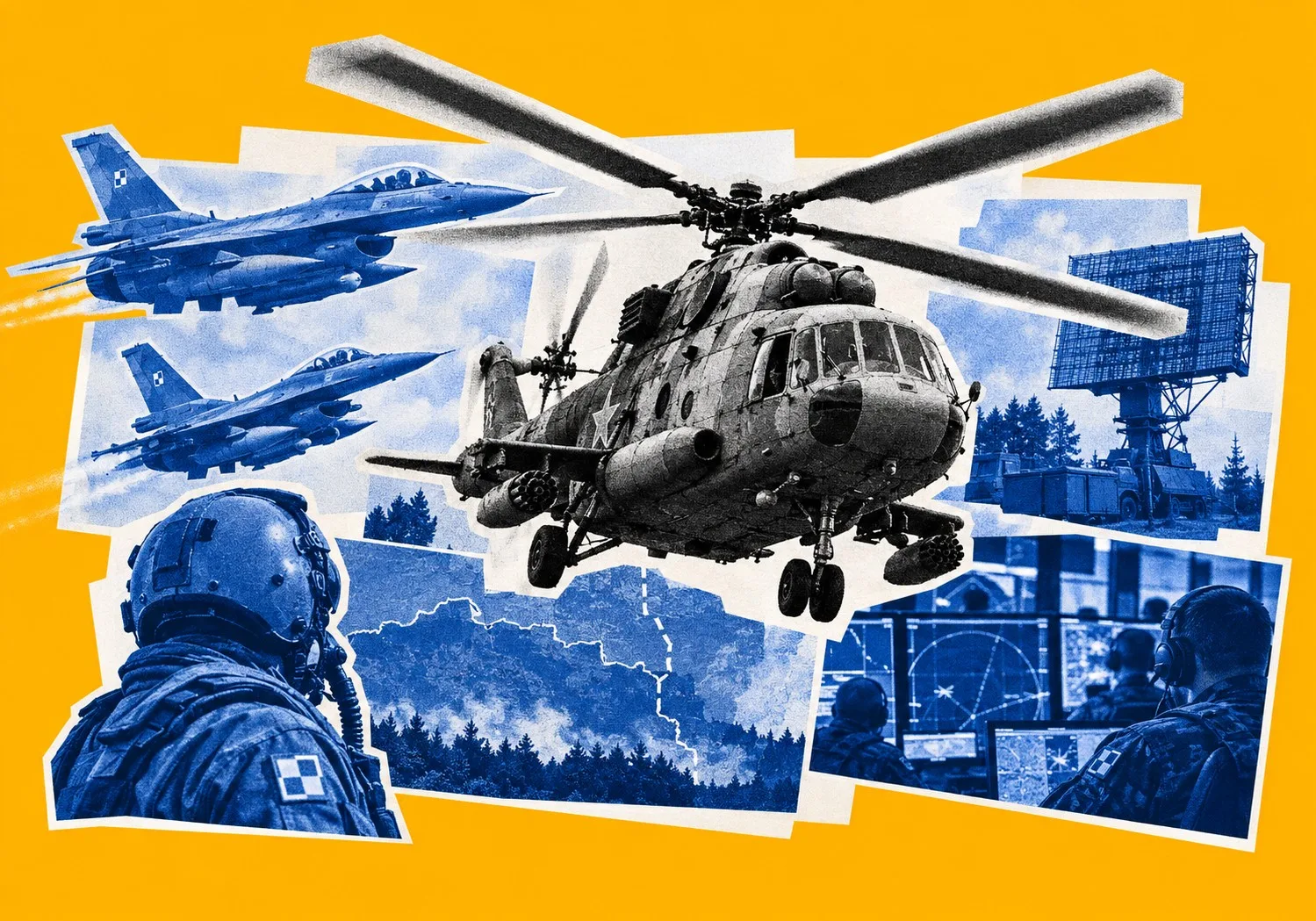
The incident near Braniewo has forced the Polish military command to overhaul existing crisis-response procedures. Following intrusion by a Russian Mi-8 helicopter deep into Polish airspace—lasting several tens of seconds—the timeframe for deciding to shoot down a hostile object has been reduced to an absolute minimum. Fighter pilots will no longer have to risk their lives by flying close to the enemy for visual identification.
 ## Russians Over Poland
On Wednesday, a Russian helicopter from the Russian exclave of Kaliningrad Oblast violated Polish airspace to a maximum depth of approximately 300 metres and remained there for 42 seconds, the Operational Command of the Polish Armed Forces announced in a statement.
It was added that the incident occurred on Wednesday at 11:08 AM, north of the town of Braniewo.
Before early-warning radars could fully process the telemetry data, the aircraft was already on the Polish side of the border. Although the flight itself lasted less than 42 seconds and the depth of the violation was a mere few hundred metres, the political, military, and psychological repercussions of this event are resonating in command offices from Warsaw to Brussels.
This event is not an isolated incident detached from a broader geopolitical context. For quite some time, military analysts have observed Moscow systematically testing Poland's defensive resolve. The Kremlin is checking how quickly Polish services react, how alliance procedures are triggered, and where the threshold of patience and combat readiness lies for a frontline state. The Braniewo incident proved that the threat is not limited solely to unmanned aerial vehicles or stray cruise missiles, but directly touches upon traditional military equipment with a crew on board.
Poland's Reaction
In response to this event, the Polish operational command did not limit itself to a standard diplomatic statement. The decision made in the Ministry of National Defence in cooperation with the Operational Command of the Polish Armed Forces alters previous procedures developed over past decades of peace.
These procedures relied on careful, multi-stage verification of every signal by general staffs. This required consultations, confirmation of intentions, and waiting for a green light from the political level. In the realities of dynamic hybrid warfare, such a delay becomes a mortal threat. Instead of minutes, Polish procedures have shifted into a second-by-second mode.
This change signifies a radical simplification of the chain of command. Commanders of individual air defence sectors have been granted significantly greater autonomy in making tactical decisions, including the right to immediately use weapons against objects unlawfully violating the country's airspace.
"From now on, absolute electronics—not a pilot's eyesight—will decide when to open fire," announced Poland's Deputy Minister of National Defence, Cezary Tomczyk, on TVN24.
The pilot of a scrambled fighter jet will no longer have to visually identify the target before squeezing the trigger. From now on, the identification of a hostile unit will be the domain of advanced radar systems analysing incoming data in fractions of a second. If the radar signature, lack of a transponder, unnatural trajectory, or suspicious speed unambiguously indicate a hostile object, the target can be annihilated at a distance of many kilometres.
Such a step allows for the full potential of BVR (Beyond Visual Range) missiles, with which Polish F-16s are equipped, to be utilised. The pilot no longer has to risk a direct clash or approach a potentially armed kamikaze drone.
Furthermore, in the event of extreme danger, Polish airspace will be instantly closed to civil traffic, giving military pilots complete freedom of manoeuvre.
"We must draw conclusions. If an obvious threat arises from Russia, it is our duty to adapt procedures to give pilots absolute confidence in their actions," emphasised Cezary Tomczyk.
Anatomy of a Provocation Over Warmia
Operational details of border incidents are rarely fully disclosed to the public for national security reasons, but available information allows the sequence of events in the Braniewo area to be reconstructed with high precision.
The Russian Mi-8 helicopter—a solid machine, yet technologically inferior to the latest Western standards—approached the border line from the direction of the Russian Baltic exclave, the Kaliningrad Oblast. For years, this region has remained one of the most heavily militarised areas in Europe, bristling with radar systems and long-range missile batteries.
The moment the rotorcraft crossed the state border line, Polish ground-based radar stations immediately alerted on-duty operational services. In accordance with the rapid-reaction procedure, on-duty fighter pairs were placed on the highest alert. F-16 aircraft were scrambled into the sky with the task of carrying out a reconnaissance flight, identifying the intruder, and, if necessary, blocking its further march deep into the country's territory.
However, before the modern fighters could fully take up an interception position in the designated area of responsibility, the Russian machine made a sharp turn and returned to the territory of the Russian Federation.
Analysts believe this was a classic reaction-time test. Russian planners know perfectly well what the technological capabilities of Polish radar stations are and how quickly Polish aviation is able to take off from the ground. The 42-second flight was calculated almost to the second to check whether the Polish defence system would manage to react before the machine's eventual withdrawal. The fact that Polish fighters were immediately scrambled into the air is a clear signal that the warning system is functioning flawlessly, but reaction speed alone is not enough in today's realities.
It is worth posing a question here about Moscow's intentions. Was this solely a navigational error by the helicopter crew—which will likely be presented as the official explanation in Russian diplomatic rhetoric—or a deliberate psychological and reconnaissance operation?
Experiences from recent years point to the second possibility. Russia regularly tests the resilience of NATO states on the eastern flank, probing thresholds of political sensitivity and the effectiveness of decision-making procedures. Each such incident allows Russian staffs to gather valuable intelligence data regarding the reaction time of command systems of individual allied nations.
Sources: BBC,Gazeta Wyborcza