
Russia Struck Ukraine’s Defence Industry Killing 10. The Real Target Was the Ecosystem Behind the Battlefield

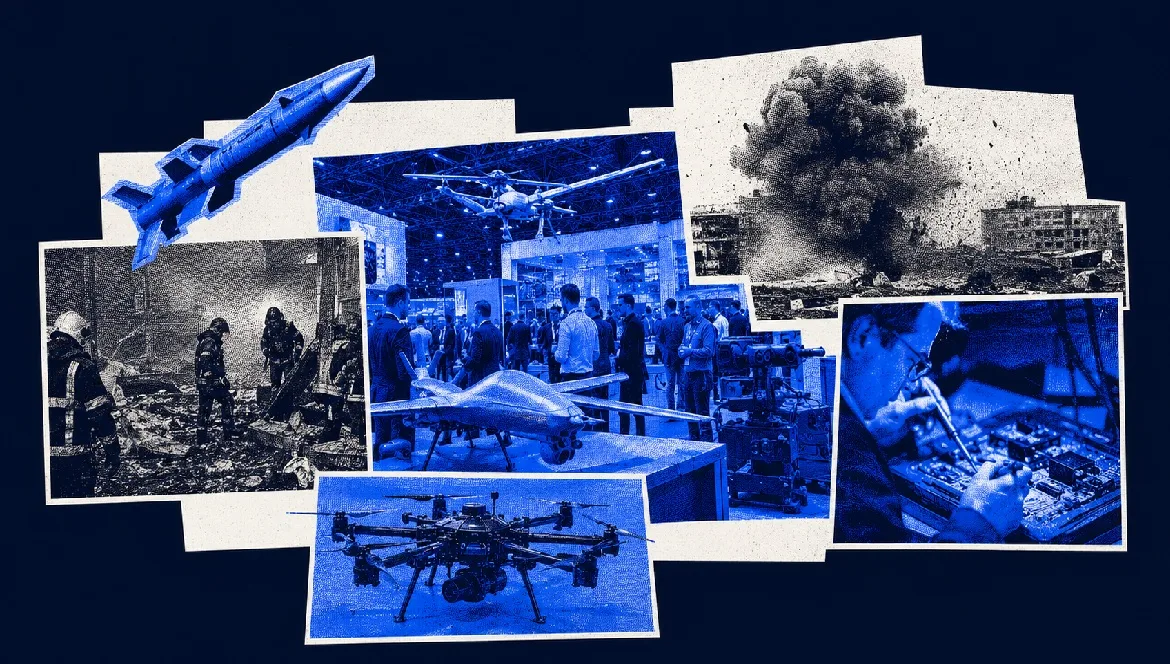
Russia’s missile strike on a gathering connected to Ukraine’s defence industry exposed a new vulnerability in the war. As Ukraine’s military advantage increasingly depends on private companies, engineers and rapid technological innovation, the ecosystem behind the battlefield is becoming a target in its own right.
On 24 July, Russia used ballistic missiles to strike a location in Kyiv region where representatives of Ukraine’s defence industry had gathered. The attack killed 10 people and wounded dozens more. One missile was intercepted, while two reached the region. The site was not a military base under the direct control of Ukraine’s Armed Forces, but the people gathered there were connected to one of the most important parts of Ukraine’s war effort: the private companies, engineers and developers building the technologies that are increasingly determining what happens on the battlefield.
That distinction is important. Russia has spent years targeting Ukraine’s military infrastructure, but the Ukrainian defence sector has changed dramatically since the beginning of the full-scale invasion. It is no longer limited to a small number of traditional state-owned factories. Hundreds of private companies now work on drones, electronic warfare, robotics, ammunition and other technologies. The sector increasingly functions as an ecosystem connecting military units, engineers, manufacturers, investors and international partners. The more important that ecosystem becomes to Ukraine’s ability to fight, the more valuable it becomes as a target.
The battlefield is expanding into the defence economy
The attack exposed a vulnerability that is becoming increasingly central to the war. Ukraine’s military advantage depends not only on the weapons it receives from abroad, but also on how quickly it can identify problems on the battlefield and turn them into new technologies. A drone can become obsolete within weeks. Electronic warfare systems are constantly being adapted. New weapons have to be tested, modified and delivered to units faster than traditional procurement systems can manage. This requires constant interaction between the people who develop military technologies and the people who use them.
That same interaction, however, creates security risks. Defence companies need to demonstrate their products. Military representatives need to assess them. Investors need to meet developers. Engineers need to exchange ideas and find partners. These activities are essential for an industry that must innovate under wartime conditions, but they can also create concentrations of people, expertise and information that an adversary may attempt to exploit.

The strike on 24 July showed the cost of that exposure. According to Ukrainian officials, the location was not under the control of the Armed Forces, while the event was connected to representatives of the defence industry. The circumstances surrounding the gathering and the security arrangements are now being investigated. Whatever the outcome of that investigation, the attack has demonstrated that even an event that appears to be part of the civilian or private sector can become connected to the wider military confrontation.
Ukraine needs an industry that can move faster than the missiles
Ukraine’s defence industry faces a difficult paradox. It must become more open in order to innovate, attract investment and scale production, but it must also become more secretive because every concentration of people, technology and information can potentially become a target. The country cannot afford to isolate its defence sector. At the same time, it cannot continue to treat cooperation as if the war has not transformed the security environment around it.
This is particularly difficult because speed has become one of Ukraine’s most important military advantages. The battlefield changes faster than traditional procurement systems can react, and technologies are constantly being modified in response to Russian tactics. The distance between a problem identified by a military unit and a solution developed by a private company must be as short as possible. That process requires meetings, testing, demonstrations and cooperation. It also requires a level of physical and informational security that Ukraine’s defence ecosystem is still learning to build.
The strike may therefore force a new model of defence cooperation. Large public exhibitions and concentrated demonstrations could increasingly give way to smaller, controlled meetings. Testing and presentation of new systems may be separated geographically. Access to sensitive information may become more compartmentalised, while companies will have to assume that even apparently routine details about their activities can become valuable intelligence.
That would make the industry less convenient and potentially less connected. But this is precisely the dilemma Russia is trying to create. A missile strike cannot destroy every Ukrainian weapons developer or eliminate an entire industrial sector. It can, however, raise the cost of cooperation, force companies to spend more resources on security, make investors more cautious and turn routine professional gatherings into potential security risks.
Russia is targeting the system behind Ukraine’s battlefield adaptation
The significance of the attack therefore extends beyond the physical destruction caused by the missiles. Ukraine’s ability to resist Russia increasingly depends on the speed with which it can develop, test and produce its own military capabilities. Drones, electronic warfare systems, robotics and other technologies are not simply separate products. Together, they form an industrial system that allows Ukraine to adapt to a battlefield that changes almost continuously.
Russia has a clear interest in disrupting that system. The target does not necessarily have to be a weapons factory. It can be the network around the factory: the engineers who develop new technologies, the companies that manufacture them, the investors who provide capital and the military representatives who explain what the battlefield requires. The physical destruction of one facility may be limited. The disruption of the relationships that allow the defence industry to function could be more significant.
This is why the attack on 24 July should be understood as part of a wider transformation of the war. The battlefield is no longer defined only by trenches, command centres and weapons depots. It increasingly includes the industrial and technological infrastructure that allows each side to adapt. In Ukraine’s case, that infrastructure is unusually decentralised, dynamic and heavily dependent on private initiative. That makes it difficult to destroy completely, but it also creates new vulnerabilities.
The defence industry is now part of the front
The immediate response will inevitably focus on the circumstances of the attack, the security failures that may have preceded it and the question of whether the gathering should have taken place in that location. Those questions are unavoidable, particularly after a strike that killed 10 people and wounded dozens more. But the longer-term challenge is broader than the security of any single event.

Ukraine cannot afford to retreat into isolation. Its defence industry must continue to innovate, cooperate and expand. The country needs more connections between the military and the private sector, not fewer, because the ability to move quickly from battlefield experience to industrial production is becoming one of the defining advantages of modern warfare.
The answer, therefore, cannot be to stop the ecosystem from meeting. It has to be to build an ecosystem that is harder to map, harder to disrupt and harder to destroy. That will require more distributed production, more careful control of information and a new understanding of what constitutes a military target in a war where technology is changing the balance of power.
Russia has spent years trying to turn Ukraine’s geography into a military vulnerability. The next phase of the war is showing that the same logic applies to Ukraine’s industrial geography. The defence sector is no longer somewhere behind the front line. For Russia, it is part of the front.
Source: Reuters, Channel 24