
Russia Is Rebuilding Chersonesus to Rewrite What It Cannot Own

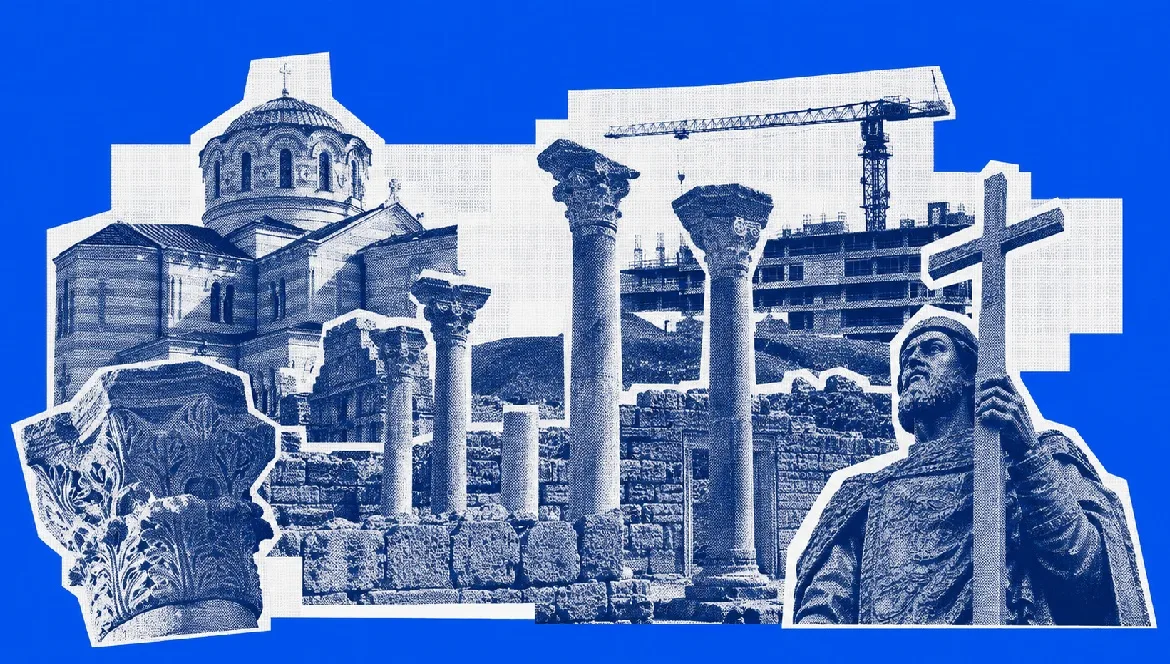
Russia is not simply damaging an ancient city in occupied Crimea. Through construction, archaeological excavations and the removal of artefacts, it is reshaping the historical landscape of Tauric Chersonese and placing it inside a new political narrative. UNESCO’s decision to add the site to its List of World Heritage in Danger highlights a broader problem: cultural heritage under occupation can be destroyed not only by demolition, but also by being excavated, rebuilt and repackaged until the history it once preserved becomes increasingly difficult to recover.
For more than two thousand years, Tauric Chersonese survived the rise and fall of empires. Founded by Greek colonists in the fifth century BC, the city became an important centre of trade and culture in the northern Black Sea region before passing through Roman and Byzantine rule. Its remains, together with the surrounding agricultural landscape known as the chora, were inscribed on the UNESCO World Heritage List in 2013.
Now the site has been placed on UNESCO’s List of World Heritage in Danger.

The decision, adopted at the organisation’s 48th World Heritage Committee session, is an international acknowledgement that the ancient city and its surrounding landscape are being threatened under Russian occupation. Ukraine says the site has suffered from unauthorised excavations, large-scale construction and the removal of archaeological artefacts, while the occupying authorities have transformed the landscape through the construction of a new complex known as “New Chersonesus”.
The significance of the decision goes beyond the damage to individual monuments. Chersonesus illustrates a broader problem in occupied territories, where cultural heritage can become a tool of political control. The objective is not necessarily to erase the past completely. It can be enough to excavate it, rearrange it, remove parts of it and surround what remains with a new narrative.
The destruction does not need to look like destruction
The most effective way to destroy a historical site is not always to demolish it. Sometimes the original remains are left standing, but the landscape around them is transformed so extensively that the historical context that gave them meaning is gradually lost.
This is the central concern surrounding the construction of “New Chersonesus”. According to Ukraine’s submission to UNESCO, the development covers a large area and includes tens of thousands of square metres of new construction, including museums, religious buildings and other facilities. Construction has affected archaeological layers in and around the ancient city, including areas associated with ancient structures and burial sites.
The problem is that archaeology does not consist only of isolated objects. A wall, a coin or a fragment of pottery becomes historically meaningful through its relationship with the surrounding layers, buildings and landscape. Once that context is destroyed by construction or uncontrolled excavation, it cannot simply be reconstructed later.
This is why the transformation of Chersonesus is so significant. The ancient city may continue to exist physically, but the landscape that allows researchers and visitors to understand its development is being altered. Modern buildings and infrastructure are being placed over a historical environment that took centuries to form, creating the possibility that the original site will eventually become only one element within a much newer and politically curated complex.
A historical site can therefore be damaged without being demolished. The stones may remain, while the history they are capable of communicating becomes increasingly difficult to recover.
Archaeology becomes an instrument of occupation
The archaeological dimension of the project is particularly important because the occupation has removed Ukrainian institutions from the normal management and study of the site. Excavations and construction are taking place under the control of the occupying authorities and Russian institutions, without Ukrainian oversight or the kind of independent international access that would normally be expected at a World Heritage site.
Ukraine’s submission to UNESCO describes large-scale archaeological work connected to the construction of the new complex and raises concerns about the removal of archaeological material from Crimea to institutions in Russia. The problem is not merely that artefacts may be transported from one museum to another. Archaeological objects derive much of their value from the context in which they are found, and once that context is destroyed, a significant part of the historical information disappears with it.

This makes the excavation of Chersonesus fundamentally different from a normal archaeological research project. Archaeology requires time, documentation and the preservation of relationships between objects and the layers in which they are found. Construction projects operate according to different priorities. When the two processes collide, the archaeological record can be forced to move at the speed of development.
The result may not look like a dramatic act of destruction. New buildings appear, museums are opened and the site can even be presented as more accessible than before. Yet beneath that appearance of development, archaeological layers may have been disturbed or removed, while artefacts are separated from the physical environment that gave them meaning.
What is presented as the preservation of history can therefore become a mechanism for permanently altering it.
The new complex is also a new historical narrative
The political significance of Chersonesus is impossible to separate from its archaeological importance. The site has long occupied a central place in Russian historical narratives because of its association with the baptism of Prince Vladimir, an event that Russian state ideology has used to construct a historical connection between Crimea, Christianity and the origins of the Russian state.
The occupation has given Moscow the opportunity to place this interpretation at the centre of a much larger project. The construction of “New Chersonesus” is not simply about providing facilities for visitors to an ancient archaeological site. It creates a new environment in which the history of Chersonesus can be presented through a specifically Russian political and religious narrative.
This is a recurring feature of Russia’s approach to cultural heritage in occupied territories. Historical sites are not treated as politically neutral spaces. Instead, they are used to construct a sense of continuity between the distant past and the present political order. The further back that continuity can be projected, the more useful it becomes for presenting the current occupation as something other than a recent act of military force.
The ancient city is therefore made to serve a modern political argument. Its history is not necessarily erased; it is reorganised so that some elements become central while others are pushed into the background. The result is a form of historical engineering in which archaeology provides the raw material for a new political narrative.
This is also why the construction of new buildings on or around an ancient site can be so significant. A new complex does not simply occupy physical space. It can determine how the site is interpreted by future visitors, what historical connections are emphasised and which ones are treated as secondary.
Crimea’s heritage is larger than one ancient city
UNESCO’s decision also called for the protection of several other important Crimean heritage sites, including the Khan’s Palace in Bakhchysarai, the cave cities of Crimean Gothia, the Crimean Astrophysical Observatory and Sudak Fortress.

Together, these sites demonstrate why the question of cultural heritage in Crimea cannot be reduced to the fate of a single monument. The peninsula is a layered cultural landscape shaped by Greek, Roman, Byzantine, Gothic and Crimean Tatar histories, among others. Its importance lies precisely in the coexistence of these different historical periods and communities.
An attempt to impose a single political narrative on that landscape does not require every monument to be destroyed. Historical priorities can be changed in other ways. Some periods can be celebrated while others are marginalised; artefacts can be removed from their original locations; new construction can reshape the landscape; and museums can present the past through a framework designed to support a contemporary political message.
This makes cultural destruction under occupation more difficult to identify than the destruction of a monument by a missile or a bulldozer. The physical damage may be gradual, while the transformation of meaning takes place over years. By the time the process becomes fully visible, the original context may already be impossible to restore.
The danger is therefore not only that Crimea’s monuments may be damaged. It is that the peninsula’s complex history may be reorganised into a simpler story that serves the political needs of the occupying power.
UNESCO can document the damage. It cannot yet stop it
The decision to place Chersonesus on the List of World Heritage in Danger gives the international community an important mechanism for documenting what is happening. UNESCO can record unauthorised construction, monitor changes through satellite imagery, raise concerns about the removal of cultural property and call for international cooperation to prevent the illegal trafficking of artefacts originating from occupied Crimea.
But the organisation faces a fundamental limitation. Crimea remains under Russian occupation, and Ukrainian experts cannot access the site to conduct normal archaeological and conservation work. The international community can document new construction and monitor the transformation of the landscape, but it cannot currently exercise direct control over what is happening on the ground.
That makes the UNESCO designation important not only as a warning but also as a formal record. The decision establishes that the international heritage system recognises the site as being under threat and that the changes taking place there cannot be treated as ordinary development.
This record may become particularly important in the future. Artefacts removed from Crimea may need to be traced and returned, archaeological damage may need to be assessed and parts of the site may require conservation or restoration. The more detailed the documentation of what happened during the occupation, the greater the possibility of establishing what was lost, what was moved and what can still be recovered.
What is lost cannot always be rebuilt
The most serious damage to Chersonesus may not be the destruction of one particular wall or the removal of one particular artefact. It may be the gradual destruction of the relationship between the different parts of the site.
Ancient cities are not collections of isolated objects. Their streets, buildings, cemeteries, agricultural territories and surrounding landscapes form a connected historical system. The relationship between these elements tells researchers how the city functioned and how its inhabitants interacted with the wider region.
Once that system is broken, restoration becomes far more difficult. A damaged wall can sometimes be stabilised, and a building can in some circumstances be reconstructed. An artefact taken to another country can theoretically be returned. But an archaeological layer destroyed by construction cannot simply be put back, and the historical context of an object removed from its original location cannot be recreated in a museum thousands of kilometres away.
This is what makes Chersonesus such a revealing example of cultural destruction under occupation. The process does not necessarily depend on the complete erasure of the past. Instead, the past can be excavated, rearranged and repackaged until it serves a new political purpose.
What cannot be legally owned can be claimed symbolically. What cannot be completely erased can be surrounded by a new narrative. What cannot be removed without losing its context can nevertheless be extracted.
The ancient city survived the collapse of empires because its history remained layered. Its current danger lies in an attempt to make those layers serve a single modern political story.
UNESCO has now formally acknowledged that Chersonesus is at risk. The more difficult question is what will remain of the original site when Ukraine eventually regains access to Crimea — and whether the damage to its archaeological context can ever be fully undone.
Sources: UNESCO World Heritage Centre, Ministry of Foreign Affairs of Ukraine