
RAF Fairford Bomb Plot: Five British Men Arrested Near US Bomber Base

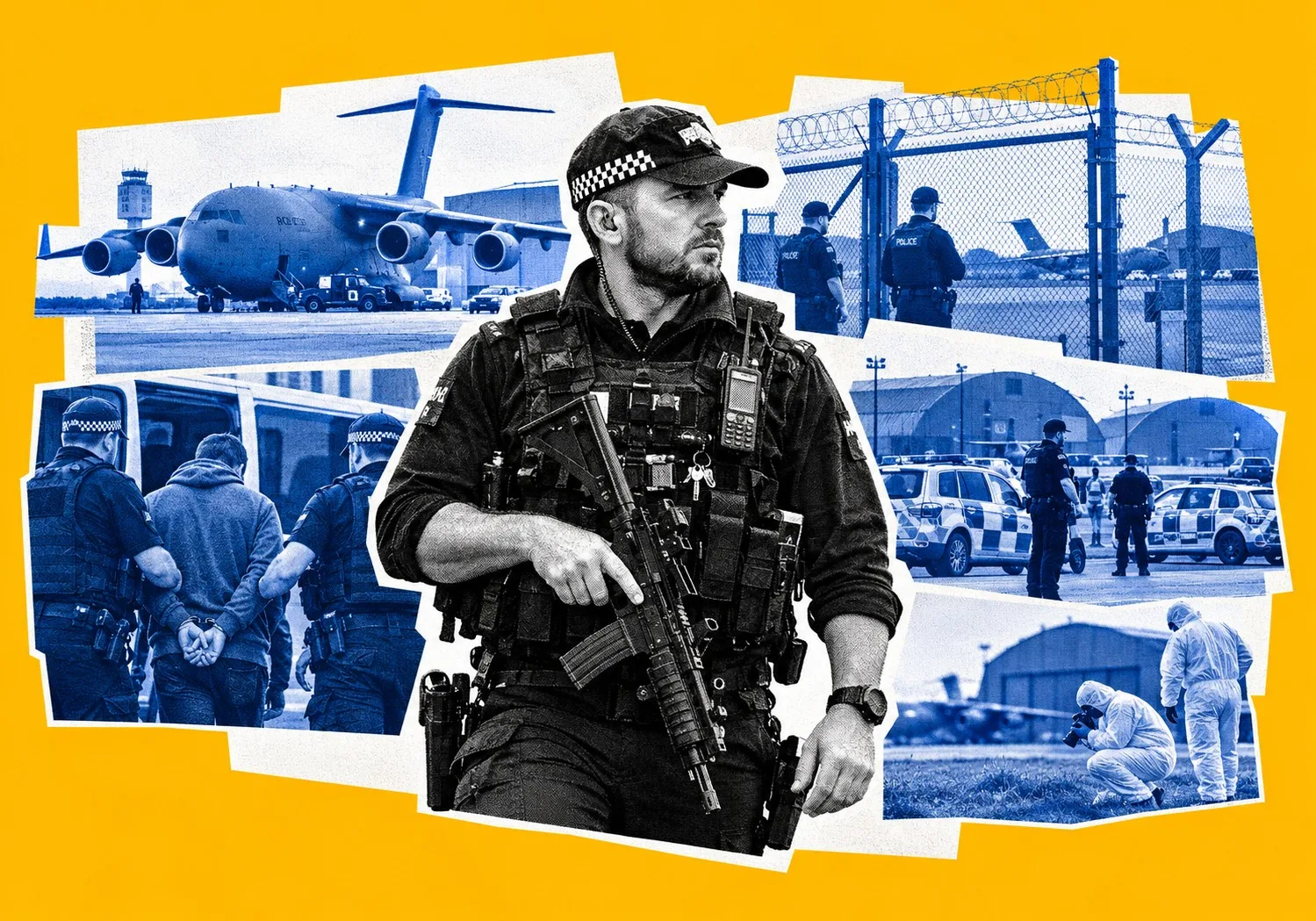
Five British nationals remain in custody under the Terrorism Act following a counter-terrorism operation near RAF Fairford in Gloucestershire. The plot targeting the United States Air Force strategic bomber installation has prompted a reassessment of domestic security. Investigators are formally probing potential state-backed operational links to Iran and the threat of homegrown proxy sabotage.
In the early hours of Sunday, September 27, counter-terrorism police and armed officers intercepted five British nationals in Gloucestershire and placed them under arrest under the Terrorism Act, disrupting an active conspiracy.
The five men—all British citizens in their early twenties hailing from London—were detained in the village of Whelford directly adjacent to RAF Fairford.
The base is a strategic airfield utilised by the Royal Air Force and the United States Air Force for heavy bomber deployments and global missions.
The intervention followed an emergency 999 call from a resident who spotted three suspicious vans moving toward the perimeter of the military facility.
Beyond the physical threat to a military installation lies an operational situation.
Investigators have opened formal inquiries probing a suspected state-backed link to Iran, pointing to a risk where foreign powers bypass military deterrence by outsourcing sabotage to domestic operatives.
As army bomb disposal experts deployed remote-operated robots to inspect the three seized vans and roughly 85 local households were evacuated within a 400-metre cordon, the incident prompted operational reviews across Whitehall regarding the mechanics of state-sponsored aggression.
The Whelford Interception and the Local Footprint
The Sunday morning arrests highlight the vulnerabilities and the response times of internal security structures.
According to statements released by the Metropolitan Police's Counter Terrorism Policing command, the intervention was triggered shortly before 01:00 local time when emergency services received reports of three vehicles travelling through the Gloucestershire countryside.
 Local police units, backed by armed response teams and counter-terrorism specialists, moved on the convoy near Whelford.
The suspects were apprehended on suspicion of offences under the Explosives Act before being transitioned to detention under terrorism legislation.
Aerial footage and official briefings confirmed that army bomb disposal technicians examined the three vans parked near the airfield perimeter, with large items and potential explosive components recovered from the inspection zones.
Senior National Coordinator for Counter Terrorism Policing, Vicki Evans, confirmed that five men remain in custody while forensic teams process digital devices and recovered materials.
The escalation prompted Gloucestershire Constabulary to declare a major incident, leading to the temporary evacuation of nearby residents while explosive ordnance experts secured the scene.
While international commentary referenced prior intelligence tracking, British police statements state that the interception originated from local vigilance, transforming the incident into a contained counter-terrorism operation.

Why Fairford Matters to Washington
The selection of RAF Fairford carries geopolitical weight in military planning.
Situated in Gloucestershire, the base features a runway spanning nearly two miles, reinforced to support heavy strategic bombers such as the US Air Force B-1B Lancer and B-52 Stratofortress.
These aircraft carry conventional payloads, including precision munitions designed for penetration missions.
In recent months, approximately a dozen B-1B Lancers have been stationed at the base, serving as a staging post for long-range global operations, supporting campaigns connected to Middle Eastern contingencies and operations involving Iran.
This operational profile makes Fairford a hub for allied power projection and transatlantic defence coordination.
Mounting an attack against such an installation requires logistical sophistication, reconnaissance, and operational planning.
The involvement of five young British nationals points toward structured handler-operative networks rather than isolated acts of lone-actor radicalization.
Intelligence analysts note that mounting an operation involving multiple vehicles, suspected explosives, and coordinated movement near a high-security military perimeter demands logistical backing and communication infrastructure provided by foreign intelligence handlers or illicit networks.
Tracing the Tehran Connection
As legal proceedings advance, the focus of the investigation has centered on potential foreign state sponsorship, with security sources confirming active probes into a suspected Iranian connection.
Relations between London and Tehran have remained strained for years.
Security officials are examining whether the arrested British nationals acted as a proxy cell directed, financed, or radicalised by Iranian intelligence entities seeking to target Western military assets involved in strategic campaigns.
The formal probing of an Iranian state link places Tehran's diplomatic standing in a precarious position.
British Defence Secretary Wes Streeting and other officials have emphasised that the United Kingdom stands ready to confront security threats, warning that the state will act against hostile actors and their proxies.
Investigating state-backed proxy plots launched through domestic citizens introduces evidentiary hurdles.
Establishing the operational chain of command between local operatives and foreign intelligence handlers requires international intelligence sharing and forensic analysis of digital trails.
While economic and diplomatic punitive measures remain responses, security experts note that traditional deterrence holds sway over decentralized networks designed to offer plausible deniability to foreign capitals.
The Iranian embassy in UK has said it "categorically rejects" speculation linking the country to the arrests of five men near RAF Fairford.
In a statement posted on X, the embassy writes it "strongly condemns the recent unfounded and malicious speculations published by some British individuals and media outlets".
"The circulation of such fabricated speculations, particularly in the aftermath of the criminal acts of aggression committed by the United States and the Israeli regime against the Iranian people, will serve no purpose other than to fuel Iranophobia propaganda in the UK," the embassy adds.
"Islamic Republic of Iran reserves the right to take appropriate legal measures, as necessary, to safeguard the rights and interests of the country and its people in response to misleading and damaging media narratives".
Where Criminal Law Meets Statecraft
The legal and institutional challenges raised by the Fairford arrests affect contemporary counter-terrorism architecture across Europe.
Prosecuting domestic nationals acting on behalf of foreign powers forces legal systems to navigate zones where domestic criminal law intersects with interstate geopolitical conflict.
The UK Terrorism Act provides detention and investigative powers, but untangling crime-terror-state operations demands integration between local police forces, national counter-terrorism units, and external intelligence agencies.
Traditional criminal statutes struggle to capture the strategic dimensions of an act designed to violate domestic law and achieve strategic disruption on behalf of a foreign adversary.
This institutional convergence reflects a structural shift across European security environments.
Governments are transitioning away from conventional deterrence models designed to hold nation-states at bay through open military retaliation.
Against decentralized, deniable proxy networks operating from within domestic borders, traditional military deterrence is rendered ineffective.
Instead, internal security agencies and counter-terrorism police form the frontline of national defence.
The participants in this paradigm are specialised intelligence units that secure operational validation, alongside security officials advocating for surveillance powers, defence funding, and legislative curbs on hostile state actors.
Conversely, domestic security infrastructure faces operational costs, institutional strain, and the challenge of securing installations against an internal adversary.
Living with the Domestic Threat
The Fairford conspiracy demonstrates that domestic radicalisation is not limited to ideological extremism or lone-actor plots tracked within MI5’s threat matrix.
When British citizens in their early twenties operate as a kinetic proxy cell directed by a foreign intelligence service, the distinction between domestic criminality and state-level warfare ceases to function in practice.
Security planners address the operational reality of domestic proxies holding UK passports and residing in suburban areas until receiving activation signals through digital channels or handlers stationed abroad.
For Whitehall, this necessitates a review of legal protections and counter-espionage oversight mechanisms.
While parliamentary committees debate whether counter-terrorism legislation requires expansion to address state-directed proxy networks, the operational burden rests on regional police forces and local infrastructure.
The Gloucestershire incident indicates that foreign actors can bypass border infiltration by utilizing domestic networks for operational tasks.
As forensic teams examine the digital evidence connecting Whelford to Tehran, the vulnerability identified at Fairford involves the use of local operatives against domestic military infrastructure.
Sources: BBC, Reuters, The Guardian