
Poland Faces a New School-Safety Challenge as Youth Violence Escalates

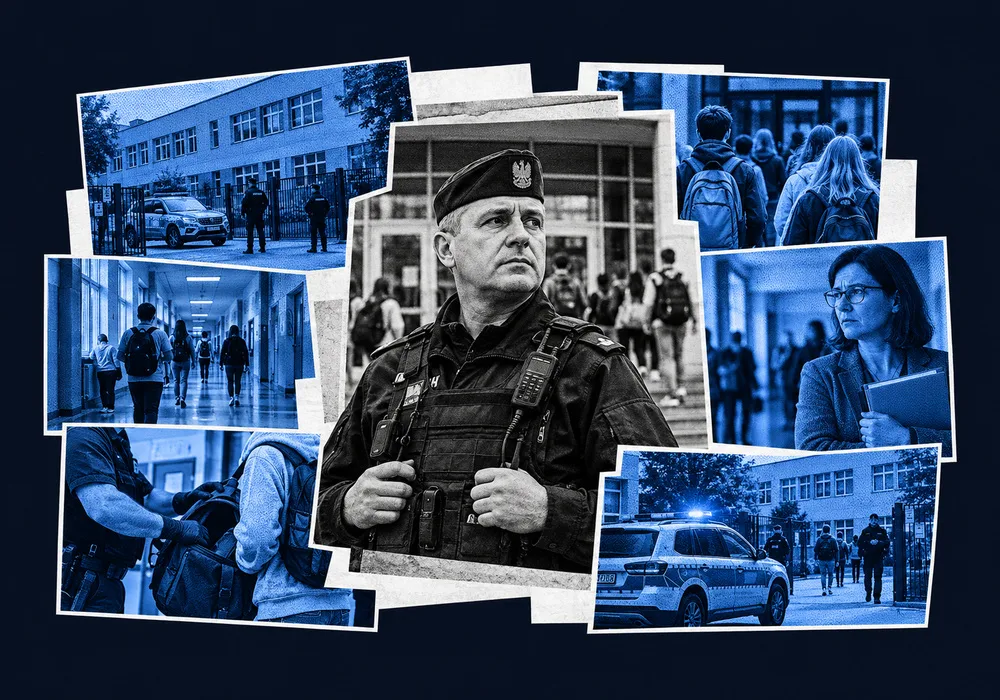
A series of attacks and a foiled school assault in Poland within two days has triggered an emergency government response, including increased police patrols and renewed efforts to restrict violent online content. The incidents are also raising wider questions about youth violence, copycat behaviour and the ability of European schools to respond to threats that increasingly cross the boundary between the physical and digital worlds.
A series of violent incidents at schools in northern Poland over the past two days has prompted an unusually strong response from the government, raising concerns that the country may be facing more than a string of isolated attacks.
On October 7, a 19-year-old student attacked people at a vocational school in Ostrołęka with a machete. Ten people, including five students, two teachers, two bystanders and the attacker himself, were injured. A homemade explosive device was also found in his backpack and reportedly came close to detonating. Students barricaded themselves inside classrooms before being evacuated, while police detained the suspect roughly 20 minutes after the attack.
The following day, a second attack occurred at a primary school in Leszczydół-Nowiny, northeast of Warsaw. A 15-year-old former pupil attacked three members of staff with a knife. A 37-year-old school employee died of her injuries, while the school's head and a teacher were injured. The school principal reportedly managed to restrain the attacker before police arrived.
The two attacks were followed by another alarming development. Police in Sierpc detained a 17-year-old who had allegedly threatened to attack a school. Officers found two knives in his possession, while investigators discovered searches on his phone relating to how to carry out such an attack. Police said the intervention was made possible after students and a teacher reported his behaviour.
From isolated incidents to a potential pattern
Poland has traditionally been regarded as a relatively safe country when it comes to serious violence in schools. The concentration of incidents within a matter of days has therefore changed the political response from dealing with individual crimes to assessing whether a broader phenomenon is emerging.
Prime Minister Donald Tusk convened an emergency meeting with ministers responsible for the interior, education, digitalisation and health, as well as security officials and the police chief. The government ordered increased police patrols around schools and said officers should also enter school buildings in coordination with their administrations.
The authorities are also examining whether the incidents could have an online dimension. Tusk warned of a possible copycat effect, while police are investigating information about an alleged internet challenge connected with the attacks. In the latest case, the 15-year-old suspect reportedly wore a helmet equipped with a camera, leading authorities to investigate whether he intended to record the assault.
That does not establish that the attacks were coordinated or that an online challenge caused them. But the possibility is significant because it shifts part of the security problem away from the physical school environment and towards digital spaces where violent material, threats and imitation can spread rapidly.
Poland's security debate is moving online
The government is now linking the school attacks with a wider debate over how effectively Poland can restrict illegal and violent content on the internet.
Warsaw's official response says legislation implementing elements of the EU Digital Services Act had included mechanisms intended to limit access to illegal material, including violent content, threats and incitement to hatred. The government argues that the legislation was vetoed by the president and is now seeking alternative measures that would allow illegal material to be blocked more quickly.
This creates a difficult policy balance. The government wants faster intervention against material that can facilitate violence or target children, while any expansion of state powers over online content inevitably raises questions about freedom of expression, judicial oversight and the limits of government intervention.
For European governments, the issue is increasingly broader than school security. Digital platforms can turn an isolated act of violence into a model for imitation, particularly when perpetrators seek notoriety or deliberately record their actions.
The pressure on schools is expanding
The attacks also expose the growing number of responsibilities being placed on European schools. Educational institutions are expected not only to provide education, but increasingly to prepare for physical attacks, online radicalisation, mental-health crises and other security threats.
Poland's education and interior ministries said on October 8 that they were strengthening crisis-preparedness procedures in schools. Updated guidance covers responses to dangerous intruders and aggressive students, while authorities are also working on procedures for wider emergency situations.
The government has additionally highlighted access to psychological support for children and teenagers, including the national 116 111 helpline. The authorities say the recent incidents require attention not only to policing but also to violence in families, schools and young people's wider social environment.
That distinction will be important. Increased police presence can reduce immediate risks and improve response times, but it cannot by itself explain why teenagers become interested in extreme violence or why some seek to reproduce violent behaviour seen online.
A wider European problem
Poland's experience is particularly notable because it comes as European governments are already paying greater attention to youth violence, online radicalisation and the effect of social-media algorithms on minors.
The incidents in Ostrołęka, Leszczydół-Nowiny and Sierpc remain under investigation, and authorities have not established a common motive linking the cases. Nevertheless, the speed with which another potential attack was prevented after the first two incidents has demonstrated how quickly police, schools and online behaviour can become part of the same security equation.
For Poland, the immediate response is likely to be greater police visibility, tighter school procedures and renewed pressure for stronger regulation of illegal online content. The longer-term challenge will be determining whether these measures can address the underlying drivers of youth violence without turning schools into heavily securitised spaces.
The fact that one planned attack was reportedly disrupted after students alerted a teacher also points to another element of the response: prevention depends not only on police and technology, but on whether pupils, teachers and parents are equipped to recognise warning signs before violence occurs.
Sources: Polish Prime Minister's Office, Polish Ministry of Education, Polish Police