
Poland and Belarus Hold First High-Level Talks in Years at the UN

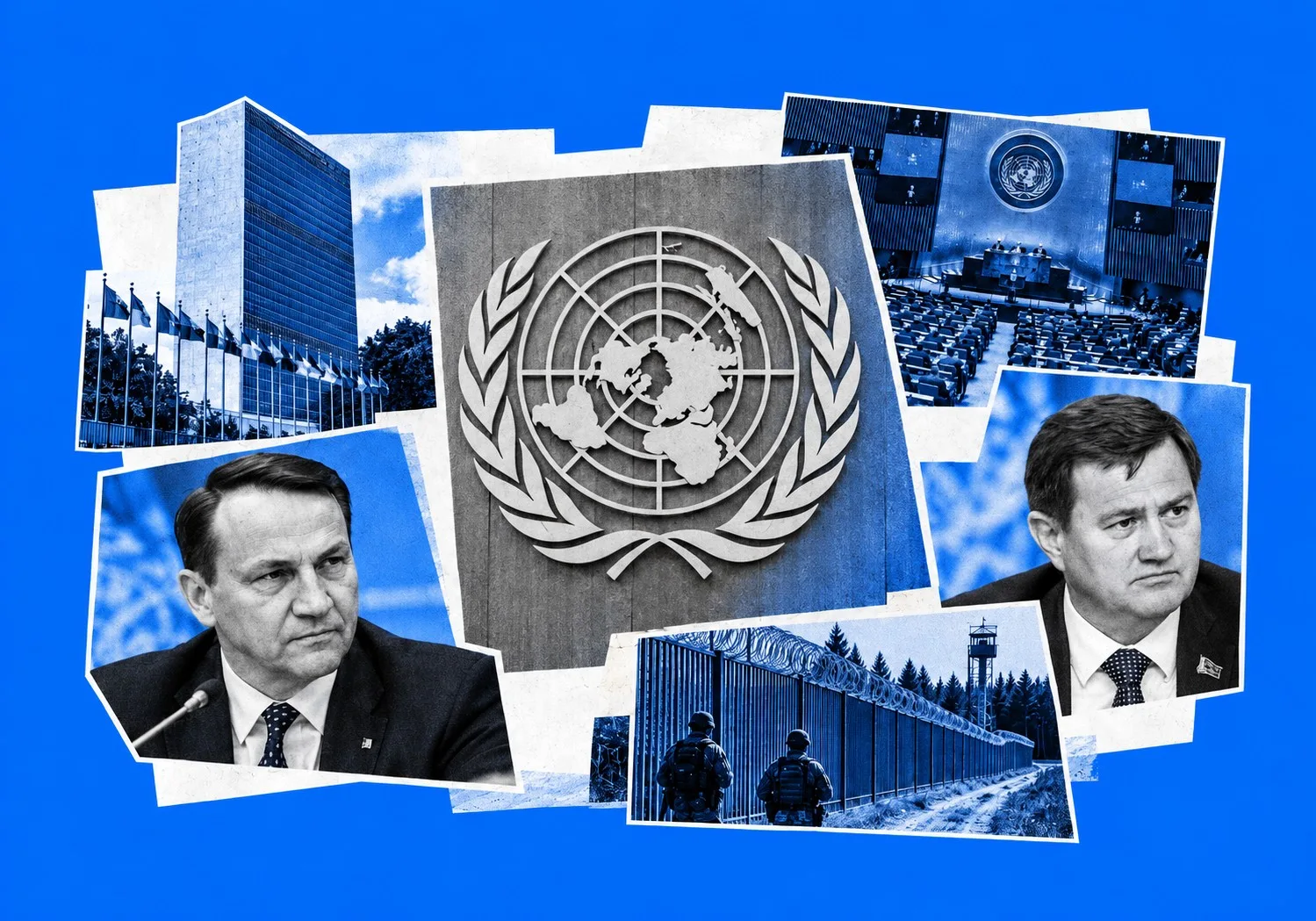
A decade of diplomatic freeze between Warsaw and Minsk shifted slightly on the margins of the United Nations General Assembly in New York. Poland’s Foreign Minister, Radosław Sikorski, met his Belarusian counterpart, Maxim Ryzhenkov. For a foreign ministry that treats the eastern border primarily as a fortified defense perimeter, the meeting was unusual.
Held at UN headquarters, the encounter brought together two governments whose official relations have been defined by hostility since 2020. Warsaw framed the talks through practical necessity.
In Donald Tusk’s administration, statecraft occasionally requires engaging hostile actors when national interests—such as regional stability or the release of detained citizens—are at stake. The optics immediately divided domestic observers, raising questions about whether the move was a necessary tactical test or an unearned concession to an autocrat.

A Decade of Enforced Estrangement
To assess the meeting, the preceding breakdown in relations must be considered.
Ties collapsed in stages following Alexander Lukashenko’s contested re-election in August 2020 and the subsequent crackdown on protests. Thousands were imprisoned, and opposition figures fled to Poland and the wider European Union.
Domestic repression turned into external pressure in 2021. Minsk engineered a migration crisis, pushing thousands of travelers across the borders of Poland, Lithuania, and Latvia in an effort to destabilise the EU's eastern flank.
When Russian forces invaded Ukraine in February 2022, Minsk placed its airspace, rail networks, and training grounds at Moscow's disposal.
For Warsaw, dealing with Minsk became politically and militarily impossible. The border transformed into a heavily guarded military zone backed by physical barriers and regular troops. Until now, high-level political contact was treated as a non-starter. European Union sanctions, diplomatic expulsions, and strict travel bans isolated the Belarusian leadership completely from Western capitals.
Borders and Prisoners
What prompted Sikorski to test the waters now?
According to foreign policy insiders in Warsaw, two factors drove the reassessment.
First, substantial state investment in physical and electronic border barriers has reduced irregular crossings to a fraction of their peak numbers. The frontier is demonstrably more secure. Furthermore, enhanced cooperation between Polish border guards, Frontex, and regional partners has plugged critical surveillance gaps that were previously exploited by state-backed smuggling networks operating out of Grodno and Minsk.
Second, Minsk offered specific gestures to signal a willingness to talk. Most notably, authorities released selected political prisoners, including Andrzej Poczobut, a prominent journalist and activist representing Poland’s minority in Belarus, whose prolonged detention had long strained bilateral ties.
Other civil society figures and independent trade unionists were quietly moved from high-security penal colonies to lower-regime facilities or released outright under external pressure.
Speaking after the session, Sikorski adopted a cautious tone.
He noted that secure borders give Warsaw room to negotiate from strength, while prisoner releases create a narrow opening. However, he managed expectations, stating that while neighbours occasionally find reasons to stabilise local frictions, state recognition does not equal moral approval.
The Belarusian Foreign Ministry described the New York exchange as a "positive restart" that should lead to regular dialogue, pointing out that bilateral communication channels should not remain dormant for an entire decade.
Airspace Violations and the Shadow of Moscow
Beneath the diplomatic contact lies an unresolved security challenge. A primary item on Sikorski’s agenda was the frequency with which Russian cruise missiles and drones have entered or crossed Belarusian airspace during strikes on western Ukraine. Warsaw made clear that Minsk's tolerance of these flights poses a direct threat to NATO's eastern flank.
Over the past year, multiple incidents involving stray munitions hitting Polish and Romanian airspace have heightened readiness levels across NATO's eastern command. Polish military radar systems track these trajectories daily, and Warsaw expects neighboring authorities to take active measures to prevent Belarusian territory from being used as a launchpad or unobstructed corridor for Russian aerial attacks.
At the same time, Polish planners are preparing practical steps on the ground, including plans to reopen the Polish embassy in Minsk. Reoccupying the mission is viewed not as a reward for the regime, but as a functional listening post required to manage consular issues, issue humanitarian visas, and monitor internal developments closely without relying solely on third-party intelligence.
Drills Near the Suwałki Gap
The fragility of the diplomatic moment was highlighted days before the UN meeting. In western Belarus, near the Polish and Lithuanian borders, the armed forces launched unannounced combat drills. Mechanised infantry and tank brigades took positions close to the Suwałki Gap—the 104-kilometre corridor connecting the Baltic states to the rest of NATO while separating Belarus from Kaliningrad.

Western intelligence agencies monitored the exercises closely. While Minsk called the drills defensive, the location carried strategic significance.
NATO planners view the Suwałki Gap as a critical chokepoint; rapid military buildups there carry the risk of quick escalation, especially given the density of Russian troops stationed permanently on rotational deployments across Belarusian training ranges. For Warsaw, the drills served as a reminder that military planning must continue regardless of diplomatic talks.
Divisions Within the Democratic Opposition
The meeting in Manhattan drew sharp criticism from the Belarusian democratic opposition in exile. For activists operating from Warsaw, Vilnius, and elsewhere, direct engagement with Lukashenko’s representatives is viewed with deep skepticism and concern over potential backroom deals.
Pavel Latushka, deputy leader to Sviatlana Tsikhanouskaya and head of the National Anti-Crisis Management, offered a critical assessment. He argued that giving a platform to the regime's foreign minister hands Minsk political capital, undermining coordinated European sanctions and isolation. Latushka noted that hundreds of political prisoners remain detained in penal colonies under severe conditions without guarantees of release, meaning marginal concessions should not outweigh systemic human rights abuses.
Opposition figures also pointed to Moscow's influence. Belarus is tied to the Kremlin through military and economic agreements that limit its foreign policy autonomy.
Every move by Minsk is coordinated or monitored in Moscow, meaning Western outreach risks fracturing the EU consensus without securing structural human rights concessions.
Analysts in Brussels have warned that any bilateral deals struck outside the framework of common European foreign policy could weaken the effectiveness of ongoing sanctions targeting key sectors of the Belarusian economy, including potash, petroleum, and financial services.
Managing the Border Reality
Ultimately, the brief meeting in New York is neither a reset nor a capitulation. It is a calculated probe driven by security needs and the duty to test whether remaining Polish citizens can be freed from Belarusian prisons.
Poland’s foreign policy establishment faces a difficult balance: maintaining deterrence against hybrid pressures, supporting the Belarusian democratic opposition, and managing security risks on its eastern border.
Whether this diplomatic opening leads anywhere depends entirely on future developments on the ground, the fate of remaining detainees, and the trajectory of the war in neighboring Ukraine.
For now, Warsaw's position is clear: it is prepared to talk, but its security measures remain fully in place and its strategic vigilance remains absolute.
Sources: Defence24, Euronews, Rzeczpospolita, Euractiv