
Northern Ireland tensions rise over historic Orange Order march

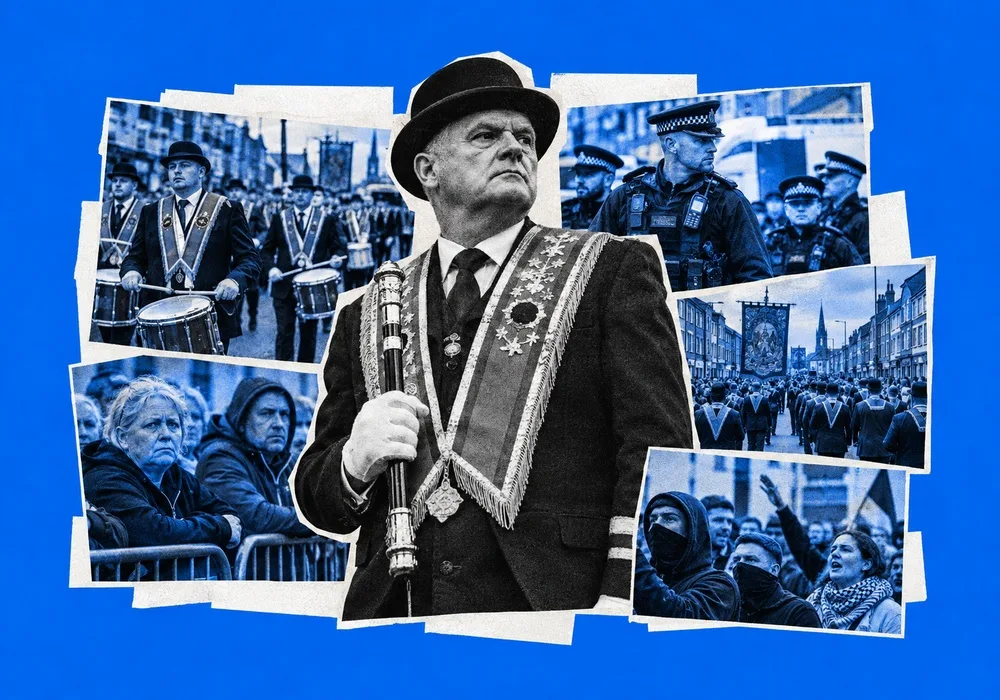
A decision to allow the Orange Order to march along Portadown’s Garvaghy Road for the first time in almost three decades has reopened one of Northern Ireland’s most sensitive disputes. Thousands of nationalist protesters gathered along the route as a series of overnight court rulings cleared the way for the parade, putting renewed pressure on the region’s political, judicial and policing institutions.
Tensions have risen sharply in Northern Ireland after the Orange Order was given permission to march along Portadown’s Garvaghy Road for the first time in almost three decades. The decision has revived one of the most contentious disputes of the Troubles, with thousands of nationalist protesters gathering along the route to oppose the parade. A series of court hearings continued into the early hours of Sunday before the final legal obstacles to the march were removed.
The dispute centres on the annual parade organised by Portadown District LOL No 1, part of the Protestant Orange Order. The organisation has traditionally regarded marching through Portadown as an expression of its British and Protestant identity, while residents of Garvaghy Road, a predominantly Catholic and nationalist area, have long opposed the route. The confrontation became one of the defining symbols of the wider dispute over parading rights during the 1990s.
A route associated with the Troubles
Garvaghy Road became internationally known during the Drumcree confrontations of the 1990s. Orange Order members traditionally marched from Drumcree Church through the nationalist neighbourhood, while residents argued that the procession was deliberately provocative and should not take place without the community’s consent. Attempts to enforce the route led to large security operations, protests and serious disorder.
The confrontation reached a particularly intense point in 1997, when authorities allowed the Orange Order to march through the area amid widespread nationalist opposition. The episode contributed to some of the most serious unrest in Northern Ireland during the final years of the Troubles. Following the 1998 Good Friday Agreement, the disputed section of the route was effectively closed to Orange Order parades.
The Orange Order has continued to seek permission to return to Garvaghy Road, but the route remained unavailable for nearly 30 years. The latest decision therefore breaks with a long-established arrangement that had kept one of the most sensitive local disputes largely contained. Its significance extends beyond a single procession because the route has become closely associated with competing interpretations of identity, equality and community rights in Northern Ireland.
Parades Commission approves the return
The immediate dispute began with a decision by Northern Ireland’s Parades Commission to approve the Orange Order’s application for the September 27 procession. The commission imposed a series of restrictions on the parade, including limiting the number of participants allowed on the Garvaghy Road section. It also introduced conditions concerning the conduct of the procession and the use of music.
Although the decision did not provide the Orange Order with unrestricted permission to hold a large march, the authorisation of the route itself represented a major change. The organisation had been excluded from Garvaghy Road since the late 1990s, making the commission’s decision particularly significant for both sides of the dispute.
Residents subsequently challenged the decision in court. The legal battle became increasingly intense as the date of the parade approached, ultimately producing several rulings within hours of the planned procession.
Extraordinary overnight court proceedings
A High Court judge initially issued an injunction preventing the march from taking place along the disputed route. The ruling temporarily appeared to bring the confrontation to an end, but the Orange Order and the Parades Commission appealed the decision.
The Court of Appeal subsequently overturned the injunction following a late-night hearing. Lady Chief Justice Siobhan Keegan said the High Court had made an error in law and allowed the legal process concerning the parade to continue. The case was then returned to the High Court for further consideration, creating an unusual situation in which the final legal position was still being determined during the night before the march.
A further challenge was rejected in the early hours of Sunday, leaving the Orange Order legally entitled to proceed. The final proceedings concluded only a few hours before the planned parade, highlighting the exceptional sensitivity of the case and the pressure on Northern Ireland’s judicial and political institutions.
Thousands oppose the parade
While the courts were considering the case, opposition to the march was growing on Garvaghy Road. Thousands of protesters gathered in the area, with residents and nationalist activists forming a blockade ahead of the planned procession. The demonstration included prominent nationalist politicians, bringing the dispute directly into Northern Ireland’s wider political debate.
First Minister Michelle O’Neill and Sinn Féin leader Mary Lou McDonald joined the protest, reflecting the depth of nationalist opposition to the decision. Nationalist representatives have argued that residents should not be required to accept a parade that they regard as unwanted and provocative simply because it has received legal authorisation.
Unionist politicians have taken a fundamentally different position, stressing the importance of respecting decisions made by the courts and the Parades Commission. They have argued that political leaders should not undermine the authority of Northern Ireland’s institutions when their decisions are unpopular with one side of the community.
Pressure on the police
The Police Service of Northern Ireland faces a particularly difficult task in managing the confrontation. The force must enforce a legally authorised parade while also preventing the situation from developing into violence between demonstrators, marchers and police officers.
The PSNI has described the situation as exceptionally challenging and has prepared additional resources for the operation. Officers have also been gathering evidence of possible offences committed during protests, indicating that the police response will extend beyond managing the immediate procession.
The role of policing is particularly sensitive in Northern Ireland because relations between communities and the security forces were themselves deeply affected by the Troubles. Any large-scale intervention on Garvaghy Road therefore carries the risk of becoming part of the political dispute rather than simply remaining a public-order operation.
Why the dispute remains so difficult
The disagreement over Garvaghy Road reflects two competing understandings of rights. The Orange Order argues that its members have the right to express their cultural and religious identity through traditional parades, while nationalist residents argue that freedom of assembly must be balanced against the rights and wishes of communities directly affected by a procession.
Neither position is new. The same arguments were at the centre of the Drumcree confrontations more than 25 years ago, and the Good Friday Agreement did not eliminate the underlying disagreement over how competing communal identities should coexist.
Instead, Northern Ireland’s post-1998 political system was designed to manage those differences through institutions, elections and power-sharing. The Parades Commission is part of that framework, operating as an independent body responsible for regulating contentious parades and balancing the rights of organisers with the potential impact on communities and public order.
A test for the post-Good Friday Agreement settlement
The return of the Orange Order to Garvaghy Road is significant because the previous arrangement had allowed the issue to remain largely contained for decades. The latest decision has reopened a dispute that many people associate with the most unstable period of Northern Ireland’s recent history.
That does not mean that the region is returning to the conditions of the Troubles. Northern Ireland now has substantially stronger political and legal mechanisms for dealing with disputes, and the overwhelming majority of political disagreements are conducted through democratic institutions rather than sustained violence.
Nevertheless, the events in Portadown demonstrate that the social divisions underlying the conflict have not disappeared. Questions surrounding British and Irish identity, unionism and nationalism, cultural recognition and community consent remain politically sensitive, particularly when they involve symbols and locations associated with the Troubles.
The immediate challenge for Northern Ireland’s authorities is therefore to enforce the legal decision without allowing the dispute to develop into broader disorder. How the authorities, political parties and communities handle the aftermath could influence how similar parades are managed in the future and whether the latest decision becomes an isolated case or a new precedent for contested routes.
The significance beyond Portadown
The Garvaghy Road dispute also illustrates the continuing difficulty of balancing individual and communal rights in Northern Ireland. A legally authorised parade can still be viewed by the affected community as an unacceptable intrusion, while preventing it can be interpreted by the organisers as discrimination against their cultural identity.
That tension has never been completely resolved by the peace process. Instead, it has been managed through a combination of political compromise, policing, regulation and restrictions on individual events. The latest decision has disturbed that balance and placed the institutions responsible for maintaining it under renewed pressure.
For Northern Ireland, the immediate priority is preventing a historic dispute from turning into a new cycle of confrontation. The longer-term issue is whether the region can continue to manage deeply contested expressions of identity through its post-1998 institutions, particularly when one community’s assertion of cultural rights is perceived by another as a challenge to its own security, dignity or place within the political settlement.
Sources: Northern Ireland Parades Commission, The Irish Times